


Blogpost keywords: personalized wine glasses with pictures, custom photo wine glasses, UV printed wine glasses
Personalized wine glasses with pictures have become a popular choice for weddings, corporate events, and brand promotions, but achieving a crisp photo reproduction on glass requires understanding UV printing technology, substrate preparation, and the file standards that separate a professional result from a disappointment.
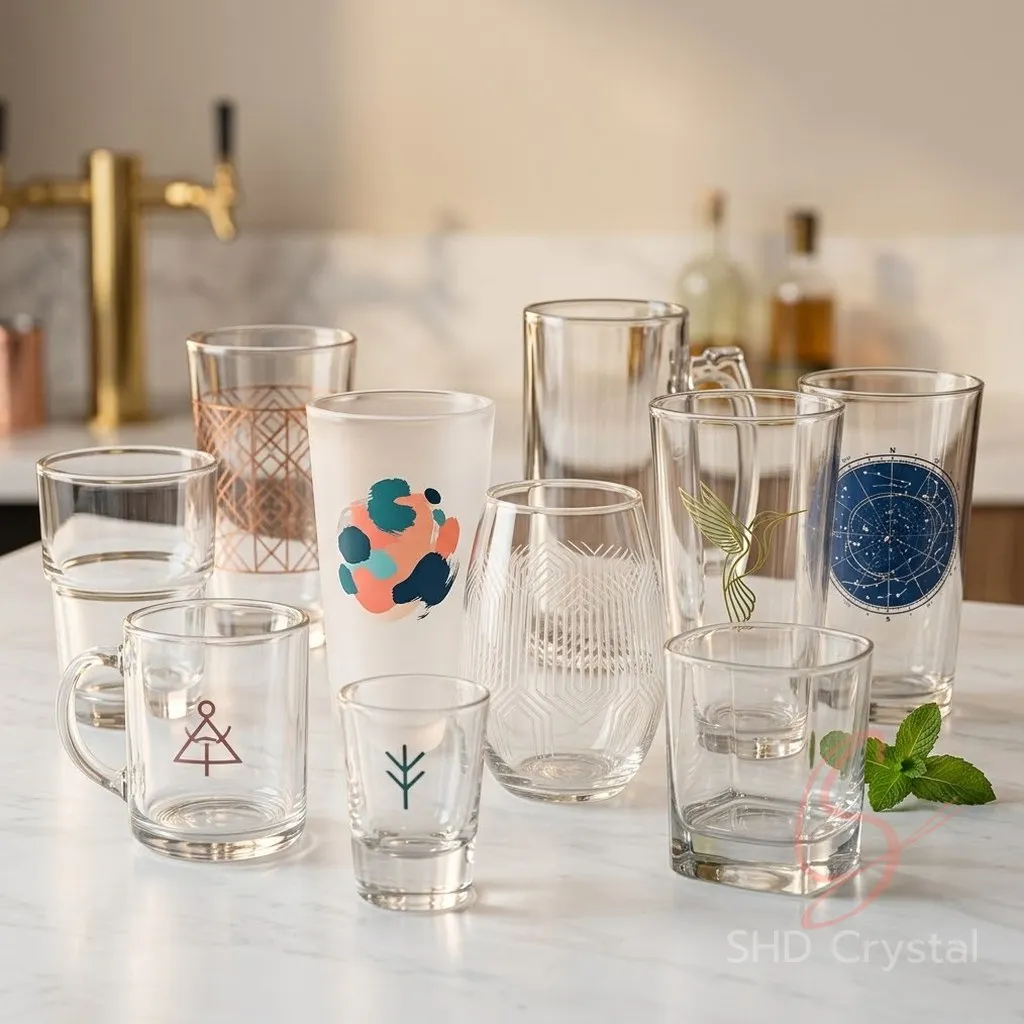
What UV Printing Technology Means for Personalized Wine Glasses With Pictures
UV printing on glass deposits ink onto the surface and cures it instantly with ultraviolet light. Unlike screen printing, which pushes ink through a mesh stencil, UV flatbed printing builds color droplet by droplet — the same principle behind inkjet printing, adapted for rigid, non-porous substrates.
The critical detail is ink chemistry. UV-curable inks bond with glass, but glass is non-absorbent. Without a primer layer, the ink sits on the surface rather than gripping it. A responsible supplier applies an adhesion-promoting coating before printing — skipping this step leads to peeling after a few wash cycles. Buyers evaluating custom photo wine glasses should always ask whether the supplier uses a primer.
Resolution matters for photo reproduction. A UV printer capable of photo-quality output runs at 720 to 1440 DPI, but perceived sharpness depends on the source file. A 300 DPI image on a wine glass bowl looks sharp; a 72 DPI web image looks soft on the best equipment. Buyers should specify 300 DPI minimum at actual print size in their RFQ — the standard threshold for photographic reproduction on glass.
How Photo Quality Requirements Differ From Engraving and Etching
A horizontal comparison helps clarify the landscape. Personalized wine glasses with pictures via UV printing deliver full-color, photo-realistic imagery — faces, landscapes, gradients, and complex illustrations reproduce faithfully. Sandblasted or acid-etched designs, by contrast, produce monochrome frosted patterns with no color gradation. Laser engraving sits between: fine detail but limited to single-tone marks on the glass surface.
The trade-off is durability versus visual range. Etched and laser-engraved designs are essentially permanent — physically carved into the glass. UV-printed imagery, while remarkably durable when properly cured, is a surface treatment. In practice, hand-washing preserves UV prints for years, but aggressive commercial dishwashers gradually degrade the image. Buyers sourcing for hospitality should discuss wash-cycle resistance and request sample testing before committing to large orders of UV printed wine glasses.
Color matching adds another layer. The glass may be clear, green-tinted, or amber, and each tint shifts the perceived color of the printed image. A white base coat helps neutralize the glass color and improves vibrancy, but adds a production step and modestly increases per-unit cost. For custom photo wine glasses where brand colors must match precisely, requesting a Pantone-referenced proof run is a smart move before scaling.
What a Photo Personalization Order Looks Like in Production
A typical flow for personalized wine glasses with pictures starts with file submission. The buyer provides high-resolution images — TIFF or PNG preferred, RGB color mode, minimum 300 DPI at actual print dimensions. The supplier's pre-press team checks resolution, converts color profiles, and creates a digital proof for approval. Once approved, pre-washed and primed glass blanks load onto the UV flatbed.
Each glass requires a custom fixture; the curved bowl means the print head must maintain consistent distance across the image area. Experienced UV printed wine glass operations distinguish themselves here — maintaining focus across curved substrates demands precise fixture design. Printable area is limited by bowl geometry: a full wraparound photo on a wide-bowl Bordeaux glass requires rotating the glass or running two passes, while narrow flutes present tighter constraints for custom photo wine glasses.
Comparison: UV Printing vs Other Photo Personalization Methods
Method | Photo Capability | Durability |
UV flatbed printing | Full color, photographic detail, gradients | Moderate — hand-wash preserves for years; commercial dishwashers degrade over time |
Sublimation transfer | Full color but limited to pre-shaped wraps | Lower — prone to edge peeling on curved glass |
Screen printing | Limited color separation, not photographic | High — ink bonds well but image complexity is restricted |
UV flatbed printing gives buyers of UV printed wine glasses the widest creative range, but it is not the only option. Sublimation transfer produces colorful results on pre-formed sleeves, though it struggles with tight curves. Screen printing remains the workhorse for solid-color logos — economical at scale but unable to reproduce photographic detail. The better approach is matching the method to the use case.
FAQ
What resolution should my image files be for personalized wine glasses with pictures?
A minimum of 300 DPI at actual print size is standard. Files below 150 DPI appear soft or pixelated. TIFF or PNG in RGB color mode are preferred — avoid compressed JPEGs, which introduce artifacts visible on glass.
How do UV printed wine glasses hold up in commercial dishwashers?
UV-cured ink is durable under normal conditions, but commercial dishwashers use high temperatures and alkaline detergents that accelerate wear on UV printed wine glasses. Hand-washing extends print life significantly. Buyers sourcing for restaurants should request wash-test samples.
What is the typical minimum order quantity for custom photo wine glasses?
MOQs vary by supplier, but photo-printed glassware involves higher minimums than simple logo printing due to fixture setup and pre-press proofing. Many Chinese manufacturers set MOQs in the low hundreds, though smaller runs are sometimes available at higher per-unit cost.
Can I print a full-wraparound photo on a wine glass?
Wide-bowl Bordeaux or Burgundy glasses offer more printable surface area, and skilled UV operations can rotate the glass for wraparound coverage. Narrow flutes present tighter constraints — the printable width may limit composition to a single-facing image.
Conclusion
Personalized wine glasses with pictures represent a growing segment of the decorative glassware market, driven by events, hospitality, and brand marketing. UV printing makes photographic reproduction on glass genuinely practical, but buyers who understand substrate requirements, resolution standards, and durability trade-offs will get significantly better results. The real question is not whether the technology works — it does — but whether the supplier has invested in the fixtures, pre-press workflow, and quality control to make it work consistently.
Partnering With the Right Supplier for Photo-Personalized Glassware
SHD Crystal works with buyers navigating photo-personalized glassware orders — from file preparation and proof approval through production and packaging. For teams evaluating personalized wine glasses with pictures or custom photo wine glasses for an upcoming event or product line, reaching out with specifications and sample images is the fastest way to get a realistic production assessment and timeline.
If you are interested in our glassware or related products,
please feel free to contact us.

