


Blogpost keywords: engraved glass beer mugs, custom etched beer mugs, personalized beer mug engraving
Why Engraved Glass Beer Mugs Are Gaining Traction Across the Industry
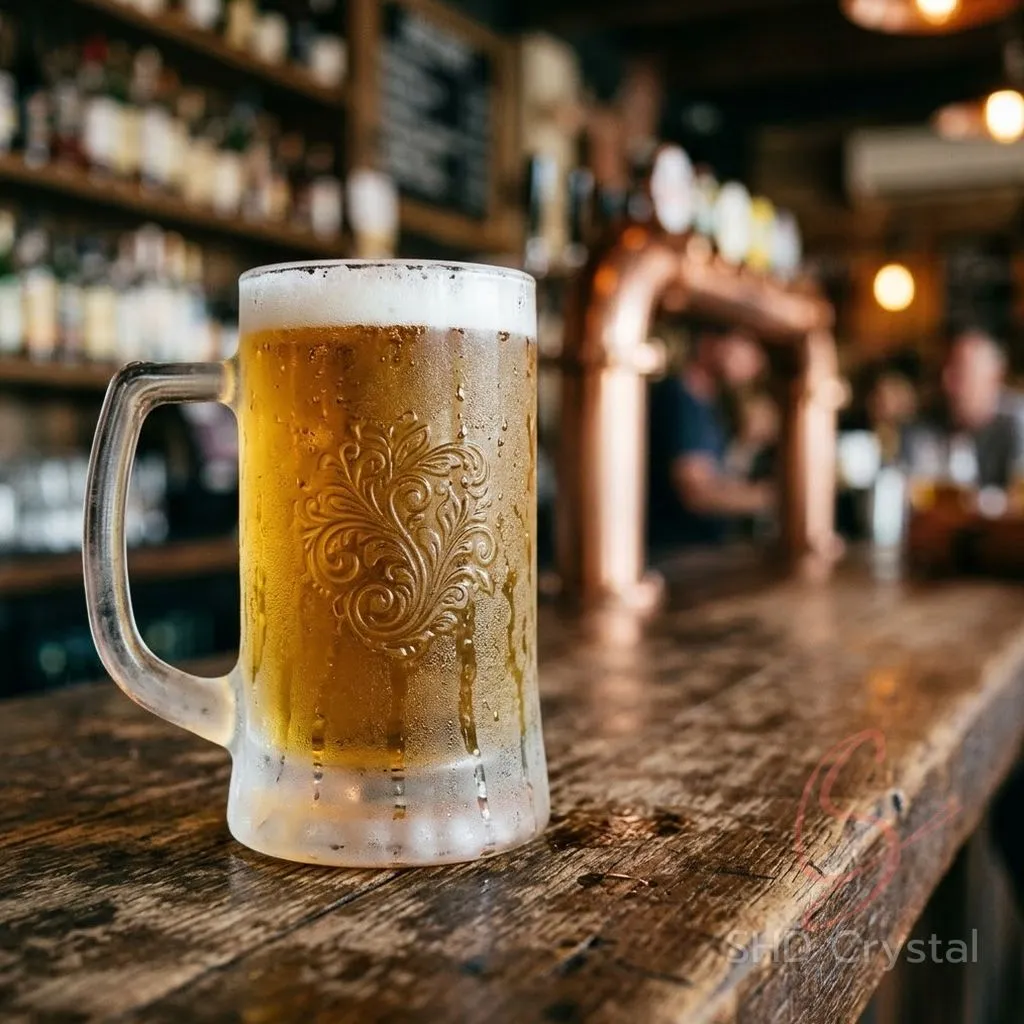
From bustling brewpub taprooms to high-end hotel bars, engraved glass beer mugs have become a subtle but powerful branding tool. Unlike printed labels that fade after a few wash cycles, engraved designs are physically etched into the glass surface, creating a permanent mark that outlasts the vessel itself. According to a 2025 Glass Packaging Institute report, the North American craft beer segment alone purchased over 18 million units of custom-etched glassware, a 12% increase from the prior year. The trend is not limited to breweries — distilleries, sporting venues, and corporate gift programs are all turning to personalized beer mug engraving to strengthen brand recall at the point of consumption.
How Engraving Depth Affects Application and Durability
Not every engraved design performs the same in real-world use. The depth of the engraving determines how well a logo survives repeated dishwasher cycles, how tactile the design feels in a customer's hand, and whether the mug is suitable for frosted versus clear glass finishes. The following table summarizes three common depth ranges and their practical trade-offs.
Engraving Depth | Typical Application | Dishwasher Durability |
Shallow (0.1–0.2 mm) | Decorative logos on promotional mugs; cost-effective for large batches | Withstands 200–300 commercial wash cycles before noticeable fading |
Medium (0.3–0.5 mm) | Taproom house logos and branded beer steins; balances aesthetics with grip texture | Exceeds 500 wash cycles; suitable for daily commercial use |
Deep (0.6–1.0 mm) | Premium etched beer mugs for gifting and collector editions; high tactile impact | Effectively permanent — survives 1,000+ cycles with no visible degradation |
A practical judgment to keep in mind: if your mugs will be handled primarily by commercial dishwashers rather than hand-washed, medium-depth engraving at 0.3–0.5 mm offers the best cost-to-durability ratio. Deep engraving, while premium in appearance, adds roughly 15–20% to unit cost and is only justified for gift-oriented product lines where tactile feel is part of the value proposition.
Laser vs Sandblast vs Acid Etching: A Horizontal Comparison
Three engraving methods dominate the market for custom etched beer mugs. Each has distinct strengths depending on production volume, design complexity, and finish requirements. The comparison below helps you match the right method to your project.
Laser engraving uses a focused CO2 or fiber laser beam to vaporize glass at precise coordinates. It excels at reproducing intricate logos with fine line weights (down to 0.3 mm strokes). Setup costs are low — no physical stencil is required — making it ideal for orders under 500 units. However, laser engraving produces a relatively smooth surface texture that some users find less tactile than sandblasted alternatives.
Sandblast engraving propels fine abrasive particles (typically aluminum oxide or silicon carbide) against the glass through a rubber stencil. The result is a frosted, matte finish with pronounced texture. This method is the industry standard for premium beer steins and is favored by taprooms that want a "classic engraved" aesthetic. Setup costs are higher due to stencil production, but unit costs drop significantly at volumes above 1,000 pieces.
Acid etching applies hydrofluoric acid to exposed glass areas through a resist mask. It produces a smooth, satin-like frosted finish and is capable of covering large surface areas uniformly. Acid etching is particularly popular in European beer hall traditions where full-body frosted designs are expected. The primary drawback is that acid etching requires strict safety controls and is less flexible for small-batch or highly detailed logos.
The Brewery Taproom Scenario: Where Engraved Mugs Deliver ROI
Consider a mid-sized brewery taproom serving 200–300 covers on a weekend evening. If the house serves every pint in custom etched beer mugs featuring the brewery's logo, each table effectively becomes a branded touchpoint for the entire visit. Patrons who photograph their drinks — and over 60% of craft beer consumers report doing so at least once per visit — share branded glassware organically on social media. When those same mugs are offered for retail sale at the bar, the engraved design transitions from service ware to merchandise, creating a secondary revenue stream with margins typically exceeding 40% above production cost.
Critical Specifications: Wall Thickness, Handle Clearance, and Engraving Placement
Three technical details are frequently overlooked when ordering personalized beer mug engraving, yet they directly affect both durability and customer satisfaction.
Wall Thickness
Standard beer mugs range from 2.5 mm to 4.0 mm in wall thickness. Mugs below 2.8 mm are vulnerable to chipping during sandblast engraving, particularly around handle attachment points. For engraved applications, a minimum wall thickness of 3.0 mm is recommended. Thicker walls also improve the tactile weight of the mug, which consumers associate with quality — a perception backed by a 2024 Kansas State University packaging study that found consumers rated heavier glass vessels 18% higher on perceived value.
Handle Clearance for Engraving
Handle clearance — the gap between the mug body and the handle grip — determines whether a logo can wrap partially behind the handle without distortion. Most standard mug handles provide 25–30 mm of clearance. If your design requires a full 360-degree wraparound engraving, verify that the handle geometry allows at least 15 mm of uninterrupted glass surface on both sides of the handle attachment. Mugs with D-shaped or C-shaped handles may require stencil adjustments to avoid logo truncation.
Engraving Placement Relative to Liquid Line
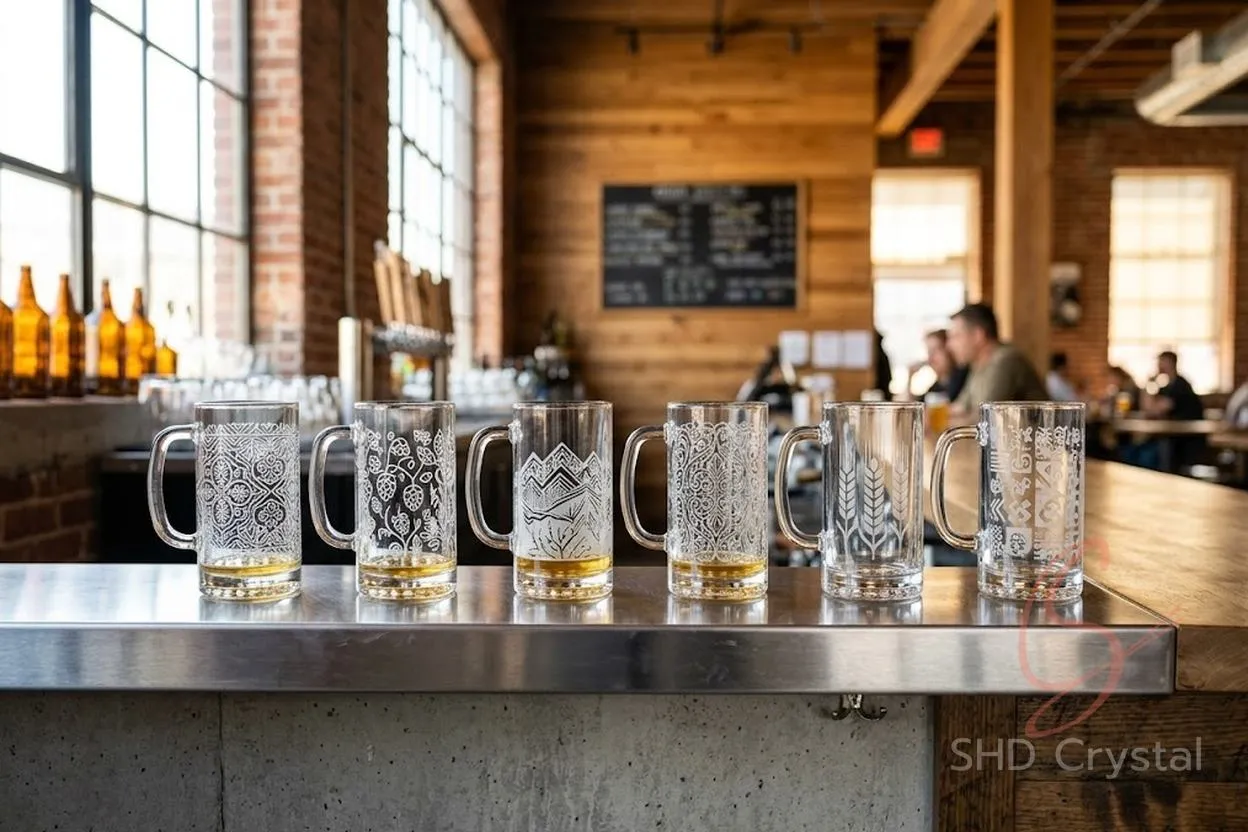
Logos placed below the liquid line are partially obscured when the mug is full, which undermines brand visibility. Positioning the primary logo above the liquid line — typically in the upper third of the mug body — ensures the design remains visible during service. This positioning also protects the engraving from abrasion caused by repeated contact with other mugs during washing and stacking.
Sourcing Engraved Glass Beer Mugs from China: What to Verify
China remains the world's largest exporter of decorated glassware, and most major engraving suppliers operate production lines in Hebei, Shandong, and Guangdong provinces. When sourcing custom etched beer mugs from Chinese manufacturers, request the following before committing to a production run: (1) a physical sample with your actual logo engraved at the agreed depth; (2) a dishwasher durability test report — reputable suppliers will provide third-party lab results from SGS or Bureau Veritas; (3) confirmation that lead and cadmium content in the glass meets FDA 21 CFR 175.300 and EU Regulation (EC) No 1935/2004 standards; and (4) a MOQ (minimum order quantity) breakdown, as many suppliers offer tiered pricing that drops significantly at 2,000+ units.
SHD Glassware, based in Hebei Province, offers engraved glass beer mugs with a stated MOQ of 500 units and provides third-party testing documentation upon request — a useful baseline when evaluating supplier reliability.
FAQ
Can engraved glass beer mugs go in the dishwasher?
Yes, but durability depends on engraving depth. Shallow engravings (0.1–0.2 mm) may show wear after 200 commercial wash cycles, while medium and deep engravings (0.3 mm and above) typically survive 500+ cycles without visible degradation. Always use commercial-grade detergents without abrasive additives.
How long does personalized beer mug engraving take for a bulk order?
Lead times vary by method and volume. Laser engraving for orders under 1,000 units typically requires 7–10 business days after sample approval. Sandblast engraving for orders above 2,000 units may take 15–20 business days due to stencil fabrication. Rush production is available from most Chinese suppliers at a 15–25% surcharge.
Is there a minimum order quantity for custom etched beer mugs?
MOQs vary by supplier and engraving method. Laser-engraved mugs often have MOQs as low as 100–200 units. Sandblast and acid etch methods typically require 500–1,000 units minimum due to stencil and setup costs. Some suppliers offer lower MOQs at higher per-unit prices.
What glass types work best for engraved beer mugs?
Soda-lime glass is the most common and cost-effective option for engraved beer mugs. Borosilicate glass offers superior thermal shock resistance but is more brittle and prone to cracking during deep engraving. Crystal glass provides the highest clarity and prestige but adds significant cost. For most taproom and promotional applications, soda-lime glass with 3.0+ mm wall thickness is the recommended baseline.
How do I ensure my engraved logo stays sharp over time?
Two factors matter most: engraving depth and glass quality. A medium-depth engraving (0.3–0.5 mm) on soda-lime glass with uniform wall thickness will retain sharpness for years of commercial use. Avoid placing logos near the rim or base where impact and abrasion are most likely. Request a sample durability test from your supplier before committing to a full production run.
Conclusion
Engraved glass beer mugs represent a durable, brand-forward investment for breweries, taprooms, and corporate gifting programs. The key decisions — choosing between laser, sandblast, or acid etching; selecting appropriate engraving depth; and verifying supplier capabilities — all hinge on understanding how your mugs will be used, washed, and displayed. By prioritizing medium-depth engraving for commercial service and requesting third-party durability testing from your China-based supplier, you can confidently order custom etched beer mugs that perform reliably across hundreds of wash cycles while maintaining the visual impact that drives brand recognition.
If you are interested in our glassware or related products,
please feel free to contact us.

