


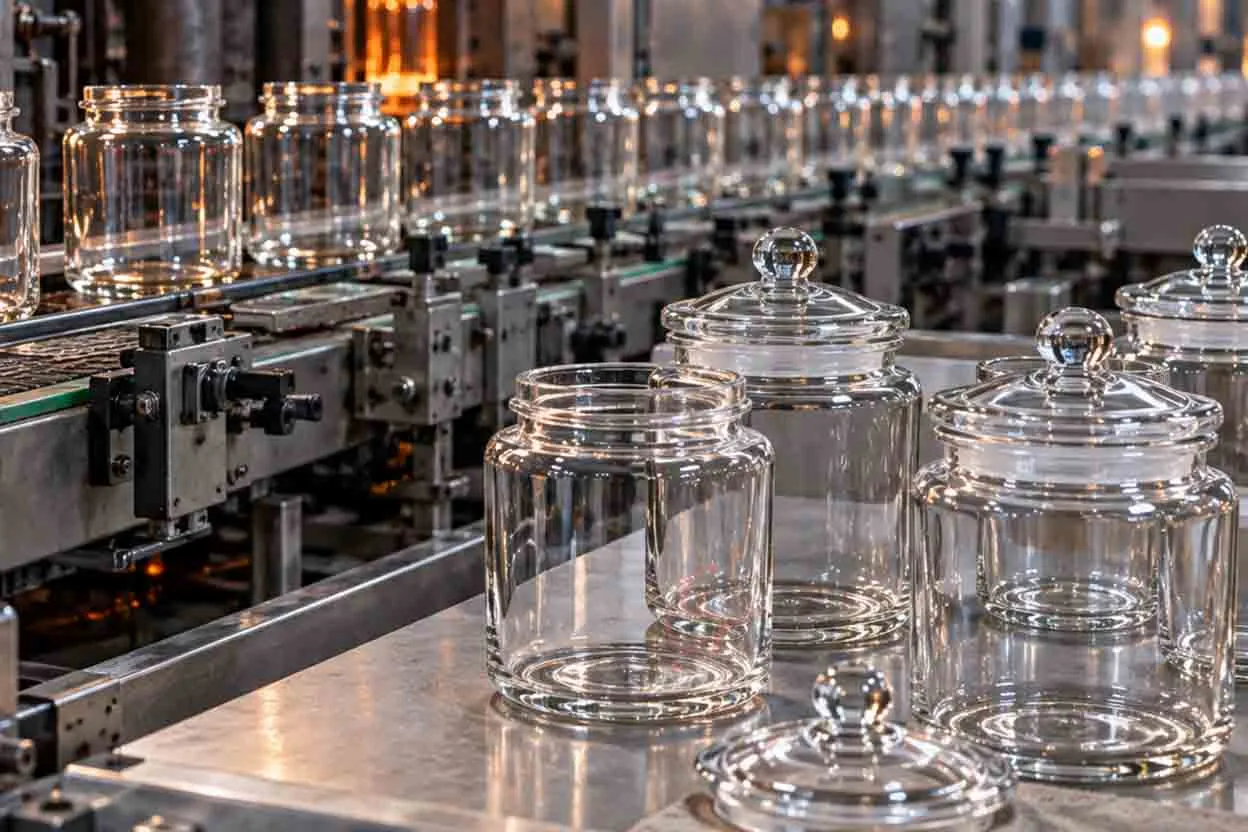
Traditional apothecary jars are recognizable for their wide glass bodies, pronounced shoulders, large openings, and fitted lids. Although the form has a historical character, modern apothecary jar production can be highly industrialized. For stable designs and larger production programs, automated forming allows the jar body to move through repeatable molding, annealing, inspection, and packing processes with much greater consistency.
At SHD Crystal, we look at glass apothecary jars as a two-part glass product rather than simply a jar with an accessory. The body and lid both need controlled dimensions, stable glass distribution, reliable contact geometry, and repeatable appearance. When production volume increases, these details become even more important.
Apothecary Jar Production Depends on Stable Automated Forming
For large production quantities, the first priority is repeatability. In automatic glass jar production, molten glass is delivered into controlled molds where timing, temperature, mold condition, and glass weight influence the final shape. Once the forming parameters are stabilized, the same jar design can be produced repeatedly with more predictable dimensions and surface definition.
This is particularly useful for apothecary-style jars because the body often includes several visually important areas:
-a broad base;
-curved or defined shoulders;
-a wide rim;
-a relatively large transparent body;
and a lid seating area that must remain consistent.
A small dimensional difference around the rim may not dramatically change the appearance of the jar itself, but it can influence how the lid sits. That is why automated production control has to consider the complete product rather than the jar body alone.
The Jar and Lid Need to Be Developed as One System
For glass apothecary jars, lid fit is one of the most visible quality points. A glass lid may use a flat seating surface, a recessed structure, a raised inner section, or another molded geometry depending on the design. Whatever the structure, the relationship between the lid and the jar opening needs to remain stable across production.
If the rim varies too much, some lids may sit higher than others. If the lid geometry changes, movement between the two components may become more noticeable.
In large-scale apothecary jar production, reviewing multiple jar-and-lid combinations gives a much better picture than checking one perfectly matched sample. The goal is not to create one exceptional pair. It is to maintain an acceptable fit across the production batch.
Glass Distribution Influences Shape and Cooling
Apothecary jars often use relatively substantial glass bodies, especially around the base, rim, or decorative shoulder areas.
During automatic glass jar production, material distribution needs to remain controlled so that one area does not become unnecessarily heavy while another becomes comparatively thin. This affects more than weight. Thicker sections cool more slowly than thinner sections. If the transition is too abrupt, annealing conditions become more important because different parts of the jar may release heat at different rates.
At SHD Crystal, we therefore pay attention to base thickness, shoulder transition, wall distribution, and rim structure together. Stable forming makes later annealing and inspection much easier to control.
Annealing Is Essential After High-Volume Forming
A jar leaving the forming machine may already have its final shape, but the manufacturing process is not complete. The newly formed glass still carries temperature differences created during shaping. Controlled annealing allows the glass to cool more gradually and helps reduce internal stress.
This is an important stage in apothecary jar production, particularly for designs that combine a heavy base, broad body, wide rim, and separate glass lid.
Automated production only creates value when forming speed is matched by stable downstream control. Higher output without controlled annealing would simply reproduce inconsistencies faster.
Large Transparent Surfaces Make Variation Easy to See
Many glass apothecary jars use clear or lightly colored glass, which means the body itself becomes a large inspection surface.
Wall distribution, mold seams, surface marks, rim definition, base stability, and glass clarity are relatively easy to compare when several pieces are placed together. This is why batch inspection should not focus only on one sample.
For large production programs, we review representative pieces across the run to see whether:
l body proportions remain stable;
l the jar sits flat;
l rim geometry remains consistent;
l lids continue to match correctly;
l surface appearance remains within the agreed range.
With automatic glass jar production, consistency across many pieces is the real measure of production stability.
Automation Does Not Eliminate Finishing Requirements
Automated forming provides the basic glass structure, but some apothecary jar designs may still require additional finishing or decoration. Depending on the project, this may include polishing, frosting, color treatment, printing, embossing, or other surface work.
For glass apothecary jars, these secondary processes should be built around a stable formed blank. If jar dimensions or surfaces vary too much before decoration, later finishing becomes harder to keep consistent. This is another reason why the forming stage remains the foundation of the entire product.
Packing Should Follow the Jar-and-Lid Structure
Glass apothecary jars create a different packing challenge from ordinary single-piece containers because the lid itself is another fragile glass component. In large-scale apothecary jar production, jars and lids may require controlled separation, dividers, inserts, or dedicated positioning to prevent glass-to-glass contact during transport.
Conclusion
Modern apothecary jar production combines a traditional glass form with highly controlled manufacturing. Stable mold forming, glass distribution, rim geometry, lid matching, annealing, inspection, and packing all contribute to whether the product can move reliably through large production quantities.
For glass apothecary jars, success is not defined by one attractive sample. It is defined by whether hundreds or thousands of jar-and-lid combinations maintain consistent proportions, appearance, and fit.
When automatic glass jar production is planned around those requirements from the beginning, the classic apothecary form becomes much more practical for stable commercial manufacturing.
Automated Apothecary Jar Production at SHD Crystal
At SHD Crystal, we support apothecary jar production through mold evaluation, automated forming, annealing coordination, lid-and-body matching, sample review, surface finishing, inspection, and export packing.
For large-volume glass apothecary jars, our focus is on turning an approved jar structure into repeatable output. By controlling forming conditions, key dimensions, lid fit, and downstream inspection throughout automatic glass jar production, the product can maintain a more stable appearance and structure across extended production runs.

