


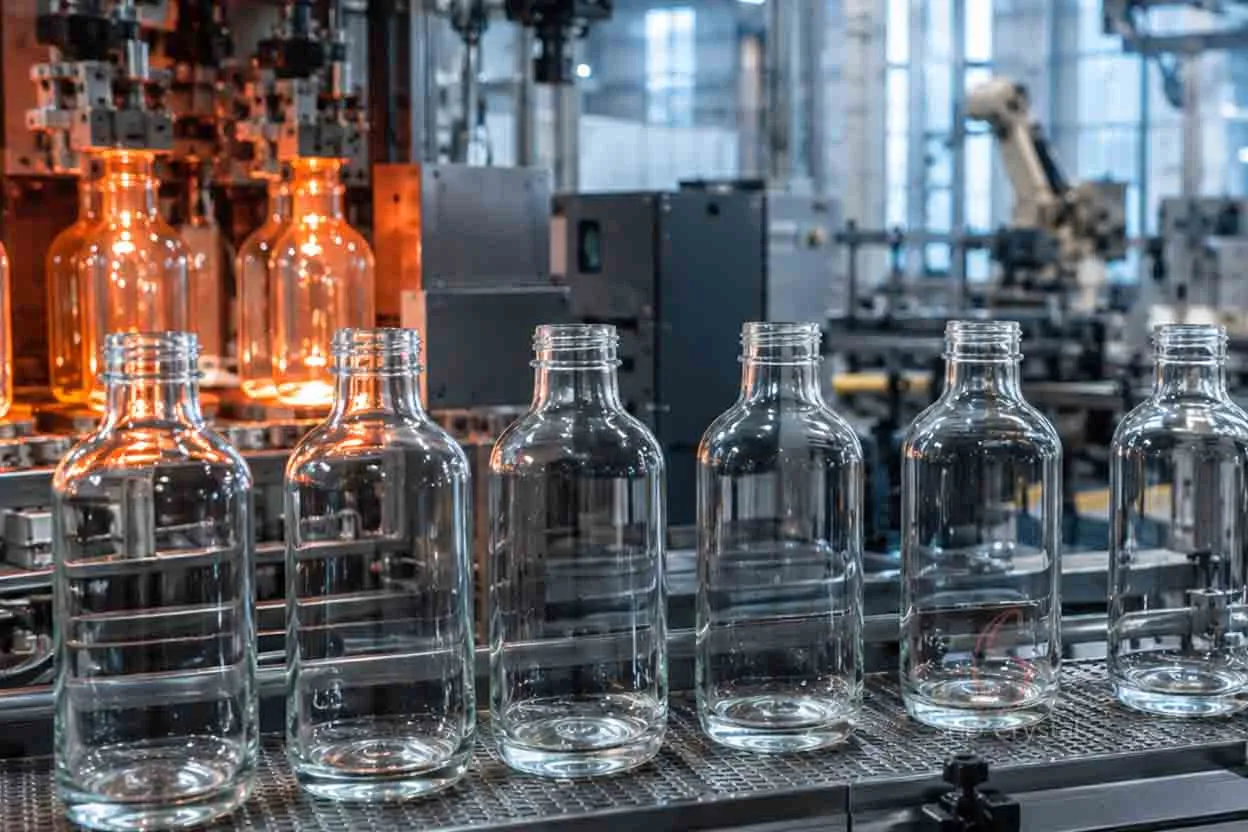
Automated molding containers are produced through a controlled sequence in which molten glass is portioned, formed in molds, cooled, annealed, inspected, and prepared for downstream decoration or packing. At SHD Crystal, we look at this process as a repeatability problem rather than a simple shaping step. For buyers developing glass liquid container bottles, dimensional stability, neck accuracy, wall distribution, and batch consistency matter because each container must continue to fit closures, filling equipment, labels, and cartons after production moves beyond the first sample.
How Automated Molding Containers Move From Glass Gobs to Controlled Forming
The core of automated container production is controlled glass delivery. Molten glass is divided into measured gobs before entering forming equipment, where mold geometry and timing determine how the material expands and contacts the cavity. Depending on the container design, pressure and air can be used during different forming stages. The objective is not only to reproduce the outside profile. The factory must also control internal volume, neck finish, base structure, and wall thickness transition.
This is where automated molding containers gain an advantage in repeat production. Machine timing, mold condition, forming temperature, and gob weight can be managed within defined production settings. If one variable drifts, flat panels may distort, shoulders can lose symmetry, or the glass can become unevenly distributed.
Why the Glass Extrusion Process Term Can Be Misleading
Buyers sometimes search for the glass extrusion process when researching bottle manufacturing. That term needs clarification. Conventional hollow container production is generally based on molding and blowing or pressing operations rather than continuous extrusion through a die. A glass extrusion process is more relevant to other glass-forming contexts, so it should not be treated as the normal explanation for bottles and jars.
The distinction matters when specifying glass liquid container bottles. If a buyer expects an extrusion-based workflow, the design discussion may focus on the wrong engineering variables. For molded containers, mold tolerance, neck tooling, forming sequence, cooling behavior, and annealing are more useful questions.
Annealing Follows the Forming Stage
After forming, cooling must be controlled. Sudden temperature differences can leave internal stress, particularly when the base is heavy or the body has uneven mass distribution. Annealing allows the container to cool through a managed temperature profile before cold-end inspection.
For automated molding containers, this stage supports structural consistency that cannot be judged from surface appearance alone. A bottle can look visually acceptable while still requiring closer process review if its thickness distribution or cooling behavior is unstable.
Inspection Connects Production With Filling Requirements
Inspection then focuses on features that affect later use. Neck dimensions influence closure fit. Bottom flatness affects standing stability. Body dimensions influence labels, filling guides, and secondary packaging. Surface defects may also become more visible after spraying, printing, or frosting.
A common purchasing mistake is approving only one visually attractive sample. The more important question is whether production can reproduce the approved structure across a full batch. Buyers of glass liquid container bottles should therefore confirm critical tolerances, decoration areas, closure requirements, packing methods, and acceptable visual variation before mass production.
Understanding the glass extrusion process distinction is useful for another reason: it helps buyers ask suppliers about the actual forming method instead of relying on a broad process term. Accurate terminology improves technical communication and reduces confusion during tooling and sampling.
Interested in custom glassware or related products?
Contact our team to discuss your project requirements.
Frequently Asked Questions About Automated Glass Container Forming
Q1: What Forming Methods Are Commonly Used for Automated Molding Containers?
A1: Automated molding containers are commonly produced through controlled molding processes in which a measured glass gob enters forming equipment and is shaped inside dedicated molds. Depending on the bottle geometry, neck design, and production setup, forming may involve blowing, pressing, or a combination of pressure and air. The selected method influences wall distribution, dimensional stability, and the type of container that can be produced consistently.
Q2: Why Does Gob Weight Matter When Producing Glass Liquid Container Bottles?
A2: Gob weight determines how much molten glass enters the mold for each container. If the glass amount varies, wall thickness, base weight, capacity, and overall bottle dimensions may also vary. For glass liquid container bottles, stable gob control helps manufacturers maintain more consistent structures across large production batches.
Q3: How Do Mold Tolerance and Forming Temperature Affect Bottle Quality?
A3: Mold tolerance influences neck dimensions, body geometry, corner definition, and overall repeatability, while forming temperature affects how easily molten glass flows into different parts of the mold. Poor coordination between these variables can contribute to uneven glass distribution, distorted panels, or dimensional differences. Automated forming systems are designed to keep these production conditions within controlled ranges.
Q4: Why Is Annealing Necessary After Automated Glass Forming?
A4: Freshly formed glass containers contain significant heat and may cool unevenly because the base, walls, shoulders, and neck do not always have the same thickness. Controlled annealing allows the glass to cool gradually and helps reduce internal stress. This becomes particularly important for automated molding containers with heavy bases, geometric shapes, or noticeable wall thickness transitions.
Q5: Is the Glass Extrusion Process Normally Used to Make Bottles and Jars?
A5: The glass extrusion process is not normally the primary forming method for conventional hollow bottles and jars. Commercial container manufacturing generally relies on mold-based forming in which molten glass is portioned into gobs and shaped through pressing, blowing, or related operations. Understanding this distinction helps buyers discuss the correct tooling, molding, annealing, and dimensional control requirements with a glass container manufacturer.
Conclusion
automated molding containers work best when design and process controls are reviewed together. Mold geometry, forming temperature, wall distribution, annealing behavior, dimensional inspection, and batch consistency all influence whether a container is ready for reliable filling and repeat orders.
Automated Glass Container Production With SHD Crystal
SHD Crystal supports automated molding containers through design review, mold development, automated forming, annealing, inspection, surface finishing, and export packing. Early coordination of capacity, neck finish, closure fit, decoration, and packing requirements helps turn a container concept into a more stable production program.

