


A custom crystal decanter does not need every visible detail to come from one manufacturing step. Some of its identity may come from the original blown form, while other characteristics are created later through cutting, polishing, frosting, engraving, color treatment, or stopper design. Understanding these crystal decanter customization options helps separate what belongs to the glass structure from what can be added through secondary processing.
At SHD Crystal, we usually review a decanter in layers. First comes the basic glass form: body proportion, shoulder transition, base weight, neck geometry, and overall silhouette. After that, decanter body finishing can add much of the visual character. This layered approach often gives a project more flexibility than trying to build every decorative detail directly into the original form.
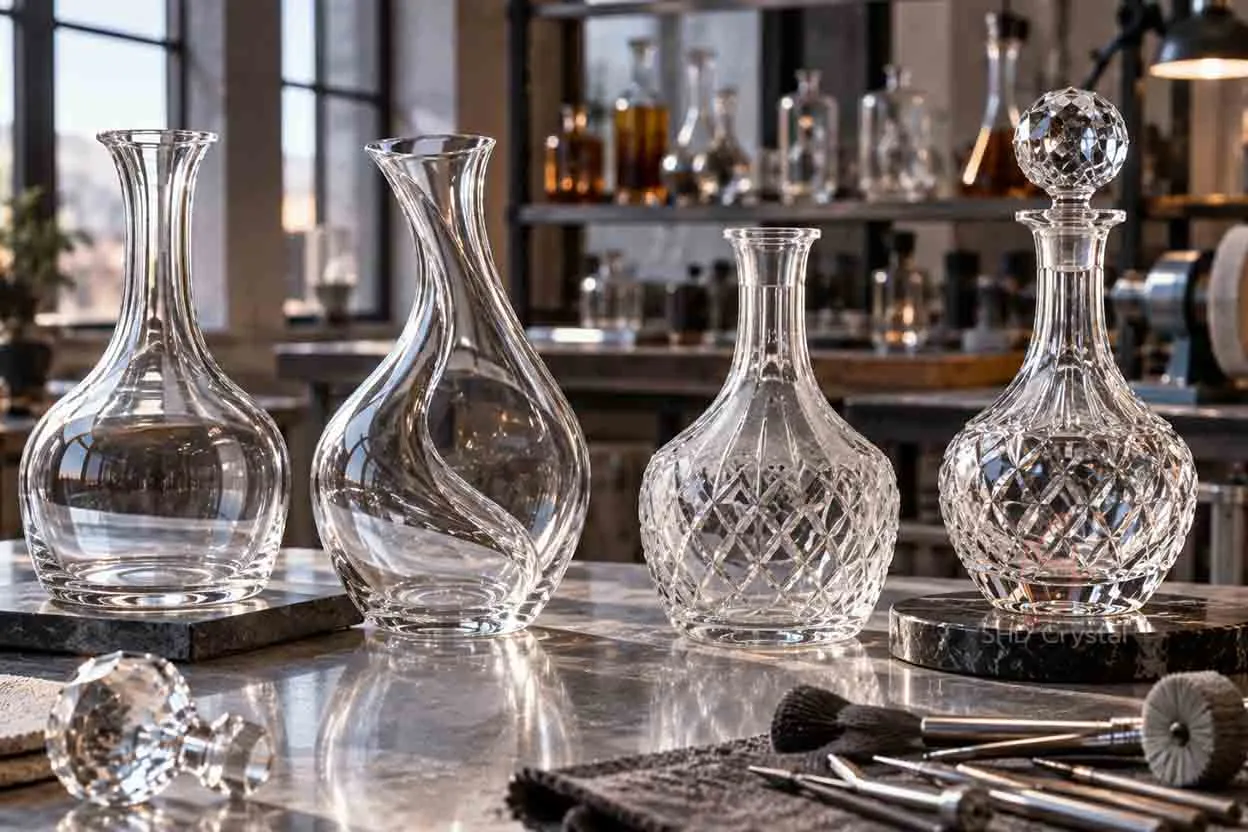
Crystal Decanter Customization Options Begin With the Main Glass Form
The largest visual decision is the body itself. Blown glass decanter shapes can range from clean cylindrical forms to rounded bodies, wide shoulders, elongated necks, asymmetric silhouettes, and heavier sculptural bases. Each geometry changes how molten glass needs to move during forming.
A simple body is generally easier to control, while sharper shoulders, narrow transitions, or unusual proportions may require more development during sampling. This is why the first stage of customization should answer a basic question:
Does the product need a unique silhouette, or can its identity come mainly from later finishing?
If the silhouette is central to the design, more attention needs to go into forming and mold development. If the basic proportion is already suitable, finishing may provide a more efficient route to differentiation.
Blown Glass Decanter Shapes Need to Respect Material Behavior
A rendering can make almost any shape look possible. Hot glass is less forgiving. During forming, glass has to distribute through the body, shoulder, base, and neck without creating unnecessary concentration in one area. Heavy bases, deep corners, and narrow necks can all change cooling behavior and wall distribution.
For unusual blown glass decanter shapes, physical samples are particularly important. A shape may look balanced digitally but feel too heavy at the base, too narrow through the neck, or visually top-heavy once the stopper is installed.
Small adjustments to shoulder angle, body width, or base proportion can often preserve the intended style while making the form easier to reproduce.
Decanter Body Finishing Creates a Second Design Layer
Once the primary glass form is stable, the body can be developed further through secondary processing. Common decanter body finishing directions may include:
n geometric cutting;
n beveling and polishing;
n frosting;
n engraving;
n surface coating;
n color decoration;
n localized polished areas.
These processes can dramatically change the appearance of a relatively simple glass body. A clean cylindrical decanter, for example, may become much more architectural after deep geometric cutting. A softly rounded vessel can move toward a more restrained premium style through frosting and polished contrast areas.
This is why customization does not always need to begin with an extremely complex mold.
Cutting Depth Must Match the Glass Body
Decorative cutting only works when the formed glass provides enough material in the right area.
Deep facets require sufficient wall thickness, while cutting too close to a thin transition can reduce consistency or create unnecessary production difficulty. Polishing also changes the final geometry because it softens and refines the cut surface.
For decanter body finishing, we therefore review the cutting plan together with the original glass structure. A strong cutting pattern should enhance the underlying form rather than fight against it.
In some projects, simplifying one cutting zone can improve visual repetition without reducing the premium character of the decanter.
The Stopper Extends the Customization Range
The stopper is another major design surface. A faceted stopper can reinforce geometric body cutting. A rounded stopper can soften a more angular vessel. Colored or sculptural stoppers can also create contrast without changing the main body mold.
For many crystal decanter customization options, stopper design provides a useful middle ground between full structural redesign and surface decoration.
However, stopper proportions still need to match the neck. An oversized stopper can make the vessel feel top-heavy, while one that is too small may weaken the overall presence of the product. Fit and appearance should therefore be reviewed together.
Not Every Custom Feature Needs a New Mold
One of the most practical lessons in decanter development is that customization can be distributed across different manufacturing stages. A project may use:
l a distinctive blown body with minimal finishing;
l a stable body with elaborate cutting;
l a simple silhouette with a custom stopper;
l or a combination of moderate forming changes and controlled surface treatment.
These different crystal decanter customization options allow brands to decide where exclusivity matters most. For some products, the strongest identity is the silhouette. For others, it is the light reflection created by cutting. In another collection, the stopper may become the signature detail. The best solution is usually the one that concentrates customization where it creates the strongest visual effect.
Conclusion
Crystal decanter customization options extend far beyond changing the outer shape. The finished product can be developed through the relationship between the original glass form, blown glass decanter shapes, stopper design, cutting, polishing, frosting, engraving, and other decanter body finishing methods.
A successful project does not need every component to be complicated. The stronger approach is to decide which parts of the decanter should define its identity and then build the manufacturing route around those priorities.
Developing Crystal Decanter Designs With SHD Crystal
At SHD Crystal, we review decanter projects from both structural and finishing perspectives. Some designs need more attention on blown glass decanter shapes, while others can achieve their strongest character through cutting, polishing, frosting, or stopper development.
Our work with crystal decanter customization options can include form evaluation, sampling, mold coordination, stopper matching, decanter body finishing, inspection, and repeat-production preparation.
In practical development, the final design often becomes clearer once a physical sample is available. Small refinements to the body proportion, cutting depth, stopper size, or polished area can make the product more distinctive without introducing unnecessary complexity.

