


Not every custom decanter needs to begin with a completely new mold. In some projects, the strongest identity comes from the glass silhouette itself. In others, a relatively simple body can be transformed through cutting, frosting, engraving, color treatment, stopper design, or presentation packaging. Good custom glass decanter development starts by deciding where customization will create the most value.
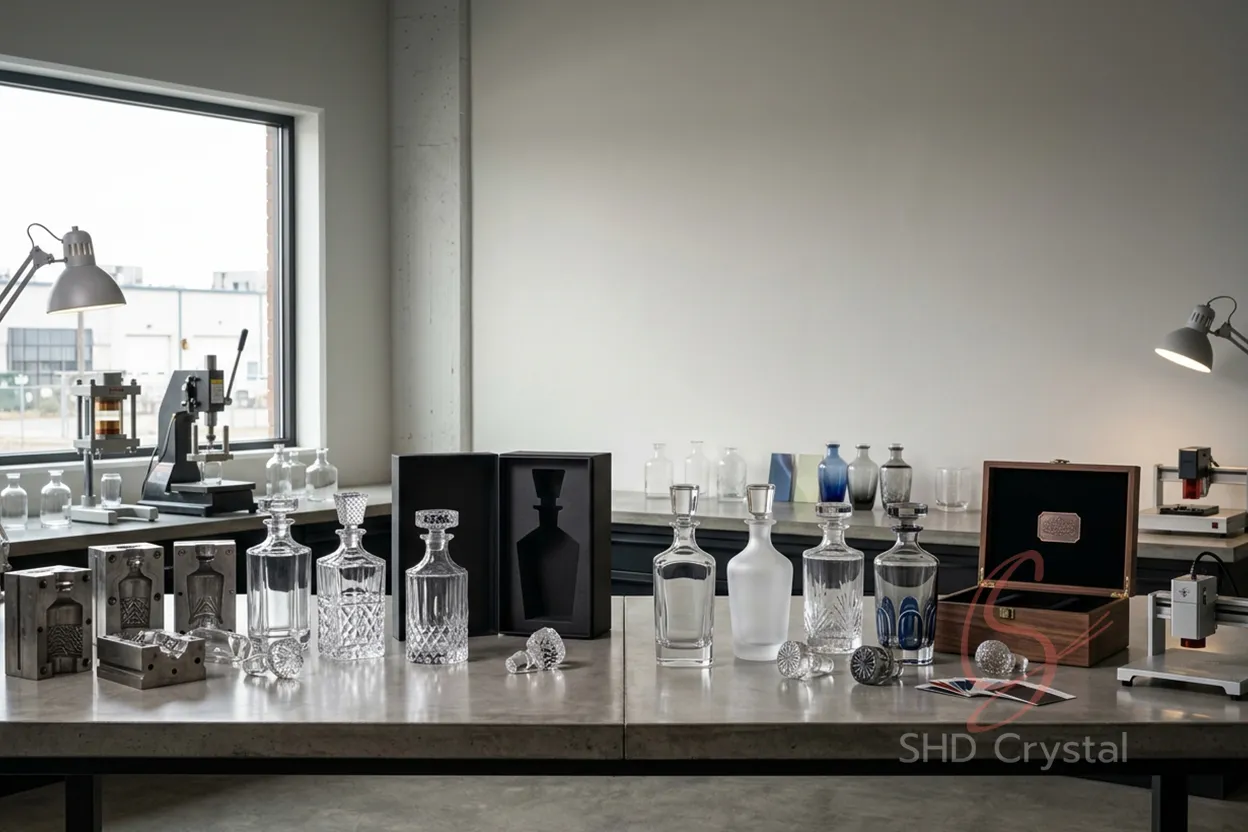
Custom Glass Decanter Development for Spirits Projects
Not every custom decanter needs to begin with a completely new mold. In some projects, the strongest identity comes from the glass silhouette itself. In others, a relatively simple body can be transformed through cutting, frosting, engraving, color treatment, stopper design, or presentation packaging. Good custom glass decanter development starts by deciding where customization will create the most value.
At SHD Crystal, we usually look at the complete concept before deciding how much of the product needs to change. For custom glass decanters, development cost, expected quantity, launch schedule, visual identity, finishing complexity, and future repeat production all influence whether a project should begin with a new structure or a more flexible finishing-based approach.
Custom Glass Decanter Development Can Begin at Different Levels
The first question is not simply, "Do we need a custom mold?"
A better question is:
Which part of the decanter actually needs to be unique?
If the main silhouette defines the brand, a new mold may be appropriate. This allows control over body geometry, shoulder shape, base proportion, embossed details, neck structure, and overall visual weight.
But if the required distinction comes mainly from surface character, an existing or simplified glass form may provide enough flexibility. Cutting, polishing, frosting, coating, engraving, or a distinctive stopper can change the final presentation significantly without rebuilding every structural detail.
These different decanter customization options should be evaluated according to the product concept rather than treated as a hierarchy where more customization is automatically better.
A New Mold Changes More Than the Appearance
Structural customization has the strongest influence on product identity, but it also changes how the glass behaves during forming.
Deep corners, pronounced shoulders, narrow necks, heavy bases, and sculptural transitions affect glass distribution and cooling. A shape that looks impressive in a rendering may need refinement once actual forming behavior is considered.
For custom glass decanters, this is why we review wall transitions, base mass, neck geometry, and stopper position before the design moves too far into tooling. A new mold makes sense when the silhouette itself needs to be proprietary or when an existing form cannot support the required proportions. But exclusive geometry also means more development work, tighter dimensional review, and less room for late structural changes.
Secondary Finishing Can Create Strong Identity
Not every premium decanter needs a highly complicated primary form. A clean glass blank can become visually distinctive through deep cutting, restrained faceting, frosting, color coating, engraving, or polished decorative zones. These decanter customization options can allow brands to create several visual directions from one stable body structure.
However, secondary finishing is not automatically simple. Deep cutting requires enough glass in the relevant area. Polishing pressure can soften facet definition. Frosting and coating need consistent surface preparation. Engraving and decoration need to follow the actual geometry of the vessel rather than only the flat artwork.
In custom glass decanter development, we therefore treat finishing as part of production planning rather than as something added after the bottle has already been completed.
The Stopper Can Become the Main Design Feature
The stopper is often underestimated during early design discussions. A faceted, rounded, colored, oversized, or sculptural stopper can dramatically change the personality of a decanter even when the body itself remains relatively restrained.
For custom glass decanters, this can be an effective way to build identity without making the vessel unnecessarily complex. But the stopper still needs to work technically. Neck dimensions, stopper contact surfaces, grinding, polishing, proportion, and replacement requirements all need review. One attractive matched sample is not enough if normal production variation makes later pieces difficult to pair consistently.
A distinctive stopper works best when visual impact and fit control are developed together.
Packaging Can Be Part of the Customization Strategy
Presentation packaging can also carry part of the product identity. A decanter developed for gifting or premium spirits presentation may use a fitted box, molded insert, separate stopper position, or other structured presentation elements. These choices influence more than appearance because the final dimensions and weight of the decanter determine how the packaging needs to protect it. For that reason, packaging should not be left until the very end of custom glass decanter development.
A heavier base, wider shoulder, or larger stopper may change box dimensions and internal support. If the decanter design changes during sampling, the packaging structure may need to change as well. Product and presentation work better when they are reviewed together.
Sampling Helps Decide Where Customization Is Worth Keeping
Physical samples often change the customization strategy. A project may begin with an ambitious new body shape, but once the sample is reviewed, the strongest visual feature may turn out to be the stopper or cutting pattern rather than the silhouette itself. In another project, a relatively simple rendering may reveal that a stronger shoulder or heavier base is necessary to achieve the intended character. This is why we prefer to use sampling as a decision stage rather than only as final confirmation.
For custom glass decanters, the first sample can help answer practical questions:
-Does the new mold add enough visual value?
-Is the base heavier than necessary?
-Does the cutting remain clear on the actual glass?
-Does the stopper feel proportionate?
-Can the finish be repeated consistently?
-Does the presentation box still fit the final product comfortably?
These answers help narrow the decanter customization options before production becomes more difficult or expensive to change.
Conclusion
Successful custom glass decanter development does not depend on maximizing the number of customized features. It depends on choosing the parts of the product that genuinely need to be distinctive. A new mold can define the silhouette. Cutting and finishing can transform a stable glass body. A stopper can carry much of the visual identity. Presentation packaging can strengthen the final experience.
For custom glass decanters, the strongest result usually comes from combining these decanter customization options selectively rather than making every component complex at the same time.
Developing Custom Decanter Projects With SHD Crystal
At SHD Crystal, we support custom glass decanter development through concept review, mold evaluation, sampling, stopper coordination, glass forming, cutting, polishing, surface finishing, inspection, and presentation packaging discussion.
In practical projects, we often find that the first design does not need to be completely replaced. A small change to base proportion, stopper geometry, cutting area, or finishing method can sometimes create a much stronger and more production-friendly result.
For brands developing custom glass decanters, identifying the most valuable decanter customization options early helps keep the project distinctive without introducing unnecessary complexity into tooling, finishing, or repeat production.

