


Custom glass jar production begins where sample approval ends. In many OEM developments, an approved sample is only the starting point of a stable glass packaging project, not the final proof that mass production will perform the same way.
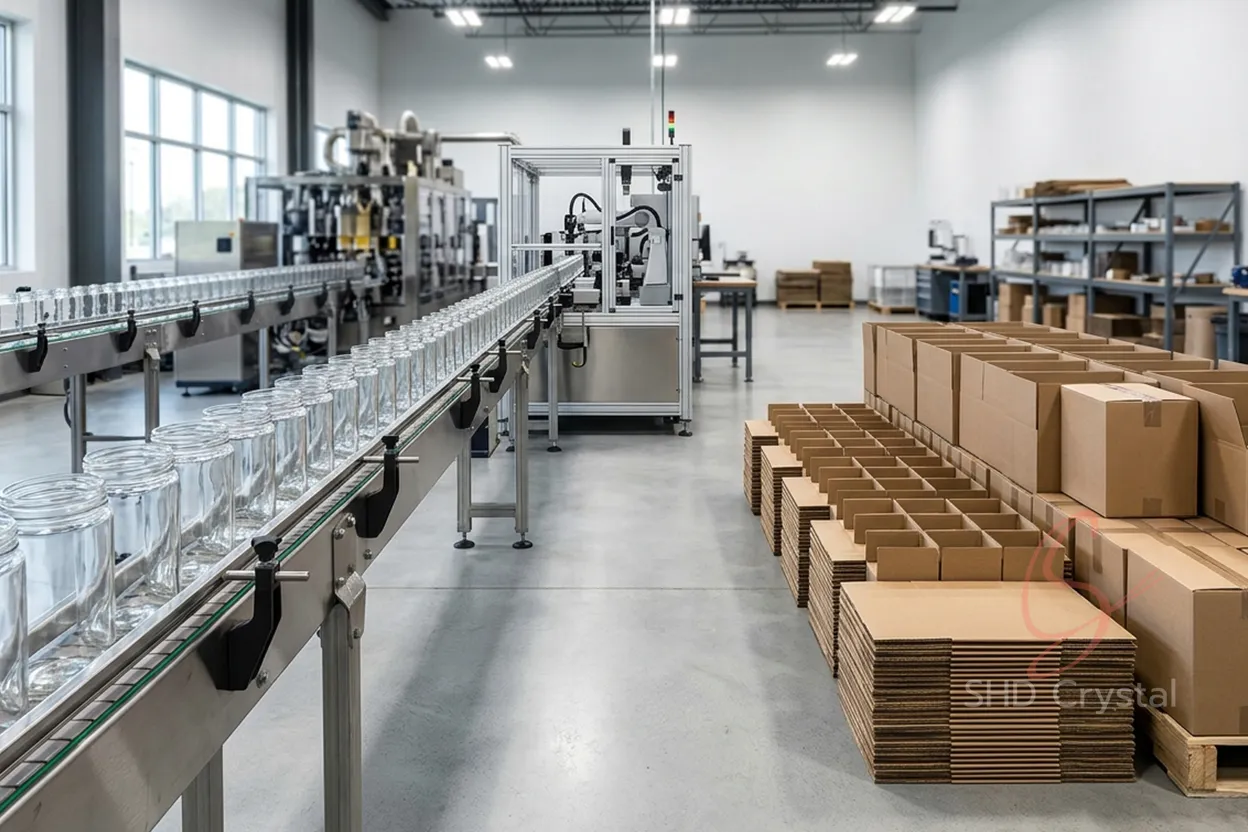
Custom Glass Jar Production for Reliable Packaging Supply
Custom glass jar production begins where sample approval ends. In many OEM developments, an approved sample is only the starting point of a stable glass packaging project, not the final proof that mass production will perform the same way.
Once a design moves into real production, the focus changes from "can this jar be made" to "can this jar be repeated consistently across multiple batches." That is why glass jar manufacturing should be treated as a connected system involving tooling, forming stability, inspection logic, and packing validation rather than as a single production event.
Custom Glass Jar Production Does Not End With Sample Approval
A confirmed sample is usually made under controlled conditions. Machine time is limited, adjustments are closely monitored, and the best available pieces are often used for review. However, custom glass jar production becomes more demanding once the order moves into repeated output.
During longer production runs, factors such as mold wear, temperature fluctuation, and material flow consistency begin to affect the final result. A sample that appears perfect may still show variation once the same design enters continuous glass jar manufacturing.
For a real glass packaging project, the main question is therefore not whether the sample is acceptable, but whether the production system can keep delivering the same structure, neck fit, surface quality, and overall performance over time.
Repeated Production Requires Clear Control Points
To keep production stable, critical dimensions and features should be defined before mass production begins. Without these control points, later inspection can become too subjective.
In many projects, the most important checkpoints include:
Neck finish geometry for closure compatibility
Overall height for filling line alignment
Body diameter for labeling and packing fit
Base stability for transport and end-use performance
When these priorities are clear, glass jar manufacturing can be checked against measurable standards instead of visual comparison alone. This helps both buyer and supplier manage the glass packaging project more efficiently.
Forming Stability Determines Batch Consistency
In repeated production, forming is one of the most sensitive stages. Even small changes in temperature, gob weight, timing, or mold condition can affect how glass moves inside the mold. If forming conditions shift, variations may appear in wall thickness, shoulder symmetry, or base weight distribution. These differences are not always obvious at first glance, but they can affect closure fit, filling behavior, stacking, and transport stability later.
Stable custom glass jar production depends on keeping forming conditions consistent throughout the production window, not only during initial setup. Controlled annealing also matters, because uneven cooling can leave internal stress that affects long-term durability.
Inspection Strategy Should Follow Functional Priorities
Inspection should not treat every feature as equally important. In a practical glass packaging project, the inspection plan should focus first on functional risk.
For example:
-Closure sealing areas affect product safety
-Neck alignment affects automated filling efficiency
-Base flatness affects stability during transport and storage
-Major body dimensions affect labels, cartons, and repeated assembly performance
Cosmetic variation outside these areas may still need review, but it should be judged according to the actual application. A structured inspection plan helps avoid over-control in non-critical zones while protecting the most important requirements in custom glass jar production.
Packing Validation Is Part of the Manufacturing System
In a professional glass packaging project, packing should not be treated as a final afterthought. Even a well-made jar can arrive damaged if the packing design does not match its shape, weight, or surface treatment. Carton structure, compression strength, internal dividers, jar-to-jar spacing, and layer arrangement all influence whether the finished containers can remain stable during storage, pallet handling, and export transportation.
For this reason, packing validation should be reviewed together with glass jar manufacturing planning. This is especially important when the jar includes unusual geometry, embossing, frosting, coating, or printing, because these features may require more careful protection than a standard cylindrical container. In a stable custom glass jar production process, packaging should support the same quality goal as forming, finishing, and inspection.
Scaling Custom Designs Without Losing Repeatability
Customization adds value, but it also introduces more variables. Embossing, coating, frosting, printing, and special surface treatments can all make production control more complex.
A stable process usually follows a clear sequence:
-Lock structural dimensions first
-Stabilize forming and annealing conditions
-Add decoration and surface finishing as controlled secondary steps
This approach helps custom glass jar production remain repeatable while still allowing the flexibility needed in a modern glass packaging project. It also makes communication easier when production adjustments are required.
Conclusion
Successful custom glass jar production is not defined by sample approval alone. It is defined by whether the approved design can be reproduced across repeated manufacturing cycles with stable forming, clear inspection priorities, and validated packing support. When tooling, process control, and packing logic work together, a glass packaging project becomes a predictable supply system instead of a series of isolated production runs.
Building a Stable Glass Packaging Project
For brands developing new containers, SHD Crystal supports custom glass jar production through tooling review, process discussion, sampling coordination, inspection planning, and export packing support. By treating glass jar manufacturing as one connected system, SHD Crystal helps customers build a more stable and repeatable glass packaging project from sample approval to ongoing supply.

