


Printing can make a glass bottle immediately recognizable, but a good result depends on much more than placing artwork on the surface. For beverages, fragrances, cosmetics, and specialty products, custom printed glass bottles need the bottle shape, printable area, graphic position, surface condition, and finishing process to work together.
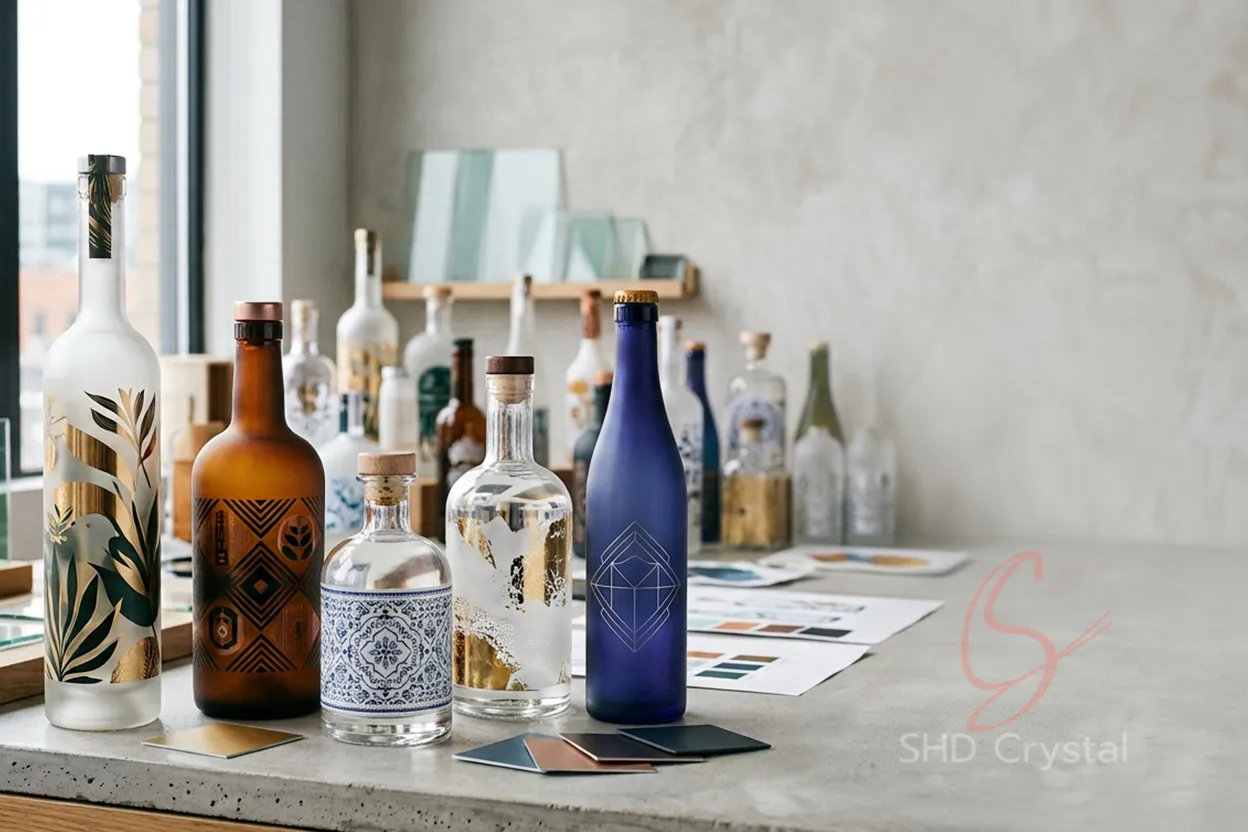
Custom Printed Glass Bottles for Brand Packaging
Printing can make a glass bottle immediately recognizable, but a good result depends on much more than placing artwork on the surface. For beverages, fragrances, cosmetics, and specialty products, custom printed glass bottles need the bottle shape, printable area, graphic position, surface condition, and finishing process to work together.
This is why printed bottle development usually begins before the artwork is sent to production. A design that looks balanced on a flat file may behave differently when transferred onto curved glass, positioned near a shoulder, or combined with frosting or coating. For brands developing branded glass packaging solutions, early coordination between the bottle and its decoration can prevent avoidable changes later.
Custom Printed Glass Bottles Need the Artwork and Bottle Surface to Work Together
Not every area of a glass bottle behaves the same during printing. Straight body sections generally provide a more predictable surface, while shoulders, tapered areas, deep curves, embossing, and transitions can make graphic placement more demanding. Mold seams and changes in bottle geometry may also need to be considered when deciding where a printed element should sit.
For this reason, we normally look at the actual bottle structure before confirming the decoration area. A logo or graphic may need to move slightly away from a curved transition, or a full decorative pattern may need to be adjusted so that its visual spacing remains balanced around the bottle.
Good glass bottle decoration should support the original bottle design rather than fight against its geometry.
Printing Methods and Surface Finishes Should Be Treated Separately
Printing and surface finishing are related, but they are not the same process. Direct screen printing or decal-style decoration can place graphics, patterns, or color details onto the glass surface. Frosting and coating, by contrast, change the appearance or texture of the bottle itself and may then be combined with printing as part of a larger decoration system.
This distinction matters because each combination can produce a different visual result. For example, a white printed element may appear crisp and bright on clear glass but look softer when applied over a frosted surface. Metallic or darker graphics may also react differently against colored or coated bottles.
When developing custom printed glass bottles, we prefer to review the complete decoration combination on a physical sample rather than assuming that artwork will look the same across every glass finish.
Print Position and Registration Become More Important as Designs Become More Complex
A simple one-color mark and a multi-element decorative pattern do not create the same production requirements. As the design becomes more complex, print position, alignment, spacing, and consistency become more visible. If multiple colors or decorative elements need to align with each other, small positional differences can become noticeable across a production batch.
Bottle shape also matters. A graphic that wraps around a cylindrical body needs different planning from one placed on a tapered or faceted surface.
For branded glass packaging solutions, the goal is not simply to reproduce artwork as closely as possible. The artwork should be adapted to a bottle surface that can be decorated repeatedly with a consistent visual result.
Project Experience: The First Sample Often Changes Artwork Placement
In practical printed bottle projects, the first physical sample often confirms the overall design while revealing smaller details that need adjustment. We may find that a graphic positioned correctly in the artwork file sits too close to the bottle shoulder once printed. A decorative line may appear uneven because it crosses a change in curvature. In another case, frosting or coating may change the contrast enough that the original print color no longer produces the intended effect. These are exactly the types of issues sampling is meant to reveal.
Instead of changing the whole bottle concept, we can usually refine the artwork position, printing area, color relationship, or surface treatment before regular production begins. For custom printed glass bottles, this physical review is more useful than approving decoration only from digital renderings.
Adhesion and Handling Should Be Considered With Appearance
A printed bottle is still a working package. It may move through filling, packing, storage, transport, shelving, and repeated handling before reaching the final user. For that reason, glass bottle decoration should be evaluated not only for visual quality but also for how it behaves in the intended use environment. Surface preparation, the selected decoration system, curing conditions, and handling requirements can all influence the final result.
Different projects may need different priorities. A fragrance bottle may emphasize fine visual detail and surface quality, while a beverage bottle may experience more frequent handling during filling, packing, and service. We therefore prefer to review decoration together with the actual product application rather than treating every printed bottle in the same way.
Custom Printed Glass Bottles Also Depend on the Quality of the Glass Blank
Printing cannot compensate for an inconsistent glass surface. Before decoration, the bottle still needs appropriate dimensional consistency, surface quality, and stable geometry. Variations in the body, shoulder, or base may affect how printed elements appear when several bottles are displayed together.
This is particularly important when artwork relies on precise positioning or when a printed element is intended to align visually with a closure, label area, embossing, or another structural feature.
For repeated production, maintaining a stable bottle blank gives the glass bottle decoration process a more reliable starting point.
Batch Review Should Look Beyond One Perfect Sample
An approved sample establishes the target, but commercial production needs repeatability. When we review printed bottles in a batch, we pay attention to print position, color appearance, edge definition, surface defects, and the relationship between the decoration and bottle shape. If additional finishes such as frosting or coating are involved, their consistency also needs to be reviewed alongside the print.
This is especially important for branded glass packaging solutions because the bottles are usually seen as a collection rather than as isolated pieces.
A small difference may not be obvious on one bottle, but it can become much easier to notice when multiple products are placed together on a shelf, display, or presentation table.
Conclusion
Custom printed glass bottles work best when bottle design and decoration are developed as one packaging system. Printable area, curvature, artwork position, printing method, surface finishing, adhesion, and batch consistency all affect whether the final bottle reflects the original brand concept.
For brands using glass bottle decoration as a key part of product identity, physical sampling remains one of the most useful stages in development. It allows the bottle, artwork, finish, and production conditions to be reviewed together before larger production begins.
Developing Custom Printed Glass Bottles With SHD Crystal
SHD Crystal supports custom printed glass bottles through bottle development, artwork coordination, sampling, printing review, surface finishing, inspection, and production management.
For brands developing branded glass packaging solutions, we can review how the bottle shape, printable area, decoration method, and finishing requirements work together. Early discussion of glass bottle decoration helps identify practical adjustments while the project is still flexible, making it easier to move from an initial artwork concept to a repeatable commercial glass container.

