


In premium spirits packaging, a substantial base and clear, weighty glass can create an immediate sense of value. But a decanter is not improved simply by adding more material. Good decanter design and manufacturing depends on how glass is distributed through the base, body, shoulders, and neck, as well as how the stopper, finishing, and final proportions work together.
Decanter Design and Manufacturing for Premium Spirits
In premium spirits packaging, a substantial base and clear, weighty glass can create an immediate sense of value. But a decanter is not improved simply by adding more material. Good decanter design and manufacturing depends on how glass is distributed through the base, body, shoulders, and neck, as well as how the stopper, finishing, and final proportions work together.
For custom whiskey decanters, these relationships become especially important. A visually impressive sample still needs to remain balanced in the hand, practical to pour from, stable during forming and annealing, and consistent enough for repeat production. In spirits packaging development, controlled structure usually matters more than maximum weight.
Decanter Design and Manufacturing Starts With Balanced Glass Distribution
Molten glass does not distribute itself evenly simply because a design appears symmetrical in a drawing.
Body width, shoulder angle, base depth, corner geometry, and neck diameter all influence how glass moves during forming. A deep base may create a strong visual anchor, but excessive material accumulation in one area can make cooling less uniform while leaving other transitions comparatively thin.
This is why decanter design and manufacturing should evaluate the complete material distribution rather than focusing only on the finished weight.
A well-balanced decanter can still feel substantial without carrying unnecessary mass. The objective is controlled weight that supports stability, appearance, and production—not simply the heaviest possible vessel.
Heavy Glass Needs a Structural Purpose
Weight can contribute to the premium character of custom whiskey decanters, especially when a thick base gives the vessel a more grounded appearance. But extra glass also creates trade-offs. It increases product and shipping weight, can make repeated pouring less comfortable, and may require closer attention during cooling and annealing.
A heavy base should therefore have a clear visual and structural purpose. If adding more material does not improve stability, proportion, or presentation, it may be creating complexity without adding meaningful value. This is an important distinction in spirits packaging development, where perceived luxury needs to be balanced with manufacturing reality.
Stopper Fit Depends on Both the Stopper and the Neck
A decorative glass stopper is often one of the most recognizable features of a decanter, but it should never be developed as an isolated accessory. The final fit depends on the relationship between the stopper surface and the neck opening. Forming tolerances, grinding, polishing, and other finishing processes can influence both components.
For custom whiskey decanters, one perfectly matched sample does not prove that the same fit will remain stable across a production batch. Several stopper-and-neck combinations should be reviewed so that normal dimensional variation can be understood before larger production begins.
A well-designed stopper should also remain visually proportionate to the body. An oversized stopper may make the decanter feel top-heavy, while one that is too small can weaken the intended premium appearance.
Clear Glass Makes Structural Differences Easier to See
Transparency is one of the strengths of a spirits decanter, but it also makes production quality more visible.
Uneven wall distribution, distorted corners, polishing marks, or inconsistent base thickness may become more noticeable when light passes through clear glass. Once amber-colored spirits are added, reflections and refraction can reveal these differences even more strongly. For this reason, decanter design and manufacturing should consider how the vessel looks both empty and filled. Faceted surfaces add another challenge. Cutting and polishing should reinforce the original geometry rather than attempt to hide inconsistencies created during forming.
In spirits packaging development, the clearer and more geometric the product becomes, the more important controlled forming and finishing usually are.
Cutting and Polishing Should Follow the Form
Decorative cutting can give custom whiskey decanters a distinctive identity, but the cutting pattern must work with the available glass thickness and the actual geometry of the formed vessel. Deep facets require enough material to create visual depth safely and consistently. Uneven cutting depth or polishing pressure can change the way light reflects from one piece to another. This becomes particularly noticeable when several decanters are displayed together. A slightly simpler cutting pattern can sometimes create a stronger production result than a highly complicated design. The goal is not to reduce character, but to make sure the decorative language can be repeated reliably across the intended production volume.
Actual Use Should Influence the Final Design
Not every decanter has the same job. A premium gift decanter may support greater weight and a more sculptural silhouette. A decanter intended for hospitality service may need easier pouring, practical cleaning, and a more manageable stopper. Retail programs may also need to consider shelf presence and presentation-box dimensions. These use conditions should influence spirits packaging development from the beginning. The most successful design is therefore not always the most dramatic one. It is the design that preserves its intended visual identity while remaining appropriate for pouring, handling, finishing, packing, and repeat production.
Repeat Production Requires Clear References
The first approved sample establishes the visual target, but long-term consistency depends on how well that target is documented.
For custom whiskey decanters, important references may include overall dimensions, base proportion, neck geometry, stopper fit, cutting depth, polishing quality, and acceptable visual variation. These details become especially useful when production resumes months later. Stable decanter design and manufacturing depends on turning the approved sample into a repeatable specification rather than relying only on visual memory.
Conclusion
Good decanter design and manufacturing is not defined by how much glass can be added to a vessel. It depends on how intelligently weight, glass distribution, stopper fit, transparency, cutting, polishing, and actual use conditions are balanced.
For custom whiskey decanters, controlled structure often creates a stronger premium result than excessive weight alone. When these details are addressed early in spirits packaging development, the finished decanter is more likely to retain its visual character while remaining practical for production and use.
Developing Decanter Projects With SHD Crystal
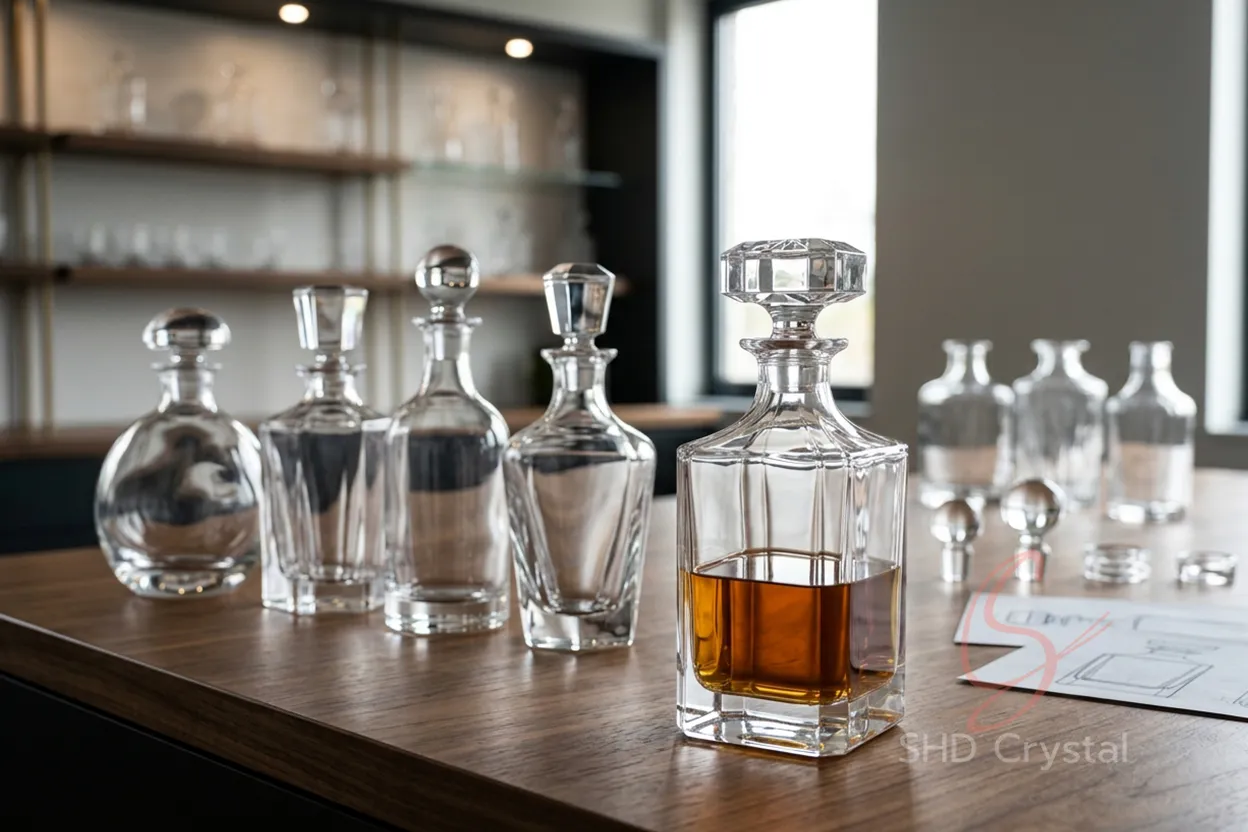
At SHD Crystal, we have found that decanter projects often improve significantly once several complete physical samples are reviewed together.
One sample may establish the intended silhouette, while comparison between several pieces can reveal differences in stopper fit, base weight, cutting depth, polishing, or overall balance. In some projects, only a small adjustment is needed—such as refining the base proportion, modifying a stopper dimension, or simplifying a cutting area—to make the design easier to reproduce.
Our work in decanter design and manufacturing includes structure review, sampling, stopper coordination, glass forming, cutting and polishing evaluation, inspection planning, and production preparation. For custom whiskey decanters and broader spirits packaging development, these early physical reviews help turn an attractive concept into a more stable production-ready product.

