


Engraved crystal glassware is valued because it turns a clear vessel into a decorative object with depth, texture, and controlled light reflection. Unlike printed patterns or simple surface decoration, glass engraving changes the physical surface of the vessel. The pattern is cut, carved, or polished into the glass itself, creating a more permanent and dimensional visual effect.
For decorative tableware, gift collections, hospitality glassware, and custom vessel projects, engraving can make a product feel more refined and collectible. However, this craft also requires careful control. Pattern depth, glass thickness, tool selection, and finishing quality all affect the final appearance and production feasibility.
How Engraved Crystal Glassware Is Made Through Decorative Cutting
Engraved crystal glassware is usually created by removing small amounts of glass from the surface through cutting, carving, grinding, or polishing. The goal is not only to draw a pattern, but to shape how the glass catches light. When the engraved area is matte, frosted, or faceted, it creates contrast against the clear body of the vessel.
This is why engraved decoration often appears more elegant than flat printing. A floral motif, geometric border, brand emblem, or relief-style figure can change as the glass moves under light. The effect is especially visible on crystal vessels because the material has good clarity and refraction.
In custom projects, the first step is usually pattern evaluation. A design that looks beautiful on paper may not work well on curved glass. Very thin lines may disappear after polishing, while overly deep carving may weaken a thin wall. For this reason, engraving should be developed with both visual design and vessel structure in mind.
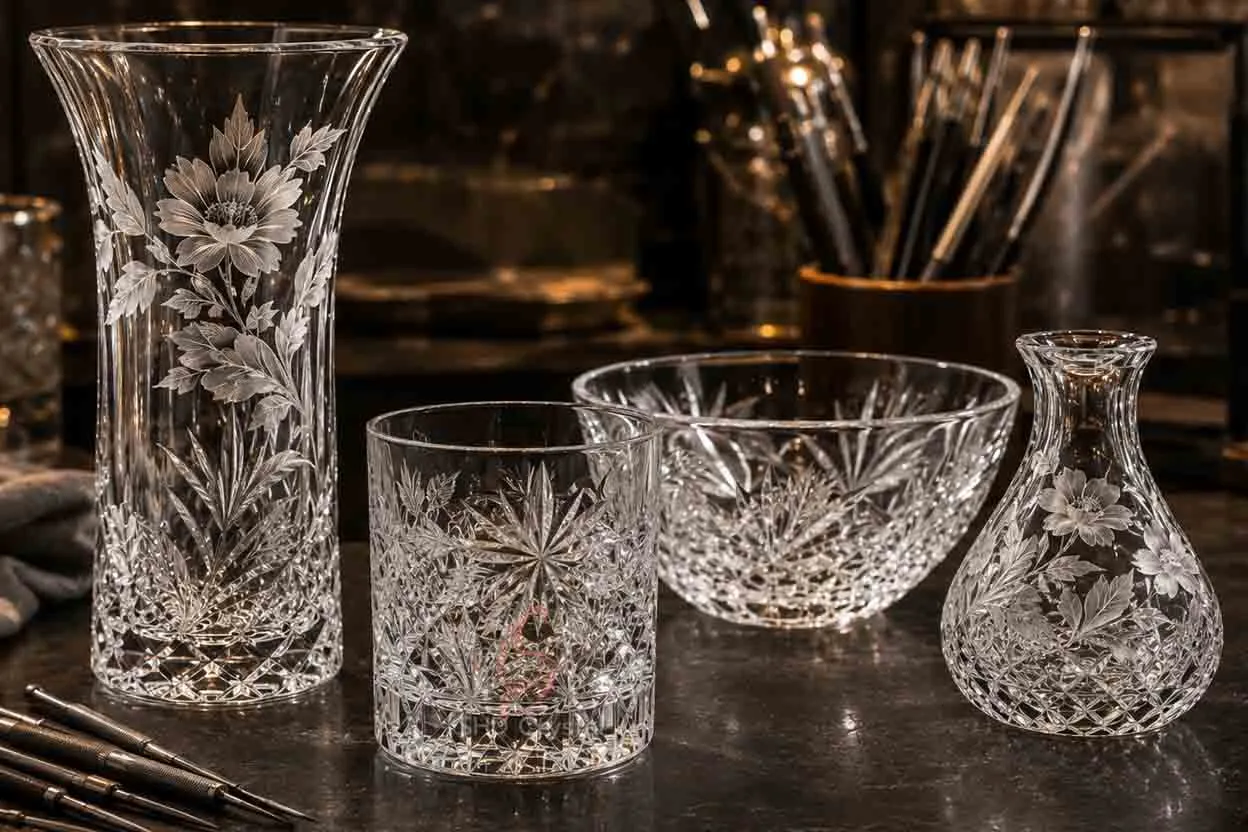
Hand-Carved Glass and Its Decorative Value
Hand-carved glass is often associated with traditional craftsmanship and premium decorative objects. Compared with fully automated surface decoration, hand carving gives the product a more artistic and layered feeling. Small variations in line pressure, edge softness, and polishing direction can make each piece feel less mechanical.
For luxury tableware or commemorative items, hand-carved glass can be used to create patterns such as flowers, leaves, crests, animals, architectural lines, or ornamental borders. These designs are commonly applied to vases, bowls, decanters, stemware, and decorative vessels.
The value of hand-carved glass is not only in the finished pattern. It also comes from the judgment required during production. The craftsman needs to understand where the vessel is thick enough for carving, how deep the relief should be, and which areas should remain smooth for balance. If too much material is removed, the design may look heavy or unsafe. If the carving is too shallow, the pattern may lose visual presence.
The Role of Vessel Relief Tools in Glass Engraving
Vessel relief tools are important for shaping raised, recessed, or layered decorative effects on curved glass surfaces. In glass engraving, these tools may include different grinding wheels, carving points, polishing wheels, and fine finishing tools. Each tool creates a different surface texture and line quality.
For example, a wider wheel can create broad decorative cuts, while a fine point can define small details. A polishing tool can soften sharp marks and improve light reflection. In relief-style decoration, Vessel relief tools help control the transition between deep and shallow areas, allowing the pattern to look more dimensional.
This is especially important for vessels with curved bodies. A flat design cannot simply be transferred onto a rounded vase or drinking glass without adjustment. The engraving direction, pattern spacing, and tool angle must follow the form of the vessel. Good tool control allows the pattern to look natural instead of stretched or uneven.
Common Applications for Engraved Glass Vessels
Engraving can be used across many types of glassware. In drinkware, it may appear as a logo, border pattern, monogram, or subtle decorative texture. In vases and bowls, deeper carving can create floral or relief-inspired decoration. In decanters and display vessels, engraving often adds a stronger sense of craftsmanship and premium positioning.
For hospitality brands, engraved crystal glassware can support a more memorable table presentation. A hotel may use engraved tumblers or wine glasses for a signature dining room. A gift brand may choose engraved decanters for a luxury collection. An event supplier may use engraved vessels for awards, wedding sets, or limited seasonal programs.
However, buyers should avoid treating engraving as a universal solution for every product. Not every glass shape is suitable for deep carving. Thin walls, narrow curves, small handles, or complex molded details may limit the available engraving area. Before confirming a design, the supplier should review the vessel structure and recommend a practical decoration method.
In a recent decorative vessel project, the buyer wanted a carved floral pattern on a clear crystal vase. The original design had very fine petals and narrow stems, but the vessel surface was slightly curved. During the development review, SHD Crystal found that some lines would become too weak after carving and polishing. If the original artwork had been used directly, the finished pattern would have looked unclear from a normal viewing distance. The solution was to simplify the smallest details, adjust the spacing between floral elements, and keep the main leaves slightly deeper than the background lines. Sample review also focused on rim safety, wall thickness, pattern continuity, and packaging protection. Because the carved areas changed how the glass reflected light, the buyer evaluated the sample under both warm display lighting and natural daylight.
This type of project shows why engraved crystal glassware requires more than decoration skill. It requires communication between design, production, inspection, and packaging teams. A successful engraved vessel should look refined, remain structurally practical, and arrive safely after transport.

Quality Factors Buyers Should Check
-Pattern clarity. The engraved design should be recognizable without appearing rough or overcut. Lines should feel intentional, and repeated patterns should remain consistent around the vessel.
-Surface finishing. After carving, the engraved area may need polishing, frosting, or controlled matte treatment. Poor finishing can leave uneven marks, sharp edges, or cloudy patches.
-Vessel strength. Engraving removes material, so deep carving should not be placed in structurally weak areas. This is especially important for drinking glasses, thin vases, and vessels designed for regular handling.
-Batch consistency. For commercial orders, one beautiful sample is not enough. The supplier should consider whether the engraving effect can be repeated across production quantities. This is where tool control, inspection standards, and process documentation become important.
FAQ
Q1: Is engraved glassware more durable than printed glassware?
Engraving is physically cut into the glass surface, so the decoration itself does not peel like some surface-applied printing. However, durability still depends on glass thickness, carving depth, finishing quality, and how the vessel is used.
Q2: Can every crystal vessel be engraved?
Not every vessel is suitable for engraving. The glass must have enough usable surface area and proper wall thickness. Very thin, highly curved, or structurally complex items may require pattern adjustment before production.
Q3: What information should buyers provide for an engraved glassware project?
Buyers should provide the vessel type, target size, artwork style, engraving area, expected quantity, packaging needs, and final use scenario. For projects involving hand-carved glass or Vessel relief tools, reference images and sample expectations are especially helpful.
Conclusion
Engraved crystal glassware combines decorative design with controlled glass removal, making it suitable for premium tableware, hospitality collections, gift items, and custom vessel programs. The best results come from matching the artwork with the vessel shape, selecting suitable carving depth, and reviewing the finishing process carefully.
For brands developing engraved crystal glassware, SHD Crystal can support design evaluation, sample development, process review, inspection, and packaging coordination to help turn decorative concepts into practical custom glassware projects.

