


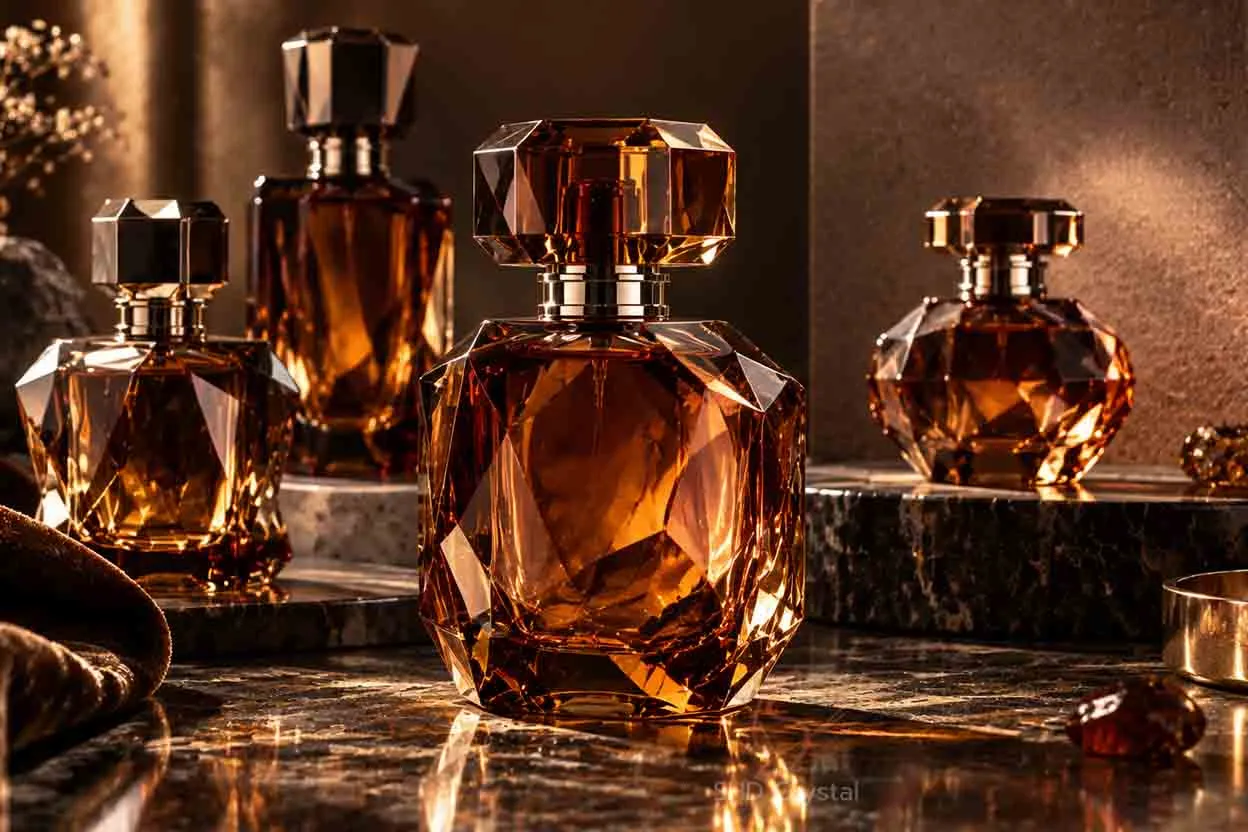
Faceted amber perfume bottles are chosen when a fragrance line needs more than a standard clear container. The amber tone brings warmth and depth, while the faceted body gives the bottle a more sculptural presence under light. For premium perfume projects, that combination can make the package feel more distinctive before the customer even tries the fragrance.
At the same time, a beautiful bottle still has to work as a real packaging product. Shape, wall thickness, neck finish, cap matching, surface clarity, and production consistency all matter when the design moves from concept to sampling and larger orders.
Faceted Amber Perfume Bottles Rely On Both Color And Structure
Color alone does not create the full effect. The faceted surface changes how the amber glass is seen from different angles. Under direct light, the cut planes can create sharper reflections and make the bottle feel more jewel-like. In softer lighting, the same bottle may look deeper, calmer, and more luxurious.
This is one reason faceted amber perfume bottles are often used for fragrance collections with a stronger decorative identity. They feel richer than a simple round bottle, but they also remain more structured than heavily ornamental designs.
A cut glass perfume bottle needs that balance. If the facets are too shallow, the bottle may lose character. If they are too deep or too busy, the shape can become visually heavy and harder to produce consistently.
Faceted Design Changes The Look Of Amber Glass
Amber glass does not appear the same on every bottle. Thickness, shoulder angle, base weight, and facet depth all influence how dark or bright the color looks. A heavier base may make the lower section appear deeper in tone. Narrow side panels may reflect more sharply. Larger flat surfaces can show a calmer, more even amber color.
For amber fragrance packaging, this matters because the visual effect is created by the interaction between color and geometry, not by color alone.
That is why sample review is important. A drawing may define the bottle shape, but only a physical sample shows how the amber tone and faceted surfaces work together in real light.
Cutting And Surface Definition Need Production Control
A cut glass perfume bottle is more sensitive to detail than a smooth bottle. Clean facet definition, polished transitions, and stable surface quality all influence the finished impression. During development, attention usually goes to:
-facet sharpness;
-symmetry across the body;
-wall thickness transition;
-base balance;
-and surface clarity after finishing.
If one area becomes too thick or too soft, the bottle can lose the crisp look that makes faceted perfume packaging attractive in the first place. For faceted amber perfume bottles, the goal is not only to create a decorative surface, but to keep the whole bottle visually balanced from the front, side, and base views.
Perfume Use Still Depends On Functional Details
Even a highly decorative fragrance bottle remains a packaging container. The neck finish has to match the pump or stopper. The shoulder should allow clean assembly. The bottle opening, spray fitting, and cap alignment all need to work properly.
This is where many attractive concepts need refinement. A bottle may look premium in a rendering, but real sampling may show that the neck proportion needs adjustment, the cap feels too small for the body, or the glass weight becomes excessive for the intended size.
For amber fragrance packaging, appearance and function should be reviewed together rather than separately.
Packaging Style Should Match The Fragrance Positioning
A faceted amber bottle usually suggests a more mature, warm, or luxurious fragrance direction. It works especially well for oriental perfumes, woody scents, vintage-inspired collections, evening fragrances, or gift-focused lines.
Compared with a minimalist clear bottle, faceted amber perfume bottles feel more expressive. Compared with very ornate decorative bottles, they can still remain commercially practical when the geometry is controlled well.
In actual project planning, the bottle often becomes part of a larger presentation system that includes the cap finish, outer box, and visual identity. A warm amber bottle paired with a matte black cap, metallic collar, or textured carton can create a more complete premium look.
Consistency Matters In Repeat Production
A fragrance bottle should not look excellent only in the first approved sample. Color depth, facet definition, base weight, surface finish, and neck accuracy should remain stable across the production run.
For a cut glass perfume bottle, small variations can become easier to notice because the faceted surface catches light so strongly. Slight differences in polishing or wall thickness may change how the reflections appear.
This is why production review should include multiple samples together rather than one individual piece.
Conclusion
Faceted amber perfume bottles combine warm color, sculptural geometry, and fragrance presentation in a way that feels both decorative and commercially useful. Their success depends on more than amber glass alone. Shape proportion, facet definition, closure compatibility, and batch consistency all influence whether the bottle can move from a strong concept into reliable fragrance packaging.
Developing Faceted Fragrance Bottles With SHD Crystal
At SHD Crystal, we support fragrance projects that involve faceted amber perfume bottles, cut glass perfume bottle development, and broader amber fragrance packaging direction. From shape review and sampling to finishing coordination, component matching, and production control, the aim is to help the bottle keep its intended character while remaining practical for real packaging use.

