


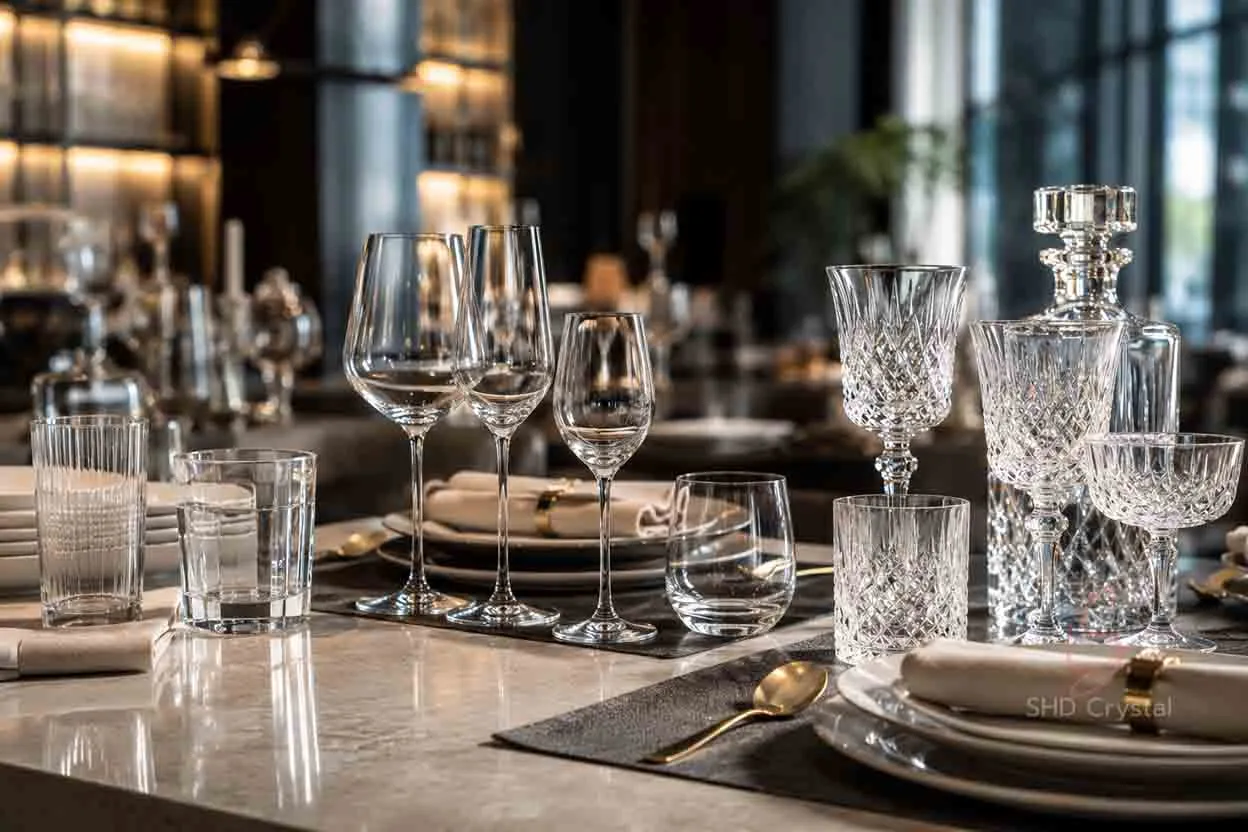
food and beverage glassware purchasing becomes easier when buyers stop asking which material is "best" and start asking what the tableware will experience every day. A hotel breakfast room, high-volume restaurant, cocktail bar, banquet hall, and fine-dining venue create very different demands. Mechanical impact, commercial washing, temperature change, replacement frequency, presentation, and food-contact requirements all influence the right choice.
Food and Beverage Glassware Procurement Starts With Service Pressure, Not Prestige
In busy catering environments, glassware is picked up, stacked, washed, transported, and returned to service repeatedly. That explains why tempered dinnerware has a visible presence in institutional catering, cafeterias, restaurants, and other intensive-use programs.
Tempering places the glass through an additional controlled treatment that improves resistance to mechanical and thermal stresses. Current professional foodservice collections use fully tempered glass specifically for intensive service, thermal variation, repeated washing, and higher resistance to impact.[1]
That does not make the product unbreakable.
This is an important procurement distinction. Tempering can make suitable glassware more resilient and can change its breakage behavior, but chips, severe impacts, accumulated surface damage, or misuse can still cause failure. A professional buyer should therefore consider replacement practices and inspection routines alongside material selection. Where Tempered Glass Earns Its Place. For operations serving hundreds of meals each day, tempered dinnerware can be particularly practical for drinking glasses, plates, bowls, tumblers, and other frequently handled pieces.
The advantage is operational rather than glamorous.
High-volume restaurants need pieces that survive repeated service cycles. Hotel breakfast programs need tableware that moves efficiently between dining rooms and dishwashing areas. Institutional catering often values stackability and replacement efficiency more than delicate optical effects.
Thermal-shock performance can also be tested rather than assumed. EN 1183 remains a current European test standard covering thermal shock and thermal-shock endurance for brittle food-contact materials including glass tableware.[2]For procurement teams, a supplier statement such as "strong glass" is therefore less useful than knowing what treatment, testing, and intended service conditions sit behind the claim.
Ordinary Glass Still Has a Job
Non-tempered glass should not be treated as an inferior leftover category. Many forms of food and beverage glassware benefit from conventional annealed production because it provides broad freedom in shape, wall thickness, cutting, decoration, stem geometry, and optical presentation. Wine glasses, cocktail stems, decorative serving pieces, specialty bowls, and highly customized tableware may prioritize these qualities over maximum resistance to intensive handling.
A casual dining chain may value durability first. A cocktail bar may accept more delicate stemware because bowl geometry and drinking experience matter more. A luxury restaurant may deliberately mix durable service pieces with premium glass tableware at specific touchpoints.
Premium Tableware Changes the Procurement Question
Once the purchasing goal moves from operational efficiency to atmosphere, gifting, fine dining, or luxury beverage presentation, optical clarity, weight, rim quality, cutting, and refraction become more important. This is where crystal enters the discussion.
Traditional lead crystal can provide density, brilliance, and cutting characteristics associated with classic luxury glassware. EU crystal-glass legislation recognizes specific lead-crystal categories, including classifications based on lead oxide content and physical properties.[3]
Yet the word "crystal" should never replace a food-safety review.
For premium glass tableware intended to contact beverages or food, buyers need to distinguish among traditional lead crystal, lead-free crystal, and high-quality clear glass. The appropriate choice depends on the product, destination market, intended contact conditions, and verified compliance documentation.
Lead Crystal Requires a Compliance Conversation
This point is especially important for hospitality procurement.
The 2022 FDA Food Code states that crystal utensils used in contact with food must either be lead-free or comply with specified limits for lead release, depending on the utensil category.[4] In the European Union, all food-contact materials must meet the general safety principles of Regulation (EC) No 1935/2004, including the requirement that constituents must not transfer into food at levels that could endanger health.[5]The European Commission is also working on revised rules for ceramic and vitreous food-contact materials, explicitly including glass and crystal, with the objective of lowering migration limits for lead and cadmium and introducing limits for additional metals.[6]This does not mean that compliant lead crystal has disappeared from hospitality use. It means that food and beverage glassware buyers should not purchase traditional lead crystal on reputation alone. Material declarations, intended-use information, relevant migration testing, and destination-market requirements should be verified before procurement.
For some programs, certified lead crystal may still fit a carefully controlled premium service concept. For others, lead-free crystal or refined soda-lime glass can deliver the required brilliance and tactile quality with a simpler material-positioning strategy.
Premium Does Not Need to Mean Fragile
One of the more useful changes in contemporary sourcing is the space between utilitarian glass and traditional crystal. Improved forming accuracy, clearer glass compositions, polished rims, heavier bases, controlled facets, and better surface finishing can give ordinary glass materials a much stronger visual presence than buyers may expect.
As a result, premium glass tableware can be specified by the experience it needs to deliver rather than by one prestigious material name.
A restaurant may choose tempered tumblers for water service, finer wine glasses for beverage presentation, and crystal or crystal-like serving pieces for signature moments. That mixed approach often makes more operational sense than forcing every item into the same material category.
Conclusion
food and beverage glassware procurement is ultimately a balance between service pressure and presentation. Tempered glass has strong relevance in high-frequency catering because durability and operational efficiency matter. Conventional glass provides greater freedom for many decorative and specialty forms. At the premium end, crystal can add weight and optical character, but lead-containing materials require a more careful food-contact and regulatory review. The strongest specification is the one that matches each piece of tableware to its actual job.
Building a More Practical Hospitality Glassware Program
For hospitality buyers developing food and beverage glassware, SHD Crystal can support material selection, forming, tempering options where appropriate, crystal and clear-glass development, polishing, decoration, inspection, and custom production. Comparing service frequency, breakage exposure, visual positioning, and applicable compliance requirements early can help buyers combine tempered dinnerware and premium glass tableware within a more practical commercial collection.
Reference Notes
[1] Arcoroc, Tempered Glass for Professional Foodservice. Current professional product information describes fully tempered glassware as designed for mechanical and thermal resistance, intensive professional use, and commercial washing cycles.
[2] EN 1183:1997, Materials and Articles in Contact With Foodstuffs - Test Methods for Thermal Shock and Thermal Shock Endurance. The standard remains current and covers glass, glass-ceramics, ceramics, and other brittle tableware materials.
[3] Council Directive 69/493/EEC Relating to Crystal Glass. The Directive establishes categories and compositional or physical criteria for crystal glass, including traditional lead-crystal classifications.
[4] U.S. Food and Drug Administration, 2022 Food Code, Section 4-101.13. Crystal utensils used in contact with food must be lead-free or meet the applicable limits specified by the Food Code.
[5] European Commission, Food Contact Materials. Regulation (EC) No 1935/2004 provides the general EU safety framework for materials and articles intended to contact food.
[6] European Commission, Revision of EU Rules on Food Contact Materials. Current work includes vitreous materials such as glass and crystal and proposes lower migration limits for lead and cadmium together with limits for additional metals.

