


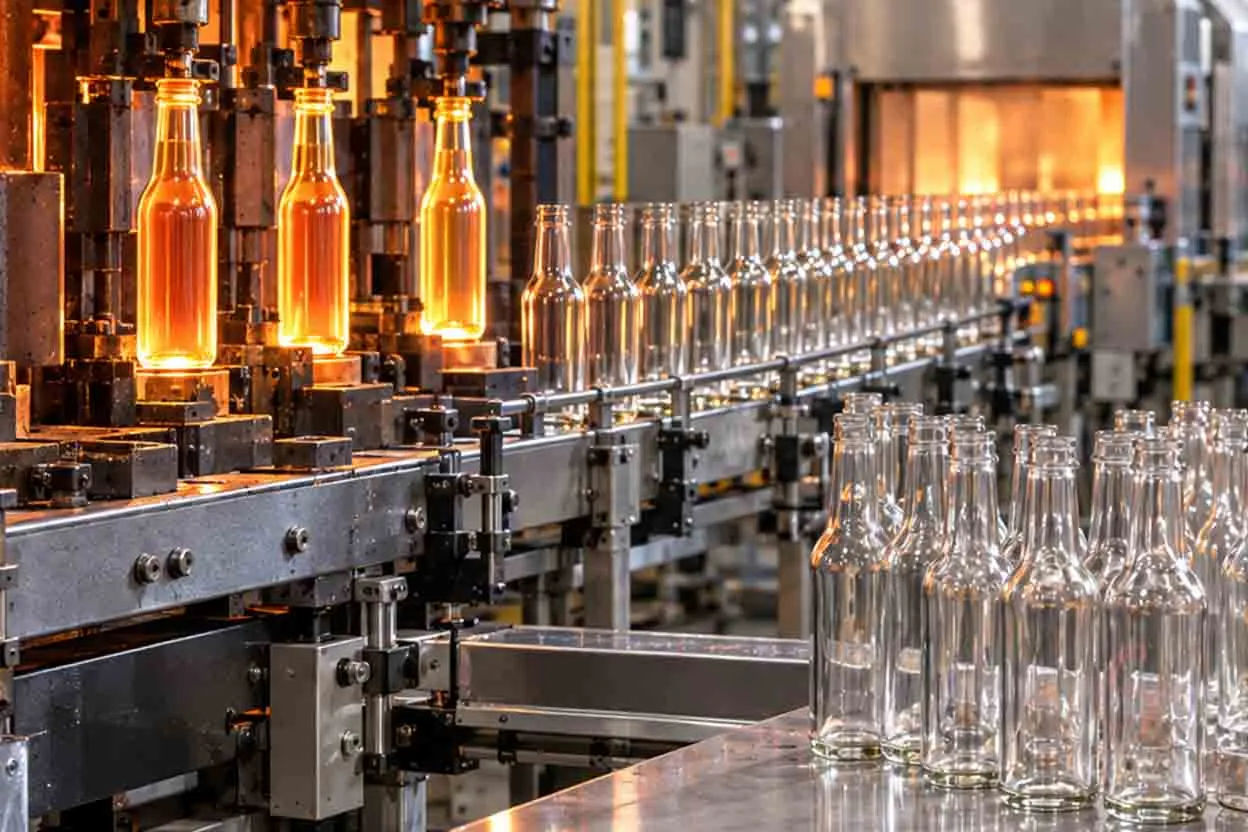
The glass bottle manufacturing process for hot sauce packaging is built around repeatability. A sauce bottle needs a stable body, controlled neck dimensions, consistent glass distribution, and a base that can move reliably through filling, capping, labeling, packing, and transport. Although hot sauce bottles can vary in shape and capacity, high-volume production depends on keeping these structural details consistent across the full run.
At SHD Crystal, we look at hot sauce glass bottles primarily as production containers. Their appearance matters, but automated forming, annealing, neck accuracy, and batch stability are what allow the bottle to work efficiently in a commercial food packaging line.
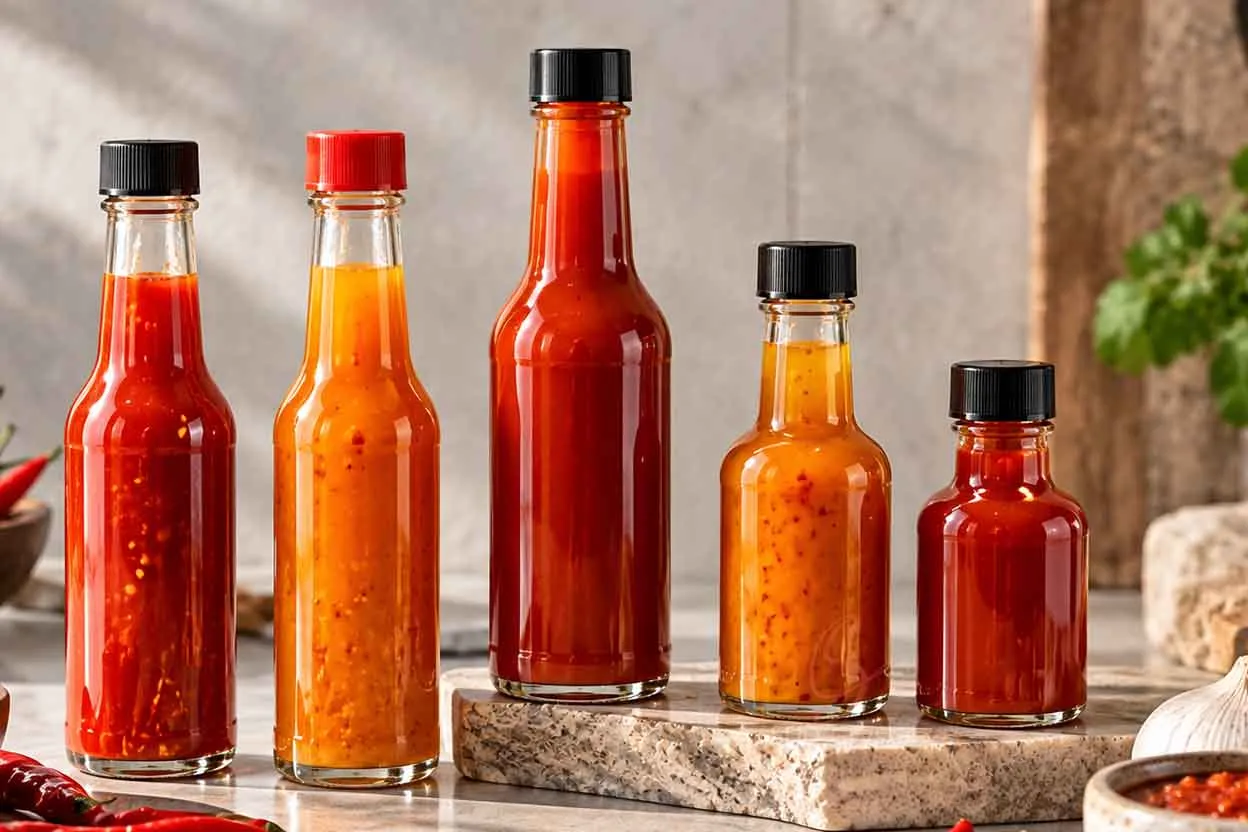
Glass Bottle Manufacturing Process Begins With Controlled Forming
In automated production, molten glass is divided into controlled gobs and delivered into forming molds. The amount of glass, temperature, mold condition, and forming timing all influence the final bottle. For hot sauce glass bottles, this stage determines the basic geometry of the body, shoulder, neck, and base.
A tall narrow sauce bottle needs different glass distribution from a short wide container. If too much material collects in the base, the bottle becomes unnecessarily heavy. If the shoulder or neck receives too little material, dimensional stability can become harder to maintain. The goal is not simply to make the bottle take shape. It is to make that shape repeatable.
Automatic Glass Bottle Production Depends on Stable Mold Cycles
Once the forming conditions are established, automatic glass bottle production allows the same bottle geometry to be reproduced continuously.
Stable mold cycles help control:
l bottle height;
l body diameter;
l neck finish;
l base structure;
l shoulder transition;
l and overall glass distribution.
These dimensions become especially important for sauce bottles because the finished container may need to run through automated filling and capping equipment.
A small variation in the neck finish can affect closure application. A bottle that is slightly unstable at the base may also create problems later on a conveyor.
For high-volume production, dimensional consistency is therefore more important than producing one visually perfect sample.
Neck Finish Matters for Filling and Closure Application
The neck is one of the most functional areas of hot sauce glass bottles. Depending on the packaging system, the bottle may use screw caps, reducer inserts, dispensing closures, or other components. Each requires the neck dimensions to remain within the intended range.

During the glass bottle manufacturing process, mold condition and forming control influence the diameter, thread definition, opening, and alignment of this area. We therefore review the neck as part of the complete production system rather than as a decorative detail. A good bottle should move from forming to filling and closure application without creating unnecessary adjustment later.
Glass Distribution Affects Weight and Cooling
Sauce bottles are often designed with relatively simple walls, but thickness distribution still matters. In automatic glass bottle production, stable material distribution helps prevent one area from becoming excessively heavy while another becomes comparatively thin. This affects bottle weight, cooling behavior, and production consistency.
A long neck, narrow shoulder, and thicker base may all cool at different rates. The bottle therefore needs a forming structure that can move into annealing without excessive internal stress.
Annealing Follows the Forming Stage
Freshly formed glass remains hot and carries temperature differences throughout the bottle. Controlled annealing allows it to cool gradually. This helps reduce internal stress created during forming and supports more stable glass structure.
For the glass bottle manufacturing process, forming speed and annealing cannot be treated separately. Faster output only makes sense when the cooling stage can handle the same production rhythm. With hot sauce glass bottles, this becomes particularly important when long-neck or heavier-base designs are produced continuously.
Inspection Confirms Whether Production Remains Stable
Automated manufacturing still requires inspection. Bottle height, neck finish, base flatness, visible surface condition, body geometry, and general dimensional stability should be checked throughout production rather than only at the beginning. In automatic glass bottle production, representative samples from different stages of a run can reveal whether mold wear or forming conditions are beginning to change.
For sauce packaging, inspection can also focus on whether bottles remain suitable for later filling, capping, labeling, and carton packing. The final objective is repeatability across thousands of bottles, not one exceptional piece.
Conclusion
The glass bottle manufacturing process for hot sauce containers depends on controlled forming, stable mold cycles, neck accuracy, glass distribution, annealing, and inspection.
For hot sauce glass bottles, these production details directly influence how smoothly the container can move through later filling and packaging operations. Well-managed automatic glass bottle production makes it possible to maintain consistent bottle geometry across large runs while keeping the product practical for commercial sauce packaging.
Automatic Bottle Production at SHD Crystal
At SHD Crystal, the glass bottle manufacturing process can support stable production of hot sauce glass bottles and other food container formats through mold coordination, forming control, annealing, dimensional inspection, and packing preparation. For projects based on automatic glass bottle production, we focus on whether the approved bottle structure can remain repeatable throughout extended production rather than evaluating only the appearance of individual samples.

