


We occasionally receive an inquiry asking whether we can help "package glass." It is an understandable question, but it can mean two very different things.
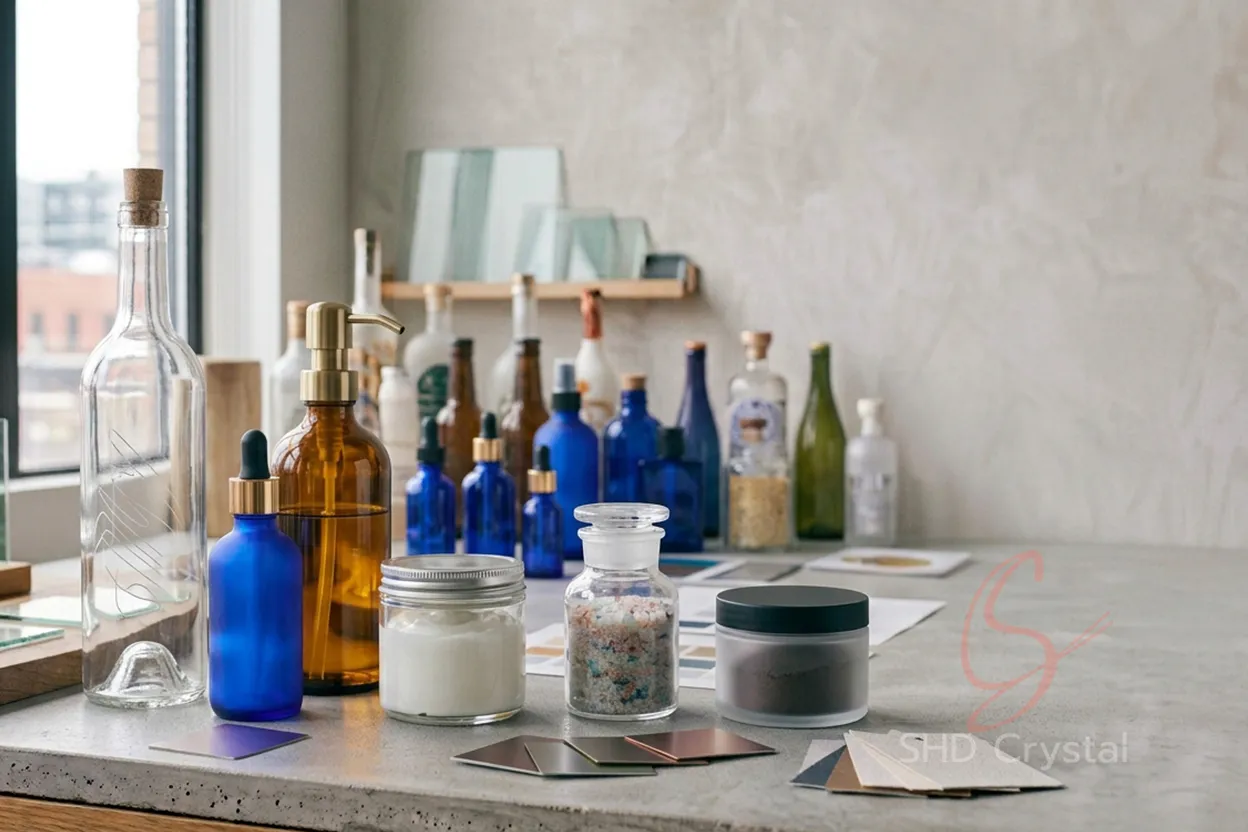
Glass Bottle Packaging Supplier for Custom OEM Projects
We occasionally receive an inquiry asking whether we can help "package glass." It is an understandable question, but it can mean two very different things.
At SHD Crystal, when we talk about glass packaging, we are usually not talking about wrapping finished glassware in cartons, wooden cases, or pallets. We mean something more fundamental: the glass itself becomes the package. A bottle holds fragrance or beverage. A jar contains cream, sauce, powder, or another solid or semi-solid product. The glass container protects, presents, stores, and helps dispense what the customer actually sells. That is the starting point of our work as a glass bottle packaging supplier. For us, packaging development begins with the product inside the glass, not with the shipping carton outside it.
Glass Bottle Packaging Supplier Projects Start With What the Glass Must Contain
Before discussing shape, color, or decoration, we usually ask a simpler question:
What is going into the container?
That answer changes almost everything.
A fragrance bottle may need a precise neck for pump assembly and a heavier base for presentation. A skincare bottle may need to work with a lotion pump, dropper, or screw closure. A sauce or beverage bottle has different filling, opening, pouring, and sealing requirements. A glass jar for cream, powder, food, or candles needs its own relationship between opening diameter, wall structure, base design, and closure. This is why custom glass bottle packaging cannot be reduced to choosing an attractive bottle from a catalog.
The glass body is part of a complete packaging system. Capacity, neck finish, opening size, closure engagement, wall distribution, base stability, and intended filling method need to support the actual product.
Some Containers Belong on an Automated Line. Others Need More Hands-On Work.
Not every glass project should follow exactly the same production route. For relatively standardized bottles and jars that require repeatability across larger production quantities, automated forming can provide an efficient route. Mold condition, forming stability, glass distribution, dimensional control, and annealing all contribute to keeping the container consistent from batch to batch.
This is particularly useful for projects such as beverage bottles, food containers, cosmetic bottles, and other molded glass packaging where customers need stable dimensions and repeat production.
Other projects are different.
A thick, highly decorative bottle, an unusual vessel profile, a premium container with more complex finishing, or an early-stage custom concept may require more manual involvement during forming, refinement, polishing, decoration, or sample development.
At SHD Crystal, we do not treat automated production and more hands-on production as competing ideas. They are different tools. The appropriate route depends on the design, quantity, structure, finishing expectations, and what the finished container is supposed to achieve. That flexibility is an important part of our glass bottle OEM solutions.
A Bottle Shape Is Only the Beginning of Customization
Customers often arrive with a silhouette in mind, but a real project quickly becomes more detailed. The bottle may need a specific glass color. The brand may want embossing in the mold rather than a printed logo. Frosting may soften the appearance. Printing or coating may create stronger visual contrast. A heavy base may improve presentation, while a lighter structure may be more practical for repeated handling.
For custom glass bottle packaging, we usually look at these elements together rather than selecting them one by one.
A beautiful bottle shape can create problems if the printable area is too curved. A visually elegant neck can become impractical if it does not match the selected pump or cap. A heavy base may look premium in a rendering but feel excessive once the bottle is filled.
Customization is therefore not about adding as many special features as possible. It is about choosing the details that still make sense once glass manufacturing and product use enter the picture.
The Closure Tells Us Whether the Package Is Really Complete
One of the fastest ways to understand whether a glass container is ready for use is to stop looking at the bottle alone.
Put the closure on it. A pump, dropper, stopper, screw cap, lid, or dispensing component immediately turns the bottle or jar from a glass object into functional packaging.
In our projects, we pay close attention to the relationship between the glass opening and the selected component. Neck dimensions, sealing surfaces, engagement depth, pipette length, pump fit, or stopper position may all affect the finished package.
This is where glass bottle OEM solutions become more practical than simply reproducing a bottle shape. The bottle and closure need to be reviewed as one system.
We have seen samples where the glass itself looked correct, but the pump sat slightly too high. In other cases, a jar opening looked refined in the drawing but felt less convenient once the intended cream or solid product was tested. These are small findings, but they are exactly what sample development is meant to reveal.
The First Sample Usually Changes the Conversation
Drawings are useful. Renderings are useful. Reference bottles are useful. But a physical sample usually tells us something the earlier stages did not.
Sometimes it is the weight. Sometimes it is the way the shoulder catches light. Sometimes the closure feels visually too large for the neck. Sometimes frosting makes a bottle appear softer than expected, or a thick base changes the apparent glass color.
We do not see these revisions as a failure of the original design. They are part of turning a concept into custom glass bottle packaging that can actually be filled, closed, handled, decorated, and reproduced. A good sample review often results in several small corrections rather than one dramatic redesign. That is usually a positive sign.
From One Bottle to a Repeatable Packaging Family
Many customers are not really developing one bottle. They are developing a line. A fragrance collection may need several capacities. A skincare brand may want bottles and jars that share one visual language. A beverage range may use related shapes with different closures or decoration. When this happens, the individual container has to work as part of a broader family.
Proportion, glass color, surface finishing, closure style, embossing, and decoration position should remain coordinated even when sizes change. Repeat production also needs clear references so later batches do not gradually drift away from the approved appearance.
As a glass bottle packaging supplier, we therefore look beyond the first successful sample. We also consider whether the project can remain recognizable and manufacturable when it expands.
Conclusion
A glass bottle packaging supplier does not simply supply glass that later needs to be "packaged." The bottle or jar is already the primary package: it holds the liquid or solid product, works with the closure, supports filling and dispensing, and carries much of the brand's visual identity.
At SHD Crystal, custom glass bottle packaging may involve automated forming, more hands-on production, mold development, bottle and jar customization, closure coordination, surface finishing, sampling, inspection, and repeat production.
Our approach to glass bottle OEM solutions starts with a simple idea: first understand what the glass needs to contain and how the finished package will be used. Once that is clear, shape, production method, decoration, and manufacturing control can follow with much more purpose.
Developing Glass Packaging With SHD Crystal
For brands developing fragrance, skincare, beverage, food, wellness, or other products, SHD Crystal supports custom glass bottle packaging in the form of bottles, jars, and related glass containers designed around the product inside them.
As a glass bottle packaging supplier, we can work from an existing reference or begin with a more customized concept, then coordinate mold development, automated or hands-on production routes, closures, finishing, and sample evaluation. These glass bottle OEM solutions are built around the glass container as the package itself—not around the carton that eventually carries it.

