


Essential oils are usually packaged in relatively small containers, but that does not make the packaging simple. Bottle color, neck finish, closure choice, dispensing method, and product characteristics can all influence how the finished package performs. When we develop glass bottles for essential oils, we therefore look beyond the bottle shape and consider how the glass container will work with the oil, closure, filling process, and intended market.
Glass Bottles for Essential Oils and Custom Packaging
Essential oils are usually packaged in relatively small containers, but that does not make the packaging simple. Bottle color, neck finish, closure choice, dispensing method, and product characteristics can all influence how the finished package performs. When we develop glass bottles for essential oils, we therefore look beyond the bottle shape and consider how the glass container will work with the oil, closure, filling process, and intended market.
For brands developing custom essential oil bottles, this early review is especially important. A bottle may look attractive on its own but still need adjustment if the dropper does not fit correctly, the reducer does not dispense smoothly, or the chosen glass color does not support the intended product positioning.
Glass Bottles for Essential Oils Need Product and Closure Requirements to Work Together
We usually begin by understanding what the bottle will hold and how the product is expected to be used:
Essential oil packaging may use droppers, orifice reducers, screw caps, tamper-evident closures, or other dispensing components. Each option creates different requirements around the bottle opening and neck finish. For a dropper bottle, for example, the pipette length should suit the bottle height, while the closure and bottle neck need to engage consistently. For a reducer system, the opening and insert need to work together so the product can be dispensed without making normal use unnecessarily difficult.
This is why we do not treat the closure as an accessory selected after the glass bottle is finished. In practical essential oil packaging solutions, the bottle and closure should be reviewed as one functional system.
Glass Color Should Match Both Product Needs and Brand Positioning
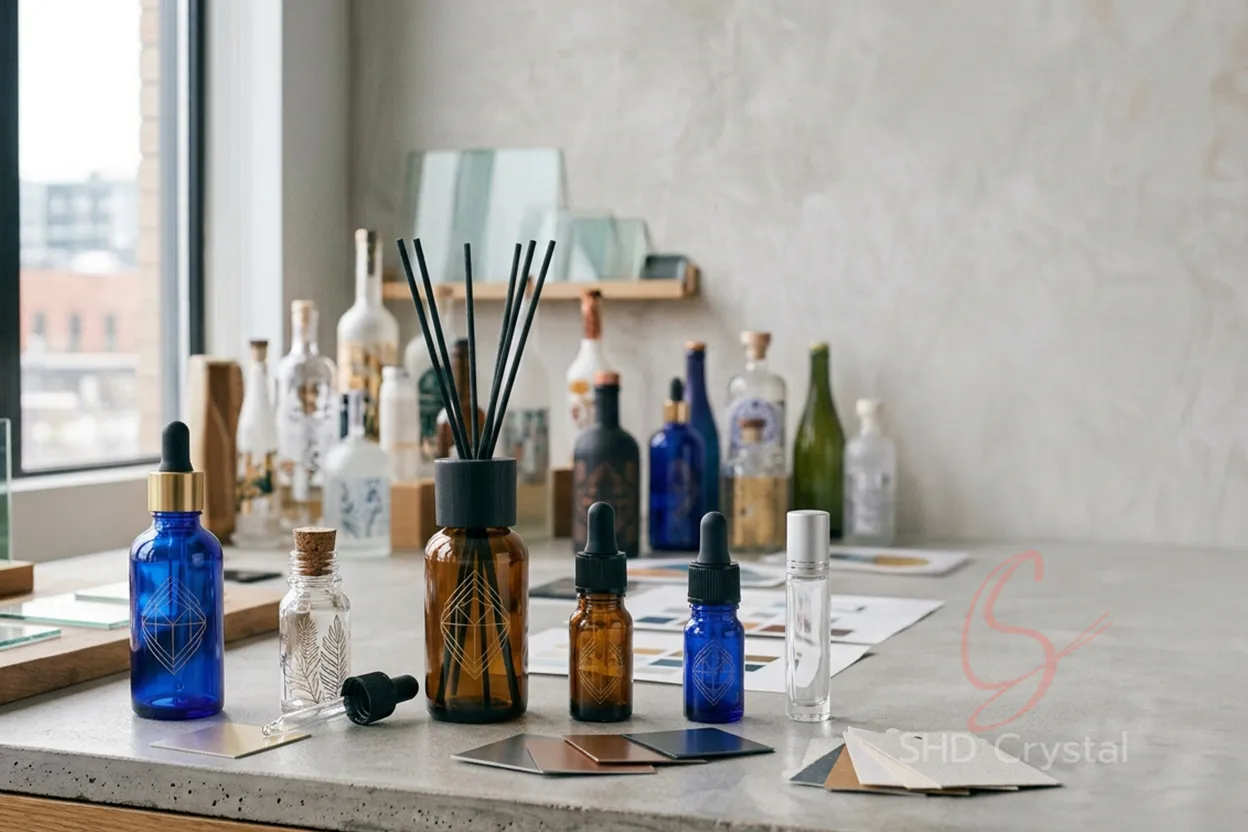
Amber, cobalt blue, green, and clear glass can all create different packaging impressions. Amber glass is commonly selected when reducing light exposure is an important part of the packaging strategy. Cobalt blue can provide a distinctive wellness or aromatherapy appearance, while green glass may support botanical or natural positioning. Clear glass can make the product more visible, but it may not be the preferred choice when light exposure is a particular concern.
We avoid treating color as a universal technical solution. The appropriate option still depends on the actual formulation, storage conditions, closure system, and product requirements.
For custom essential oil bottles, color is therefore both a functional and visual decision. Brands may use one glass tone across an entire collection to create stronger recognition, while different bottle sizes or closure finishes distinguish individual products.
Small Bottle Sizes Make Dimensional Details More Noticeable
Many essential oil bottles are compact, which means small dimensional differences can become more important. The relationship between bottle height, neck diameter, shoulder transition, and base stability can affect both filling and handling. A small change around the neck may influence closure fitting, while changes in body proportions can affect the usable label or printing area.
We also pay attention to wall distribution and bottle balance. A small bottle should still sit steadily during filling, labeling, packing, and everyday use.
For this reason, glass bottles for essential oils should not be approved only from drawings or product photographs. A physical sample provides much more useful information about proportion, hand feel, closure fit, and overall presentation.
Project Experience Shows Why the Actual Formula Matters
In practical projects, we often find that the first useful questions appear only after the bottle, closure, and actual product are tested together.
A dropper may look suitable but dispense the formula more slowly than expected. A reducer may work well with a relatively fluid oil but behave differently with a thicker blend. In another project, the pipette may technically fit the bottle but leave more product at the bottom than the customer expected. These are not problems that can always be judged from dimensions alone. When developing custom essential oil bottles, we prefer to review representative samples under actual filling and dispensing conditions whenever possible. This makes it easier to identify whether the bottle, closure, and formula are working together before repeat production begins.
Surface Finishing Should Work With the Glass Color
Decoration can significantly change the way an essential oil bottle is perceived. Frosting can soften the appearance of colored glass. Printing can create stronger brand recognition. Coating or metallic closure finishes may support a more premium positioning. However, these effects do not look identical on every glass color.
A white printed graphic may stand out sharply on cobalt blue glass but appear more restrained on clear or frosted glass. Dark printing may also lose contrast against certain colored surfaces. For this reason, we normally review decoration on the actual bottle rather than judging it only from artwork. In essential oil packaging solutions, surface treatment should support the glass container itself instead of hiding its material character.
Series Development Requires More Than One Bottle Size
Many aromatherapy, skincare, and wellness brands do not develop a single SKU. They may need several capacities, different closures, or related products that still belong to the same visual family. This creates another challenge: the proportions and color should remain coordinated even when the bottle size changes.
A 10 ml bottle and a 50 ml bottle may use the same general design language, but the neck-to-body proportion, label area, dropper length, and apparent glass color can differ.
For custom essential oil bottles, we therefore recommend reviewing the collection as a system rather than approving each size independently. This helps maintain a more consistent brand identity across the finished product line.
Sample Review Helps Reduce Later Adjustments
A physical sample is where design assumptions become easier to verify. We normally use this stage to review bottle proportions, glass color, neck and closure compatibility, dispensing behavior, printing or finishing, and overall handling. If several bottle sizes belong to the same collection, they can also be compared side by side.
Sometimes the required adjustment is very small: a printed area needs to move, a dropper length needs to change, or a closure finish does not match the glass color as well as expected. Finding these details early makes development more efficient and gives both sides a clearer reference for repeat production.
Conclusion
Glass bottles for essential oils should be developed around the product they will hold, not only around the appearance of an empty bottle. Glass color, neck finish, closure fit, dispensing method, bottle proportion, and surface decoration all contribute to the final packaging experience.
For custom essential oil bottles, we find that the most reliable approach is to review the glass container, closure, and actual formula together. This creates a stronger foundation for essential oil packaging solutions that need to remain consistent across different sizes, products, and repeat production.
Developing Essential Oil Packaging With SHD Crystal
At SHD Crystal, we support projects involving glass bottles for essential oils through bottle structure review, sampling, closure and dropper coordination, glass color evaluation, surface finishing, inspection, and production planning.
For brands developing custom essential oil bottles, we prefer to discuss the intended formula, bottle capacity, dispensing method, glass color, decoration, and collection structure early in the project. This allows us to refine essential oil packaging solutions around actual product use rather than treating the glass bottle as an isolated component.

