


For skincare, lotion, hand wash, serum, hotel amenities, and wellness products, packaging needs to do more than look refined on the shelf. Glass bottles with pump are widely used because they combine the visual and tactile qualities of glass with convenient controlled dispensing. But the finished package only works well when the bottle, pump, formula, neck structure, and decoration are developed as one system.
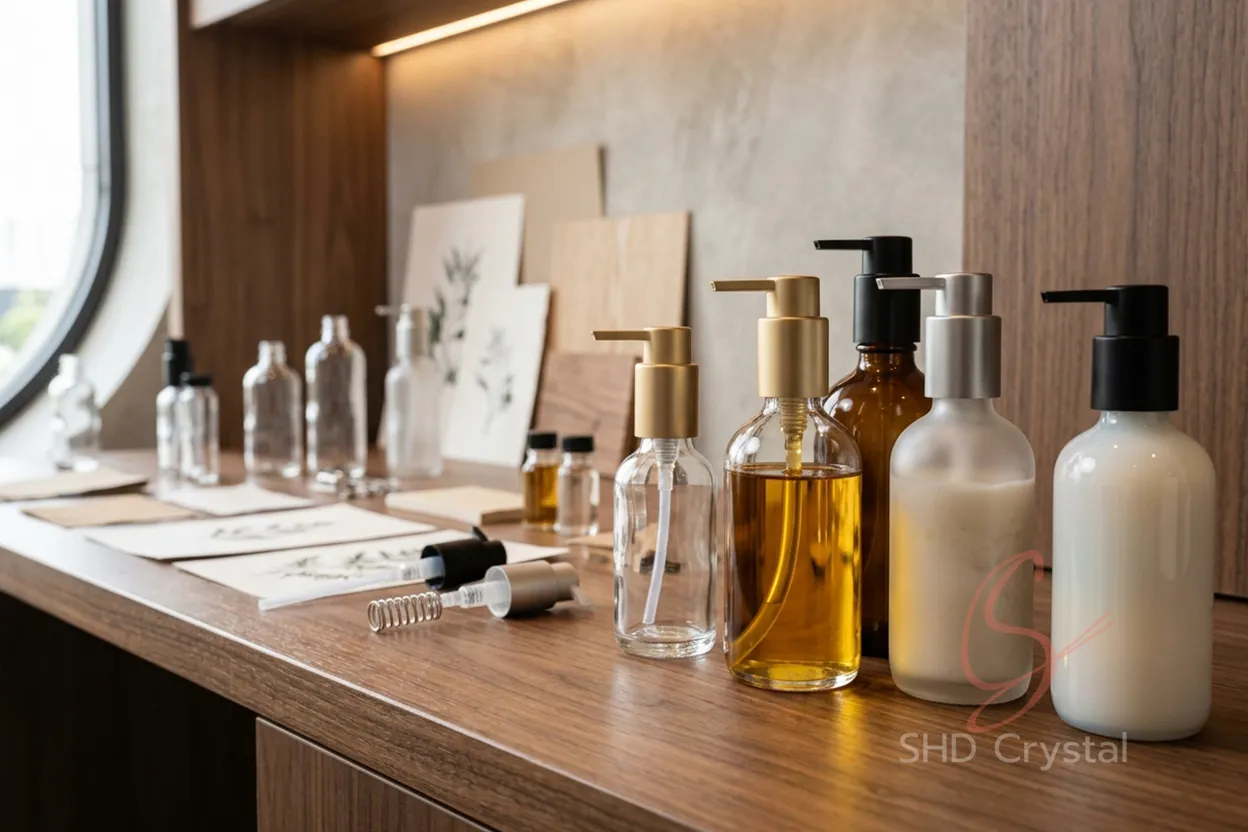
Glass Bottles With Pump for Skincare Packaging
For skincare, lotion, hand wash, serum, hotel amenities, and wellness products, packaging needs to do more than look refined on the shelf. Glass bottles with pump are widely used because they combine the visual and tactile qualities of glass with convenient controlled dispensing. But the finished package only works well when the bottle, pump, formula, neck structure, and decoration are developed as one system.
At SHD Crystal, we usually find that pump-bottle projects become much clearer once the actual product use is discussed. For custom pump glass bottles, capacity and appearance matter, but so do pump output, dip-tube length, sealing fit, formula viscosity, and repeated dispensing performance.
Glass Bottles With Pump Depend on the Complete Dispensing System
The pump is not simply an accessory added after the glass bottle is finished. The bottle neck, thread or closure structure, sealing surface, pump collar, dip tube, and internal formula all influence how the package performs. Small dimensional differences around the neck can affect assembly, while an unsuitable dip-tube length can leave unnecessary product at the bottom or interfere with smooth dispensing. This makes component matching one of the most important stages in glass bottles with pump development.
During sampling, we normally prefer to review the complete bottle rather than an empty glass container alone. The pump should sit securely, operate smoothly, and remain visually proportional to the bottle body.
Formula Viscosity Changes Pump Requirements
A light serum, body oil, liquid soap, and thick lotion do not dispense in the same way. Pump output and internal structure need to suit the product being used. A pump that performs smoothly with a low-viscosity liquid may feel slow or inconsistent with a thicker formula.
For skincare bottle packaging, this means the formula should be considered early whenever possible. Sample testing can help evaluate:
-how much product is released per press;
-whether the pump returns smoothly after use;
-whether the dip tube reaches the appropriate depth;
-whether product residue collects around the neck or pump;
-whether repeated dispensing remains consistent.
These details have a direct effect on user experience and should not be left until after the bottle design is fixed.
Bottle Shape Influences More Than Appearance
Tall, narrow bottles can create a clean and elegant skincare presentation, while broader bodies may offer more stability and decoration space. But proportions also affect manufacturing and use. A very narrow bottle may need enough base stability to remain upright during filling and everyday handling. Shoulder geometry can influence label or print area, while the relationship between neck diameter and body width changes the overall visual balance once the pump is installed.
For custom pump glass bottles, we also review glass distribution around the shoulder and neck carefully because these areas connect the decorative body with the functional closure zone.
Mold condition, forming stability, wall thickness transition, and annealing all contribute to dimensional consistency across production.
Surface Finishing Should Respect the Pump Area
Clear glass, amber glass, opal finishes, frosting, coating, printing, and metallic pump combinations can create very different product identities.
However, decorative work should not interfere with functional areas. For example, uncontrolled coating around the neck may affect component assembly. Printed graphics placed too close to a shoulder transition may appear distorted. Metallic pumps can strengthen the premium impression of skincare bottle packaging, but their finish also needs to remain visually consistent with the bottle decoration. This is why we prefer to evaluate the fully assembled sample rather than approving the glass body, pump, and decoration independently.
Sampling Often Changes Small but Important Details
In practical development, the first sample often reveals things that drawings cannot.
A body-care project may begin with a tall frosted bottle and a metallic pump because the combination looks balanced in a rendering. Once the physical sample is assembled, however, the pump may appear slightly too tall, the printable area may be narrower than expected, or the dip tube may need adjustment to reach the bottom correctly.
These are usually small changes rather than complete redesigns. For custom pump glass bottles, refining pump height, neck fit, decoration position, or bottle proportion during sampling can prevent much larger problems once production volume increases.
Repeat Production Requires Stable Component Matching
One approved sample is not enough to define a successful pump-bottle program.
When production continues across multiple batches, bottle dimensions, pump finish, print position, glass color, coating quality, and component fit all need to remain within acceptable ranges. This is particularly important in skincare bottle packaging collections with several formulas or fragrances. Small differences become more noticeable when multiple products are displayed together.
Transport protection also needs attention. Pumps, coated surfaces, glass shoulders, and decorative finishes can be damaged by movement or pressure, so dividers, sleeves, carton structure, and bottle orientation should be reviewed using representative finished samples.
Conclusion
Glass bottles with pump work best when the glass container and dispensing system are developed together. Bottle structure, pump fit, dip-tube length, formula viscosity, surface decoration, and production consistency all influence whether the final package performs as intended.
For custom pump glass bottles, early physical testing is usually more valuable than approving appearance alone. A strong skincare bottle packaging project should look refined, dispense smoothly, remain practical during filling and transport, and stay consistent through repeat production.
Developing Pump Bottle Projects With SHD Crystal
At SHD Crystal, we support glass bottles with pump through bottle structure review, sample development, pump matching, glass forming, surface finishing, inspection, and production coordination.
For brands developing custom pump glass bottles and broader skincare bottle packaging collections, sharing the formula type, target capacity, pump style, decoration direction, and shipment requirements early gives us a clearer basis for evaluating the complete package. In our experience, the most reliable results come from treating the bottle and pump as one finished product from the beginning.

