


A decanter is judged not only by its silhouette, but also by how it feels in the hand, how it reflects light, how the stopper engages, and how balanced it appears on the table. In custom barware development, glass decanter manufacturing has to connect visual design with practical production control. For brands developing custom glass decanters, clarity, symmetry, weight balance, and finishing quality all depend on decisions made long before cutting or final polishing begins.
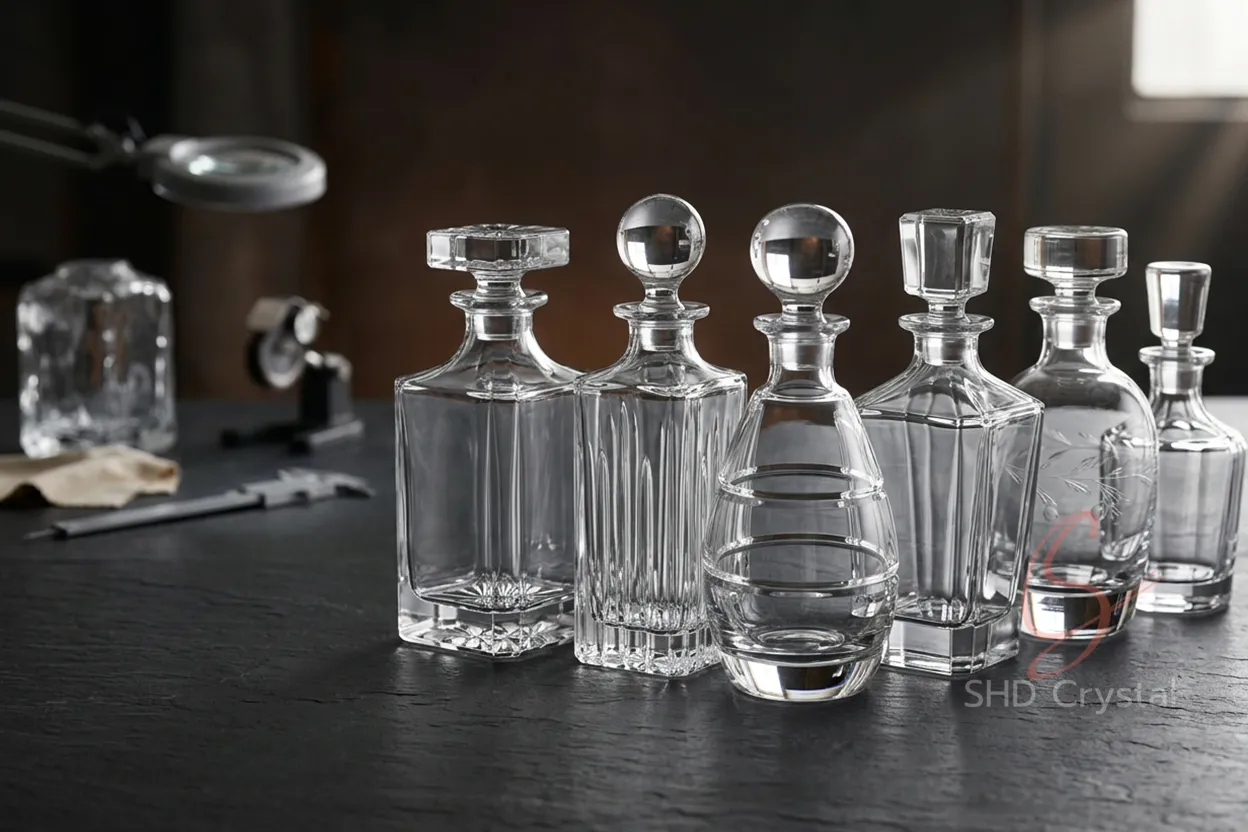
Glass Decanter Manufacturing for Custom Glass Decanters
A decanter is judged not only by its silhouette, but also by how it feels in the hand, how it reflects light, how the stopper engages, and how balanced it appears on the table. In custom barware development, glass decanter manufacturing has to connect visual design with practical production control. For brands developing custom glass decanters, clarity, symmetry, weight balance, and finishing quality all depend on decisions made long before cutting or final polishing begins.
Unlike more utilitarian containers, a decanter is often examined up close. Buyers may notice optical distortion, uneven wall thickness, base heaviness, or stopper inconsistency immediately. That is why structure, fit, and finishing should be evaluated as one connected system rather than as separate steps.
Glass Decanter Manufacturing Uses Light as a Quality Test
A clear decanter exposes its own construction. Uneven walls, distorted shoulders, heavy glass accumulation, or inconsistent bases become easier to notice when light passes through the vessel. This makes wall thickness transition an important production variable. If glass gathers too heavily in one area, the finished piece can look visually unbalanced even when its main dimensions remain acceptable.
For this reason, glass decanter manufacturing depends on coordinated control of forming temperature, mold condition, glass quantity, and timing. Stable geometry creates the foundation for later cutting, polishing, and optical finishing. For custom glass decanters, visual quality is closely tied to how accurately the formed blank is produced in the first place.
Shape Changes How Glass Behaves
Broad shoulders, square bodies, narrow necks, and heavy bases all influence how molten glass moves. A cylindrical vessel usually allows more predictable distribution, while geometric decanters introduce corners and transitions where material may gather differently.
For custom glass decanters, this creates a practical tradeoff. A thick base may improve perceived substance and tabletop stability, but excessive thickness can increase cooling differences between the base and sidewalls. If the transition is not controlled properly, the decanter may show optical imbalance or stress-related risks later in production. This is why a whiskey decanter manufacturer should evaluate structure not only by appearance, but also by how the form affects forming behavior and annealing requirements.
Stopper Fit Requires Separate Attention
The stopper is more than a decorative top. Its fit affects handling, product feel, and the overall impression of quality when the decanter is opened or closed.
Depending on the design, stopper and neck surfaces may require grinding or polishing to create the right relationship. Excessive polishing pressure can alter dimensions, while insufficient finishing may leave the contact surfaces inconsistent. A whiskey decanter manufacturer should therefore treat stopper fit as its own control point instead of assuming correct body dimensions will automatically produce a satisfactory result.
This is especially important when custom glass decanters use heavy crystal-style stoppers, faceted tops, or more decorative neck structures. In real projects, a decanter may look correct visually, but the user experience can still feel poor if the stopper is too loose, too tight, or uneven during insertion and removal.
Cutting Can Improve Optics or Expose Variation
Faceted cutting, beveling, engraving, and polishing all change how a decanter interacts with light. Precise cuts can create strong reflections and crisp edges, while manual finishing variation may become more visible across repeated facets.
This is why glass decanter manufacturing should treat finishing as a planned extension of the formed blank, not as a corrective stage. A refined result usually comes from matching the cutting plan with the actual structure of the decanter rather than forcing a decorative effect onto an unsuitable glass body.
Quality Checks Should Reflect Real Use
A finished decanter should be reviewed both empty and filled. Liquid can magnify optical distortion, reveal asymmetry, and change how the base, body, and cut surfaces appear under light.
Practical checks may also include stability on a flat surface, pouring balance, stopper engagement, edge consistency, and visible finishing quality. For a whiskey decanter manufacturer, these checks connect workshop measurements with the real experience of using the final product. For brands, this matters because a decanter is not only a display object. It is also handled, opened, poured, cleaned, and presented in hospitality, gifting, or premium spirits settings. A technically acceptable sample should still be reviewed from the user’s point of view.
Conclusion
Successful glass decanter manufacturing depends on treating structure, light, stopper fit, and finishing as connected variables. Controlled glass distribution, suitable annealing, reliable stopper matching, and disciplined cutting all help preserve both function and visual character from the formed blank to the finished vessel.
For custom glass decanters, the most reliable results come from development processes that review appearance and usability together rather than separately.
Project Experience in Whiskey Decanter Development
In practical whiskey decanter projects, the most important adjustments often appear after the first physical sample is reviewed. A decanter may look balanced in a drawing, but the actual sample can show that the base feels too heavy, the stopper sits too tightly, or the neck angle affects pouring comfort. For custom glass decanters, sample review should therefore include stopper engagement, liquid-filled appearance, tabletop stability, and hand feel rather than only checking the outside shape. This type of review helps a whiskey decanter manufacturer refine the design before cutting, polishing, or mass production begins.
Developing Custom Glass Decanters With SHD Crystal
For brands developing custom glass decanters, SHD Crystal supports glass decanter manufacturing through design review, mold development, stopper matching, cutting, polishing, quality evaluation, and export packaging coordination. As an experienced whiskey decanter manufacturer, SHD Crystal helps customers refine proportions, assess manufacturability, and translate distinctive design ideas into more repeatable finished barware.

