


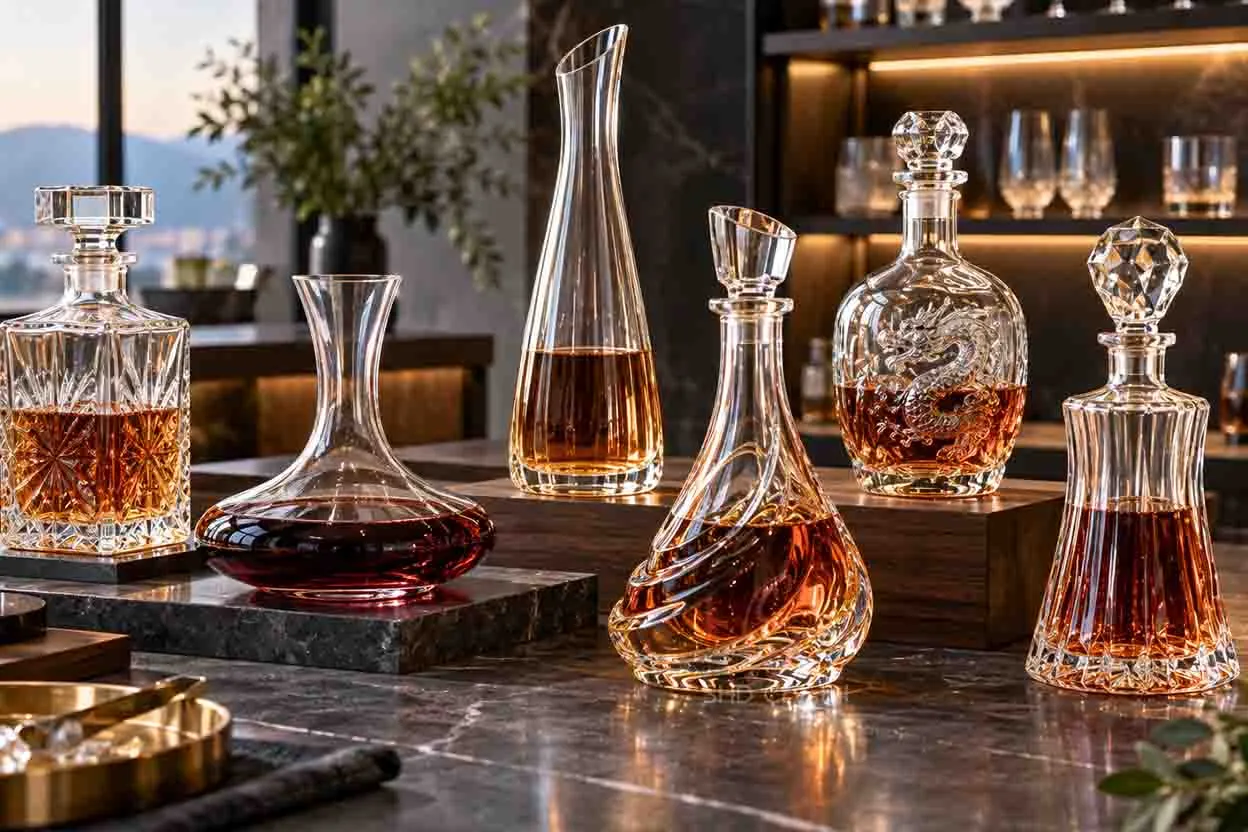
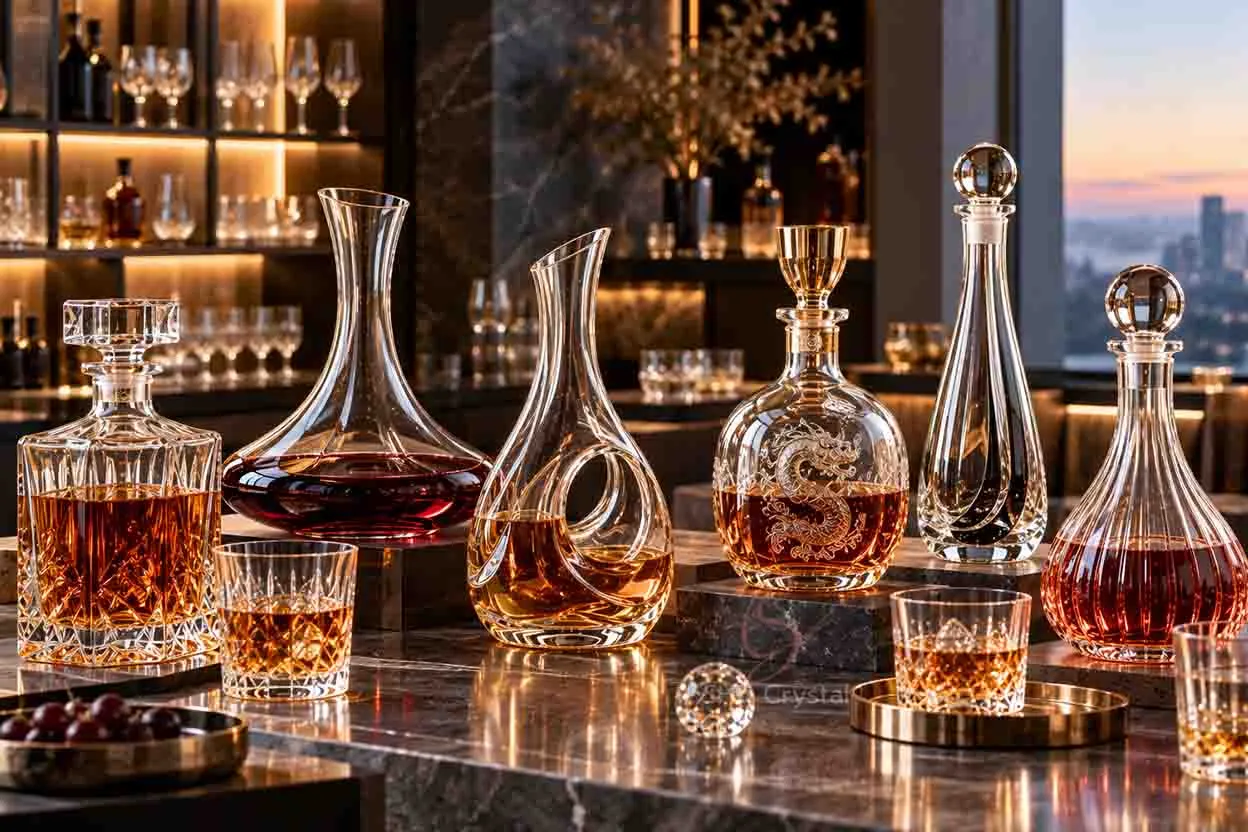
The glass decanter market is no longer defined only by traditional whiskey or wine service. Decanters now appear across home bars, premium spirits programs, hospitality settings, corporate gifts, commemorative collections, and decorative glassware lines. As these applications become more varied, bottle shape, stopper design, surface treatment, cultural styling, and presentation packaging all play a larger role in how a decanter is developed.
From a manufacturing perspective, we see the product moving in several directions at the same time. Some projects still favor classic clear crystal forms, while others use sculptural silhouettes, heavier bases, colored details, relief decoration, or more distinctive gift presentation. These changes also influence how decanter manufacturing companies plan forming, finishing, inspection, and production.
Glass Decanter Market Demand Extends Beyond Traditional Spirits Service
A decanter was once mainly associated with serving wine, whiskey, or other spirits at the table. That function remains important, but the product now carries more visual and presentation value.
A whiskey decanter may become part of a home bar collection. A decorative decanter may be developed for hotel suites or premium hospitality programs. Another design may be used as a commemorative gift or paired with matching glasses in a presentation box. This wider range of applications affects the glass decanter market because one shape no longer represents every project.
Shape Is Becoming a Stronger Product Identity
Among visible glass barware trends, silhouette is one of the most important design tools. A heavy rectangular decanter still communicates a classic whiskey character, while a tall narrow form may feel more contemporary. Rounded shoulders can soften the product, and unusual bases or asymmetric contours can make the decanter more decorative.
The stopper also contributes to identity. Faceted, rounded, oversized, colored, or sculptural stoppers can completely change the impression of the same basic vessel. For decanter manufacturing companies, these shapes create different production considerations. Heavy bases, narrow necks, angular shoulders, and complex stopper forms all affect glass distribution, molding, cooling, polishing, and fit control.
Surface Decoration Is Moving Beyond Traditional Cutting
Cut crystal remains strongly associated with premium decanters, but it is only one visual direction. Frosting, engraving, embossed relief, selective polishing, color treatment, geometric cutting, and cultural motifs can all produce different market positions.
Some products use decoration across most of the body. Others keep the vessel relatively clean and place detail only around the base, shoulder, or stopper. This restrained approach is increasingly useful when a brand wants the glass itself to remain visually clear.
In our development work, we often find that the strongest result comes from deciding which feature should lead the design. If the body shape is already dramatic, heavy surface decoration may be unnecessary. If the basic vessel is simple, cutting or relief can become the main visual feature.
Cultural and Gift-Oriented Designs Create Another Direction
Another interesting area within glass barware trends is the use of cultural, seasonal, or commemorative elements. Chinese-inspired relief, architectural patterns, floral motifs, Western holiday elements, anniversary symbols, or regional decorative references can all be translated into glass. These designs do not always need to rely on printed graphics. Cultural identity can appear through the vessel shape, molded relief, engraving, stopper geometry, color treatment, or presentation box. This gives the glass decanter market a broader connection with gifting and collectible glassware, rather than limiting the product to functional spirits service.
Hospitality Still Prioritizes Practical Performance
Design may be changing, but hospitality projects still create a different set of priorities. Hotels, restaurants, bars, and event programs may care more about pouring behavior, base stability, stopper handling, cleaning, storage, and replacement consistency.

A highly sculptural decanter can attract attention, but it may be less practical if it is difficult to hold, clean, stack, or replace. This is where decanter manufacturing companies need to balance visual trends with real service conditions.
The most suitable product for a gift collection may not be the best choice for repeated hospitality use.
Manufacturing Needs to Follow the Product Direction
Different market directions require different production approaches. A clean molded decanter depends heavily on forming consistency and glass clarity. A deeply cut product needs sufficient material in the correct areas. An embossed design requires stable mold definition. A decorative stopper needs reliable dimensional matching. As glass barware trends become more varied, manufacturing can no longer be evaluated only by whether a factory can produce a basic decanter shape.
Forming, annealing, cutting, polishing, stopper matching, decorative finishing, inspection, and packaging all influence whether a design can be repeated consistently. At SHD Crystal, we see this especially during sampling. A concept may begin with a strong visual idea, but physical samples often reveal where weight, relief depth, stopper proportion, cutting area, or finishing needs adjustment before larger production.
Conclusion
The glass decanter market is becoming more diverse in design and application. Traditional spirits service remains important, but home bar collections, hospitality, gifting, cultural themes, commemorative projects, and decorative glassware are creating more directions for product development.
At the same time, evolving glass barware trends place greater importance on shape, surface treatment, stopper design, cultural expression, and presentation. For decanter manufacturing companies, responding to these directions means connecting visual ideas with forming stability, finishing capability, functional use, and repeatable production.
Following Glass Decanter Market Changes With SHD Crystal
At SHD Crystal, our work across different decanter projects gives us a practical view of how the glass decanter market is changing. Some projects remain focused on classic clear glass and traditional cutting, while others move toward sculptural forms, cultural relief, colored details, distinctive stoppers, or coordinated gift packaging.
By combining manufacturing experience with changing glass barware trends, decanter manufacturing companies can develop products that remain technically realistic while responding to different spirits, hospitality, gifting, and decorative applications.

