


A decanter project rarely succeeds because of appearance alone. Before a product reaches final polishing or packaging, it has already been shaped by decisions about forming, sampling, finishing, and production scale. That is why glass decanter production is not simply about making a vessel—it is about choosing the right production path for the stage and complexity of the project.
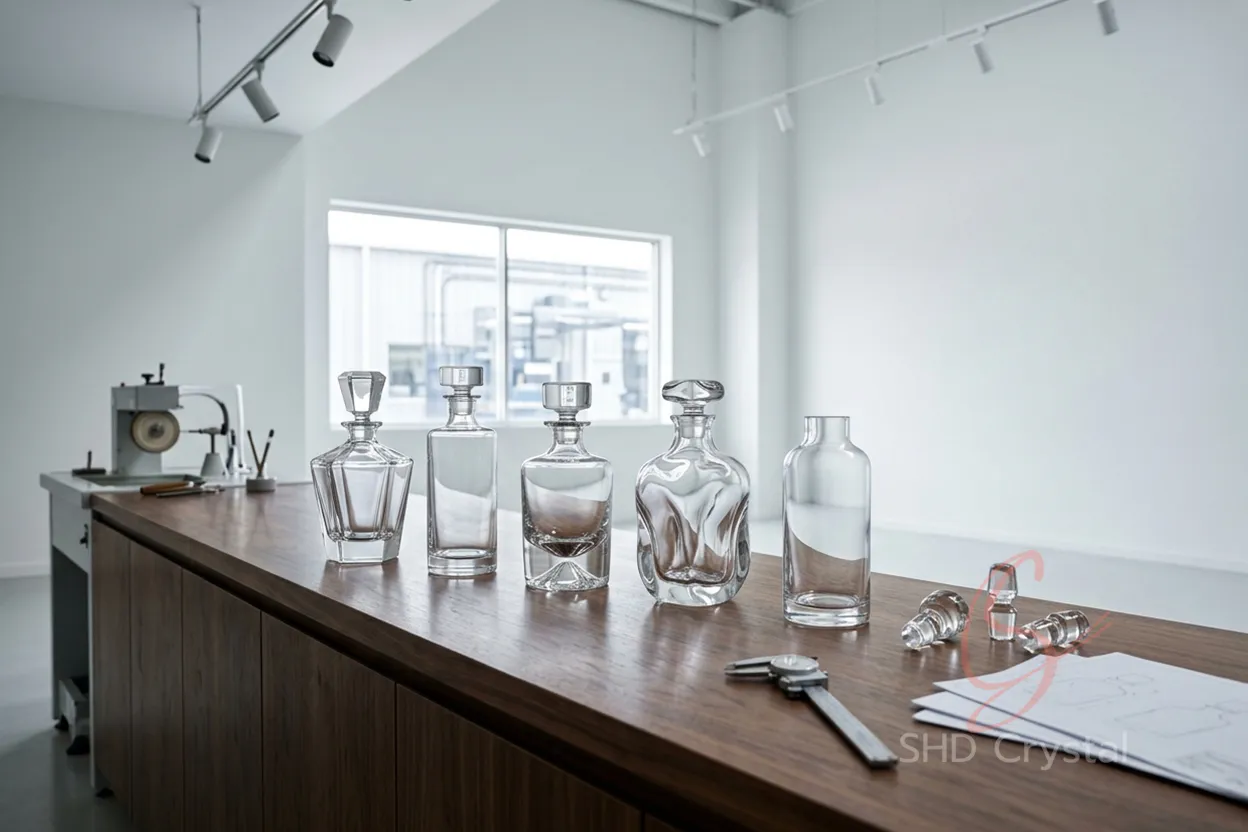
Glass Decanter Production for Flexible OEM Development
A decanter project rarely succeeds because of appearance alone. Before a product reaches final polishing or packaging, it has already been shaped by decisions about forming, sampling, finishing, and production scale. That is why glass decanter production is not simply about making a vessel—it is about choosing the right production path for the stage and complexity of the project.
For custom glass decanters, the most useful question is not whether one process is universally better than another. The more practical question is whether the selected production route fits the decanter's geometry, finishing requirements, expected volume, and future repeatability. In real OEM decanter development, flexibility at the beginning and stability later often matter just as much as speed.
Glass Decanter Production Should Follow the Product Stage
Not every decanter begins in the same way. Some projects start with a relatively open development brief. The proportions may still be under discussion, the stopper shape may not be fully fixed, or the customer may still be deciding between a simpler blank and a more decorative finished piece. In those cases, the early stage of glass decanter production often needs flexibility more than maximum output.
This is why sampling and small-run development are so important. A project may begin with hand-blown or semi-manual work to explore body proportion, base thickness, stopper scale, and overall balance. Once those details are confirmed, the production route can be reviewed again for larger quantities.
For custom glass decanters, the transition from concept to repeatable production should be planned gradually rather than forced too early.
Manual and Automated Routes Solve Different Problems
Manual or semi-manual forming can be useful when a product is still evolving. It allows more room to test unusual shoulders, geometric bodies, heavier bases, or customized stopper combinations without locking the project too quickly into one production structure.
At the same time, manual work naturally introduces more variation. Wall thickness distribution, body symmetry, and minor dimensional differences may require closer review from sample to sample.
A more mold-controlled or automated route can improve consistency once the structure becomes clearer and demand becomes more stable. In later-stage glass decanter production, this can support better repeatability for height, neck geometry, weight range, and overall form.
Neither route is automatically better. In OEM decanter development, the most practical choice depends on where the project stands and how stable the design already is.
The Formed Blank Often Determines the Final Result
A decanter may look like a finishing-driven product, but finishing cannot fully correct unstable forming. Base thickness, shoulder definition, body symmetry, neck straightness, and glass distribution all begin at the forming stage. If these fundamentals are inconsistent, later polishing, cutting, frosting, or engraving may only make variation more visible.
For custom glass decanters, this is especially important when the final design relies on strong optical clarity or geometric precision. A heavy base may look premium, but if too much material gathers in one area, cooling behavior becomes harder to control. A narrow neck may appear elegant, but it also requires stable forming if stopper fit is going to remain consistent.
Good glass decanter production therefore begins with a sound blank, not with decoration alone.
Secondary Finishing Can Carry the Design Identity
Not every project needs a highly complex mold in order to look distinctive. In some cases, the visual identity of custom glass decanters comes more from secondary finishing than from the primary form. Cutting, polishing, frosting, engraving, color decoration, or a carefully matched stopper can transform a relatively restrained blank into a more recognizable product.
This matters in OEM decanter development because it gives brands more than one path. A stable, production-friendly basic form can sometimes be paired with a more expressive finishing program, reducing tooling complexity while still preserving character. That said, finishing also needs boundaries. Deep cutting requires enough material in the relevant areas, and polishing pressure needs to remain controlled if repeated facets or bevels are expected to look similar across a batch.
Production Scale Should Match Design Maturity
A common sourcing mistake is assuming that higher capacity automatically means better project capability. In reality, a decanter project benefits most when production scale follows product maturity. If the design is still moving, if the stopper fit is still being refined, or if the customer has not yet confirmed the final decorative direction, pushing too early into a more rigid production setup can create avoidable revisions.
For glass decanter production, it is often more efficient to stabilize the structure first, then increase repeatability, and only then scale output confidently.
This is also why sample review matters so much. A design drawing may suggest that the proportions are correct, but physical samples often reveal issues with weight distribution, handling, stopper proportion, or the relationship between the base and body. Several samples reviewed together usually give a clearer picture than one piece alone.
Inspection Standards Should Reflect the Chosen Route
Whether a decanter is made through a more manual route or a more standardized one, inspection still matters. The specific checks may include body symmetry, base stability, neck alignment, stopper compatibility, visible wall distribution, and major finishing zones. In some projects, the visual standard may focus heavily on clarity and polishing; in others, it may focus more on geometric consistency and stopper matching.
For custom glass decanters, inspection should follow the actual design priorities rather than applying a generic checklist. A simple blank with a fitted stopper requires different emphasis than a deeply cut decorative decanter.
This is where structured OEM decanter development becomes more useful than one-time production thinking. The clearer the approval standards are, the easier it becomes to move from sample review into repeatable supply.
Conclusion
Successful glass decanter production depends on matching the forming route to the product's stage, geometry, and intended scale. Manual and semi-manual processes can provide useful flexibility during early development, while more controlled production methods can improve repeatability once the design is stabilized.
For custom glass decanters, the best result usually comes from treating forming, finishing, sampling, and inspection as one connected process. In real OEM decanter development, the goal is not to force every project into the same manufacturing model, but to choose the route that gives the product the best balance between flexibility, quality, and repeat supply.
Supporting Practical Decanter Development With SHD Crystal
At SHD Crystal, we usually see decanter projects improve when the production route is discussed together with the product stage, not after the design has already been fixed. Some customers begin with a relatively open concept and need flexible samples first. Others already have a stable design and need better control for repeated supply.
Our work in glass decanter production covers structure review, sample coordination, stopper matching, finishing evaluation, inspection planning, and production follow-up. For custom glass decanters, this helps turn an early idea into a clearer development path. And in OEM decanter development, it creates more room to scale a product at the right time rather than too early or too late.

