


The first sample often receives the most attention in a decanter project, but long-term sourcing is tested much later. Six months after approval, the more important question is whether the same stopper fit, proportions, cutting, polishing, and packing standards can still be reproduced. A reliable glass decanter supplier therefore needs to manage more than the first shipment.
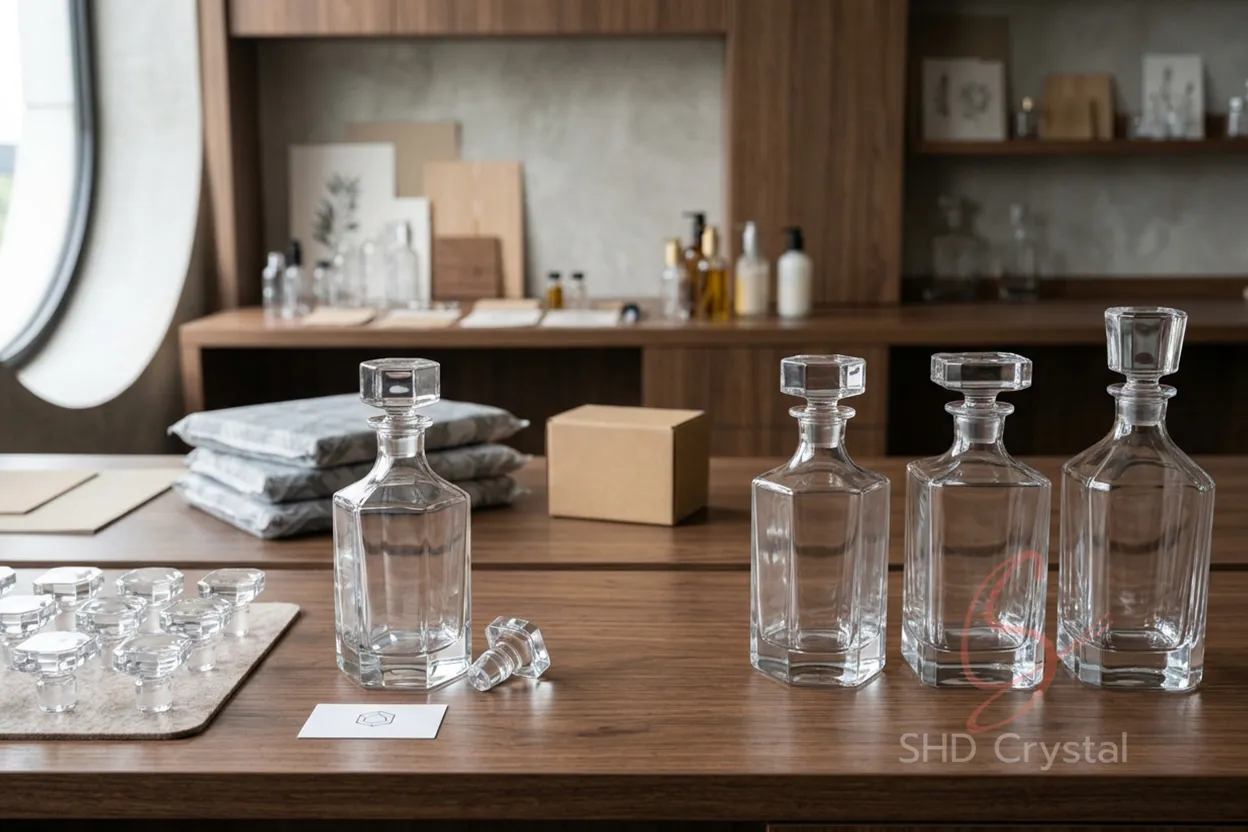
Glass Decanter Supplier for Long-Term Custom Programs
The first sample often receives the most attention in a decanter project, but long-term sourcing is tested much later. Six months after approval, the more important question is whether the same stopper fit, proportions, cutting, polishing, and packing standards can still be reproduced. A reliable glass decanter supplier therefore needs to manage more than the first shipment.
For brands developing custom glass decanters, continuity depends on how clearly dimensions, finishing references, quality criteria, component requirements, and packing details are carried from one production cycle to the next. This is especially important in commercial decanter supply, where earlier and later batches may eventually appear together in hospitality, retail, or gifting programs.
Glass Decanter Supplier Evaluation Should Go Beyond the First Sample
A successful sample proves that a design can be made once. It does not prove that the same result can be reproduced consistently after tooling has been used for several production runs or when finishing conditions change. That is why sample approval should create a production reference rather than simply close the development stage.
For custom glass decanters, important reference points may include body height, base stability, neck geometry, stopper engagement, visible cutting zones, polishing quality, and acceptable appearance variation.
When these details are recorded clearly, later production can be compared against defined references instead of relying on memory.
Sampling Discipline Matters More Than Sampling Speed
Fast sampling can be useful, but a highly polished prototype can also hide a problem if it receives more hand adjustment than normal production will allow. One useful question is whether the approved details can be reproduced through the intended manufacturing process. If a sample requires exceptional grinding, polishing, or manual correction to reach the target appearance, that should be understood before production increases. Otherwise, the approved sample may establish a standard that is difficult to maintain consistently.
For a glass decanter supplier, the real value of sampling is not simply producing an attractive piece quickly. It is revealing which dimensions and finishing details need tighter control before the design moves forward.
Repeat Orders Test Specification Control
Repeat production is not automatically easier than the first order. Mold condition, equipment settings, polishing pressure, decoration setup, or manual finishing can introduce new variation over time. This is especially visible in clear glass decanters, where differences in wall distribution, cutting depth, polished edges, or stopper position may be easy to notice when several pieces are displayed together.
In commercial decanter supply, later runs should therefore be compared with measurable references and approved appearance standards. Good records reduce interpretation. For custom glass decanters, this may include keeping critical dimensions, stopper requirements, finishing references, packaging specifications, and approved samples connected to the same project.
Packaging Standards Should Follow the Product Specification
Heavy glass decanters create transport risks that differ from ordinary drinkware.
Substantial bases, square corners, fitted glass stoppers, and cut surfaces may each require specific protection. Carton structure, dividers, stopper positioning, and internal support should therefore be reviewed using the actual finished product. Packaging also needs to be updated when the product changes. If a stopper becomes heavier, the base becomes wider, or a new decorative finish is introduced, the previous packing structure may no longer be suitable. In long-term commercial decanter supply, product specifications and packing specifications should evolve together rather than being treated as separate documents.
Communication Matters Most When Something Changes
The strongest supplier relationships are often tested when a project no longer follows the original plan. A brand may request a different stopper, change the decoration, increase the order quantity, or modify the body proportion before repeat production. These changes do not all have the same manufacturing impact.
A useful glass decanter supplier should be able to distinguish between:
-a decoration change that mainly affects finishing;
-a dimensional change that may require tooling review;
-a stopper change that needs renewed fit testing;
-a structural change that requires another sample round;
-a packing change caused by new weight or geometry.
This distinction matters because saying "yes, we can change it" is not enough. The more useful answer explains what the change affects and what needs to be reviewed before production resumes.
Continuity Becomes More Important as the Collection Grows
A single decanter SKU may be relatively easy to manage. A broader collection creates more opportunities for inconsistency.
Different capacities, stopper designs, decorative cuts, or color treatments need to remain visually related if they belong to the same product family. For custom glass decanters, this makes project records increasingly valuable as the collection expands.
The same principle applies to commercial decanter supply over time. If replacement pieces, new sizes, or repeat orders are introduced later, clear references help prevent each production cycle from becoming a new interpretation of the original design.
Conclusion
A glass decanter supplier should be evaluated not only by the appearance of the first sample, but by how well specifications, production variables, finishing references, packaging standards, and project changes are managed over time.
For custom glass decanters, long-term value comes from reducing unnecessary variation and preserving the same product intent across repeated commercial cycles. Reliable commercial decanter supply depends on continuity, documentation, and clear technical communication as much as on the quality of the first shipment.
Building a More Reliable Decanter Supply Program
For long-term decanter projects, SHD Crystal can coordinate sample references, key dimensions, stopper requirements, finishing standards, inspection criteria, and packing details before repeat production begins.
When brands develop custom glass decanters, defining these reference points early gives both sides a clearer basis for later replenishment. As a glass decanter supplier, the goal is not only to complete one successful production run, but to make future commercial decanter supply more predictable when the product returns to production months later.

