


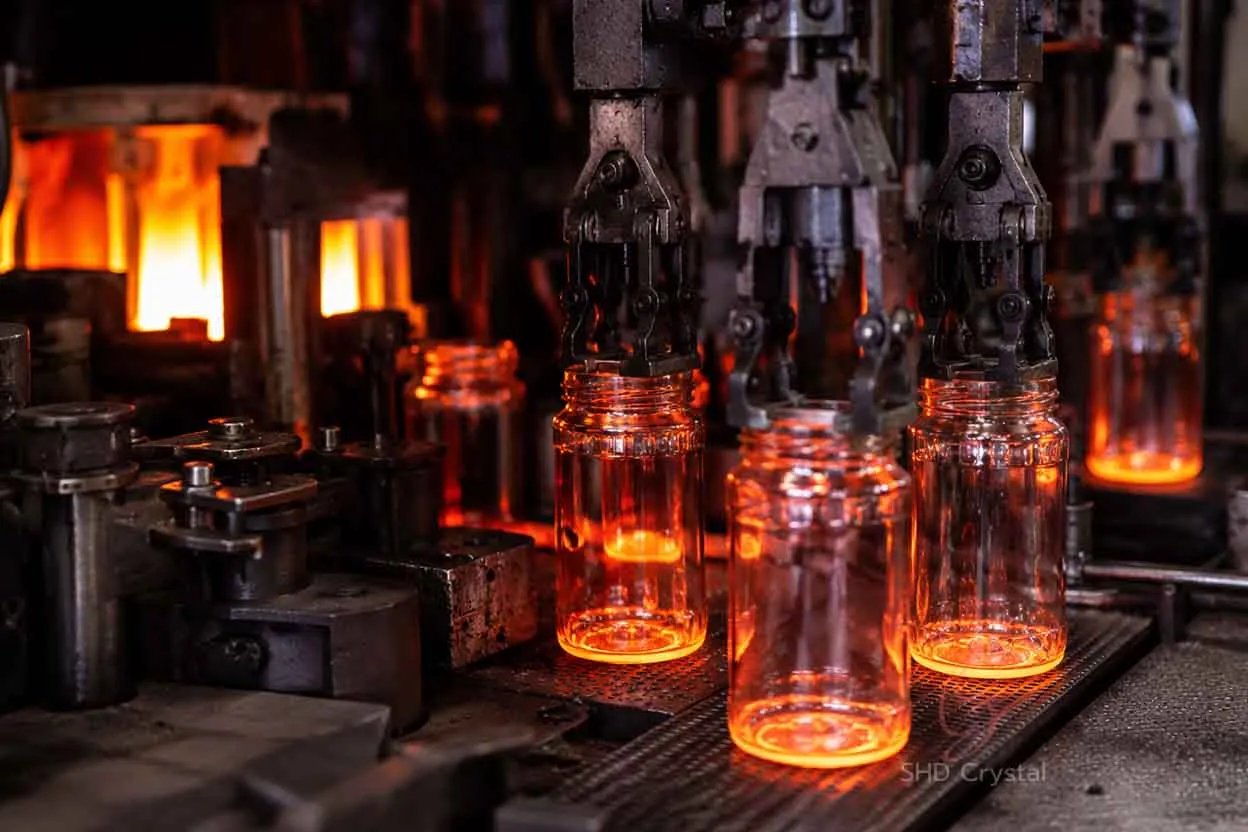
A glass jar may look simple on a shelf, but its shape comes from a carefully controlled production line. From molten glass to final inspection, the glass jars formation process includes material preparation, temperature control, gob cutting, mold forming, annealing, cold-end inspection, and packaging coordination. For a modern glassware manufacturer, every stage affects jar clarity, wall distribution, mouth accuracy, sealing performance, and batch consistency.
How the Glass Jars Formation Process Begins
The glass jars formation process starts before the jar reaches the forming machine. Raw materials are prepared, mixed, and melted in a furnace until they become stable molten glass. The molten glass then moves through the forehearth, where the temperature is controlled before the glass is cut into individual gobs.
Each gob is a measured portion of molten glass. Its weight, temperature, and delivery timing must remain stable because these factors directly affect jar capacity, wall thickness, and forming consistency. In automated glass jar production, gob control is one of the earliest quality points on the line.
Once cut, the gob is delivered into the mold section. At this stage, the selected glass forming method becomes an important part of the overall jar-forming workflow.
Press-and-Blow Glass Forming for Wide-Mouth Jars
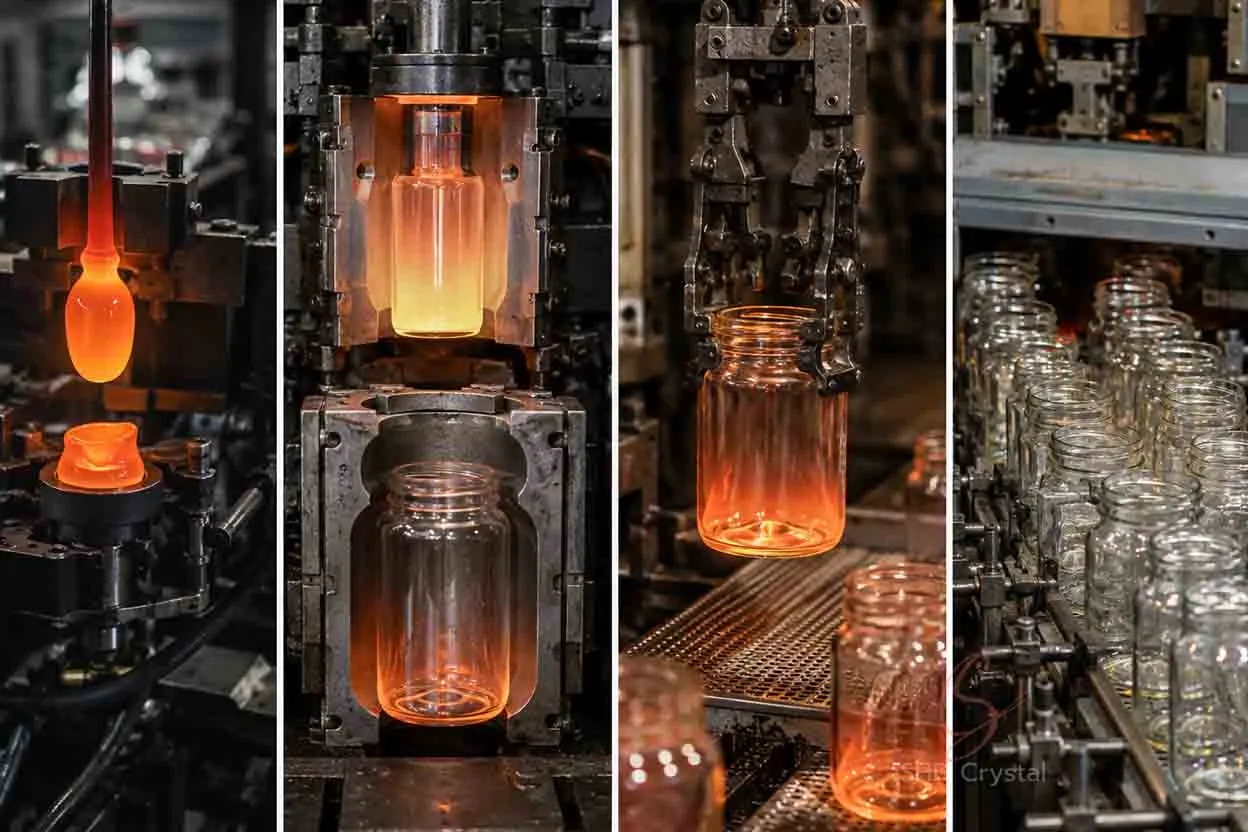
For many wide-mouth glass jars, press-and-blow glass forming is commonly used because the plunger helps form the initial parison and supports better control of wall distribution and neck finish. In this process, the gob enters the blank mold, and a plunger presses the molten glass into the first preform shape.
After the initial parison is created, it is transferred into the final mold. Compressed air then blows the glass against the mold surface to complete the final jar shape. This method is especially useful for jars that require a controlled mouth finish, stable body thickness, and reliable compatibility with lids or closures.
In the glass jars formation process, press-and-blow glass forming is often suitable for food jars, candle jars, storage jars, cosmetic jars, and other wide-mouth container designs. Even so, the final forming quality still depends on mold condition, plunger action, glass temperature, timing control, and machine stability.
Blow-and-Blow Forming and Its Role in Container Production
Blow-and-blow is another important container-forming method. Instead of using a plunger to shape the initial parison, compressed air is used in the blank mold to create the first cavity. The parison is then transferred to the final mold, where a second blowing step completes the container shape.
This method is more commonly associated with bottle production and narrower-neck containers, but it is still relevant when manufacturers compare different glass forming methods for container projects. From a factory point of view, the forming choice should match the product structure, target capacity, mouth design, appearance requirement, and production efficiency goals.
A modern manufacturer does not choose a forming method only by habit. The method should be selected according to what helps the final product perform better in production and in real packaging use.
Automated Forming Line Workflow
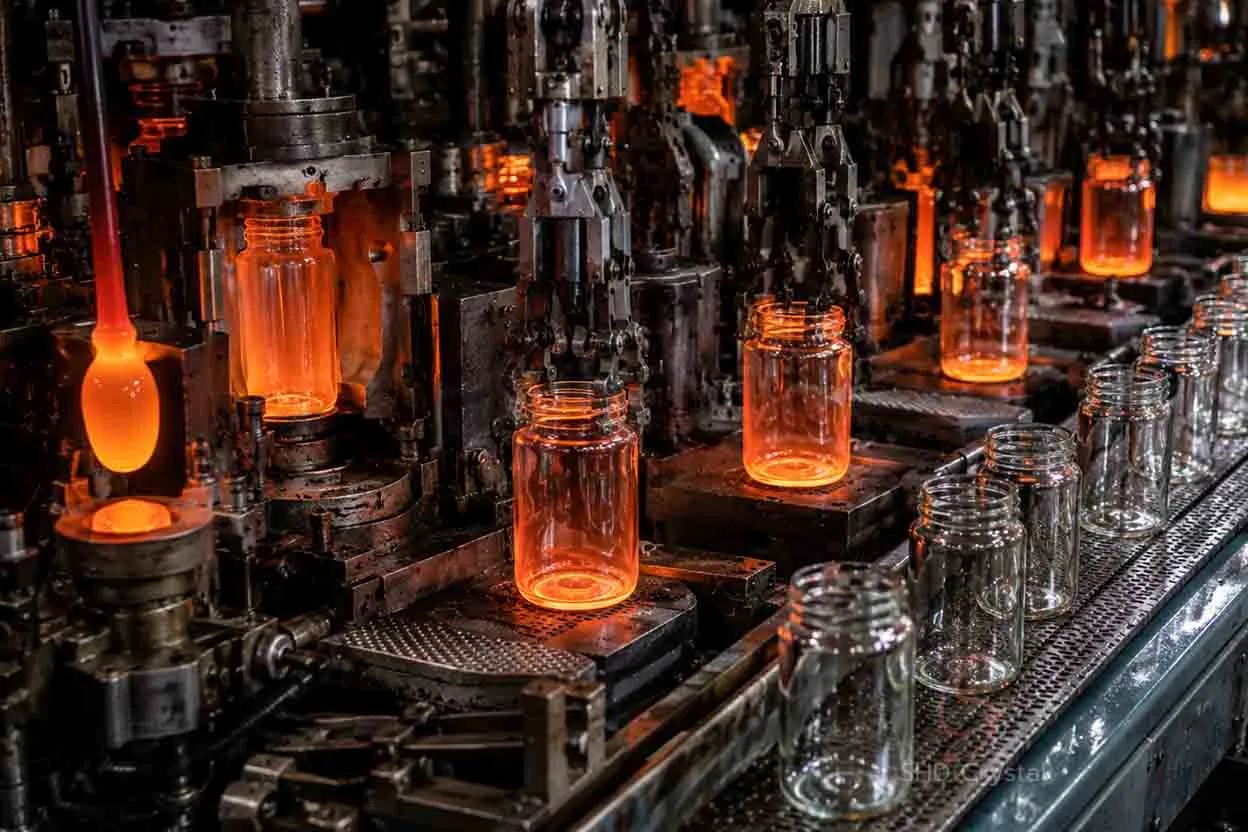
In automated glass jar production, the forming machine works through a repeated and synchronized cycle. The gob enters the blank mold, the initial parison is formed, the parison is transferred, the final mold closes, and air completes the jar shape. Mechanical take-out equipment then removes the hot jar from the mold and places it onto the conveyor.
At this stage, the jar is still at a very high temperature. Smooth transfer is important because impact, unstable take-out, or poor line coordination can lead to deformation, surface damage, or handling problems. For jars with threaded mouths, embossed bodies, or decorative surface details, stable transfer is especially important.
After leaving the hot-end forming section, the jars move into the annealing lehr. Annealing gradually relieves internal stress through controlled cooling. Without proper annealing, a jar may appear acceptable but still become more vulnerable to cracking during filling, transport, or later use.
Cold-End Inspection and Quality Control
After annealing, the glass jars formation process continues at the cold end. This stage checks whether the finished jars meet visual, dimensional, and functional expectations. In a modern factory, cold-end inspection may include appearance checks, dimensional measurement, mouth finish review, wall thickness control, crack detection, and packaging evaluation.
For jars designed to match lids or closures, the mouth finish is one of the most important checkpoints. Thread consistency, sealing surface condition, rim smoothness, and height accuracy all affect how the closure fits. A jar body may look attractive, but if the mouth finish is inconsistent, the final package may not perform as required.
Quality control also depends on batch consistency. In commercial production, one approved sample is not enough. Inspection standards, sampling procedures, and production records help confirm that the full batch can meet the same practical requirements.
Manufacturer Review Points in Custom Jar Projects
From a modern glassware manufacturer's perspective, a jar project should be evaluated as a complete system rather than a single shape. The forming method, mold design, jar capacity, mouth finish, closure compatibility, annealing performance, surface quality, inspection standard, and packaging structure all need to work together.

For example, a candle jar may require a stable base, thick wall, smooth rim, and strong overall structure. A food jar may focus more on lid matching, sealing performance, and capacity control. A cosmetic jar may place greater importance on clarity, refined surface quality, and premium presentation.
SHD Crystal reviews these points during custom jar development. When a buyer provides a drawing, sample, or reference image, the team can evaluate whether the design is suitable for press-and-blow glass forming, whether the mouth structure is practical for closure matching, and whether the final jar can support the intended filling, sealing, display, and shipment needs.
FAQ
Q01-Can automated glass jar production support custom shapes?
Yes. Automated glass jar production can support many custom jar shapes, but the design must be reviewed for mold feasibility, gob weight, mouth structure, wall distribution, and forming stability. Very sharp corners, deep textures, unusual shoulders, or special closure areas may require additional sample testing before mass production.
Q02-What should buyers prepare before starting a glass jar project?
Buyers should prepare the target jar size, capacity, mouth diameter, lid type, product filling use, decoration requirement, estimated order quantity, and reference images or drawings. These details help the manufacturer evaluate whether the jar is suitable for the intended forming method and production line.
Q03-Do different jar uses require different production considerations?
Yes. Food jars may focus on mouth accuracy and closure matching, candle jars may require stable bases and thicker walls, while cosmetic jars often need higher visual clarity and refined surface finishing. The glass jars formation process should be reviewed according to the final application instead of using one standard for every jar.
Conclusion
The glass jars formation process is a continuous production workflow that includes melting, gob cutting, mold forming, press-and-blow or blow-and-blow method selection, annealing, inspection, and packaging preparation. For modern glassware manufacturers, every stage must support the final jar's shape, strength, appearance, and closure compatibility.
For brands developing custom jars through automated glass jar production, SHD Crystal can support forming method review, mold development, sample evaluation, press-and-blow glass forming assessment, mouth finish inspection, annealing review, and packaging coordination for practical glass container projects.

