


Glass juice bottle manufacturer involvement becomes most valuable when a beverage brand is still defining how the product will be filled, chilled, displayed, and shipped. Imagine a cold-pressed juice company preparing a refrigerated line for cafes and specialty retail. The first instinct may be to choose a bottle from appearance alone. Once cap application, label position, carton layout, and cold-chain handling enter the discussion, however, the bottle becomes part of the production system.
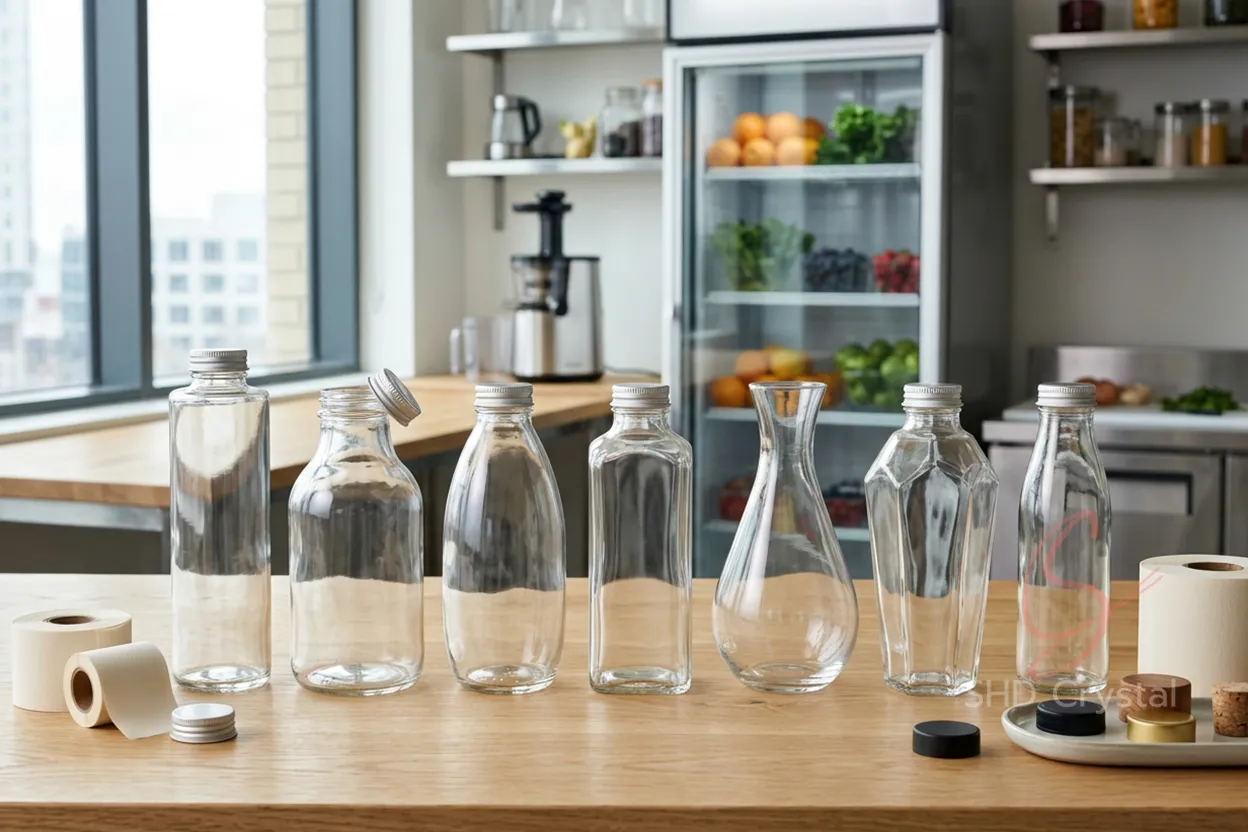
Glass Juice Bottle Manufacturer for Cold-Pressed Drinks
Glass juice bottle manufacturer involvement becomes most valuable when a beverage brand is still defining how the product will be filled, chilled, displayed, and shipped. Imagine a cold-pressed juice company preparing a refrigerated line for cafes and specialty retail. The first instinct may be to choose a bottle from appearance alone. Once cap application, label position, carton layout, and cold-chain handling enter the discussion, however, the bottle becomes part of the production system.
A Glass Juice Bottle Manufacturer Sees the Project Differently From the Design Team
Design may prioritize silhouette, filling teams neck stability, and logistics carton efficiency. For custom glass juice bottles, the useful question is not "Which shape looks best?" but "Which shape still works after filling, closing, labeling, chilling, and transport?" A square profile may create stronger shelf identity, while a round bottle may move more easily through some handling systems. A glass juice bottle manufacturer can identify where geometry creates extra tooling or packing demands before they reach mass production.
The First Sample Often Reveals the Real Brief
An empty bottle may look excellent yet expose problems once the closure is fitted: a smaller label panel, altered balance, or inconsistent cap application.
Cold pressed juice glass bottles should therefore be reviewed as complete package samples whenever possible. The representative liquid, closure, label, and carton reveal issues that an empty bottle cannot show. This is where forming temperature, mold tolerance, and wall thickness transition become practical manufacturing variables.
If glass gathers unevenly around the shoulder or base, appearance may vary between pieces. If mass distribution changes too sharply, annealing behavior may become harder to control. A glass juice bottle manufacturer is not simply checking whether a mold can create the outline. The question is whether that outline can remain stable across a production batch.
Cold-Pressed Juice Creates Its Own Packaging Questions
Cold pressed juice glass bottles may emphasize clean transparency, but buyers still need to define filling temperature, closure method, storage, and transport.
For custom glass juice bottles, decoration should follow the same logic. Labels, direct printing, frosting, or sprayed finishes may respond differently to chilling, carton contact, and condensation. The decorative concept should be tested against the route to market, not only against a studio sample.
Small Changes Can Prevent Large Production Problems
Sometimes the best adjustment is not a new bottle. It may be a wider label panel, a revised shoulder transition, a different closure interface, or a carton divider that reduces glass-to-glass contact. These changes often determine whether cold pressed juice glass bottles move smoothly from pilot filling to repeat supply.
Conclusion
A glass juice bottle manufacturer contributes most when the bottle is treated as part of the beverage operation rather than a standalone container. For custom glass juice bottles, strong decisions usually come from testing the complete package under realistic filling, refrigeration, handling, and transport conditions.
From Beverage Brief to OEM Production With SHD Crystal
As a glass juice bottle manufacturer, SHD Crystal supports custom glass juice bottles from design review and mold development through automated forming, annealing, inspection, decoration, closure coordination, and export packing. By reviewing the intended juice application early, SHD Crystal can help translate a packaging concept into a production route that is easier to sample, validate, and repeat.

