


Glass measuring beakers are widely used in laboratories because they support routine measuring, mixing, heating, transferring, and temporary holding in one simple form. In research settings, educational labs, and industrial testing environments, they are often handled many times a day, which means their value depends not only on appearance, but on clarity, stability, pouring behavior, and production consistency.
From a production point of view, a beaker may look straightforward, yet several details affect how well it performs in real use. The rim, spout, wall thickness, graduation layout, base stability, and glass quality all influence whether the finished product works reliably on a lab bench.
Glass Measuring Beakers Need to Balance Visibility and Practical Use
One reason laboratory glass beakers remain so common is that they are easy to understand and easy to use. The open-top structure allows quick access, while the wide body gives enough space for stirring, pouring, or observing the contents.
At the same time, a beaker is not a high-precision volumetric instrument. In practical use, it is better suited to general measuring and handling tasks than to exact analytical measurement. That difference should be clear during product planning, especially when graduation marks are part of the design.
A good beaker should therefore make everyday work easier without promising a level of precision that belongs to other types of lab glassware.
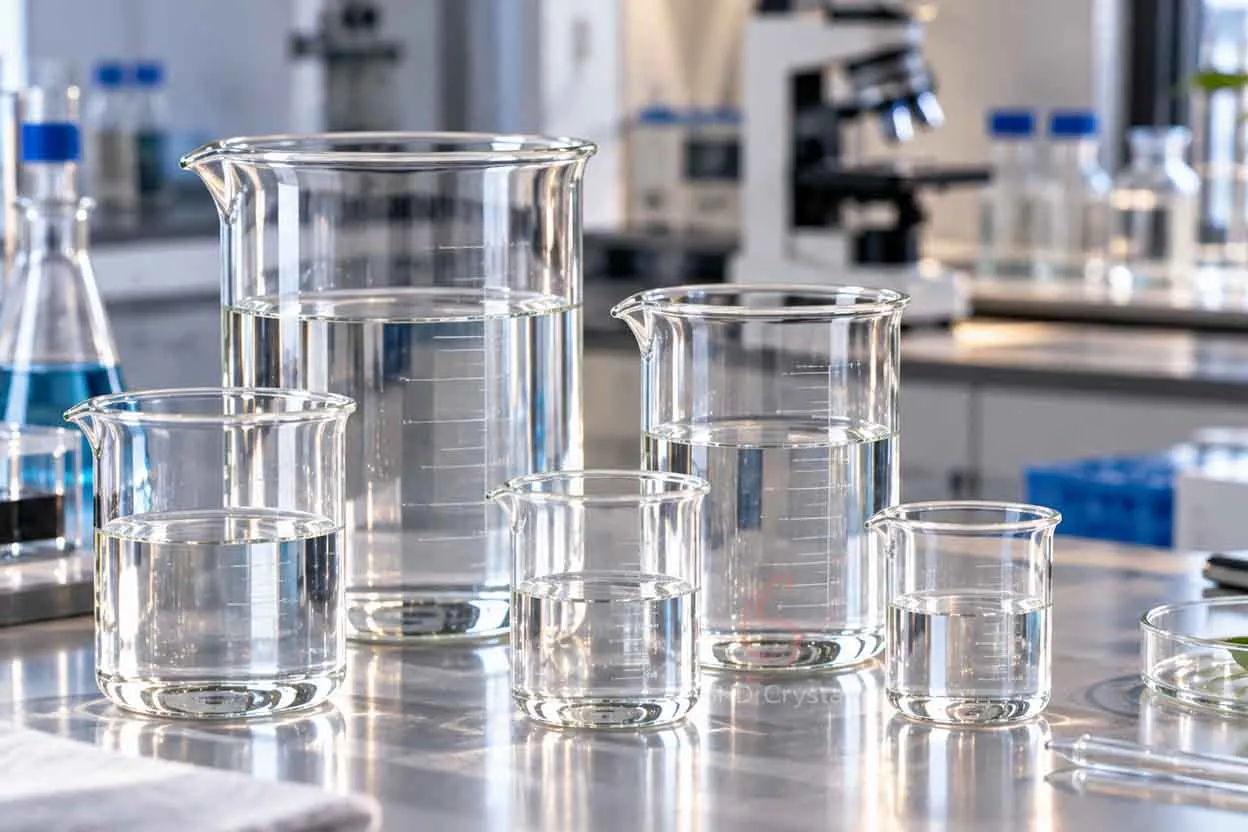
Graduations Should Be Clear but Realistic
Graduation marks are one of the first details users notice. If the markings are too faint, they become difficult to read. If they are too crowded or poorly positioned, the beaker becomes less practical during routine work.
For glass measuring beakers, the layout of the graduation area should follow the body shape and visible liquid range. Markings need to remain readable while leaving the overall form clean and easy to inspect.
In scientific glassware production, this also means controlling decoration or printing so that the marks remain consistent across batches. Uneven placement or poor contrast can reduce usability very quickly.
The Rim and Spout Affect Pouring More Than Expected
A beaker is used not only to hold liquid, but also to transfer it. This makes the spout profile and rim finish especially important. A practical pouring lip helps guide liquid with better control, while a clean rim reduces drips after pouring. If the rim is too thick, too uneven, or poorly finished, the beaker may feel awkward in use even if the body itself looks acceptable. For laboratory glass beakers, this is a good example of how a small structural feature can strongly affect the user experience.
Wall Thickness and Base Stability Influence Daily Handling
Beakers are often placed on benches, hot plates, racks, or trays, then lifted again for repeated use. That routine handling makes overall balance important. For glass measuring beakers, wall thickness should feel stable without making the vessel unnecessarily heavy. The base should sit evenly, and the body should remain visually balanced from one piece to another.
In scientific glassware production, thickness distribution also influences forming, cooling, and repeatability. If the glass is distributed unevenly, stability and appearance can both be affected.
Clarity and Surface Quality Support Observation
Many lab tasks involve more than holding liquid. Users may also need to observe color, residue, mixing condition, or fill level.
That is why laboratory glass beakers benefit from good transparency and clean surface quality. Obvious distortion, visual haze, or inconsistent finishing can interfere with both observation and presentation.
This does not mean every beaker must look decorative. It means the glass should support visibility and routine handling without unnecessary distraction.
Production Consistency Matters for Larger Supply Programs
In small quantities, one acceptable sample may appear sufficient. In larger supply programs, that is not enough. For glass measuring beakers, repeatability becomes important when multiple sizes or repeated orders are involved. Graduation position, body height, spout shape, base flatness, and overall clarity should remain within a practical and agreed range.
From our perspective, scientific glassware production works best when inspection standards are defined early. It is easier to maintain stability when the key features are identified before large-scale output begins.
Conclusion
Glass measuring beakers are simple in form, but their daily performance depends on several connected details. Graduation visibility, pouring control, wall thickness, base stability, and glass clarity all contribute to whether the beaker remains useful in real laboratory work.
For laboratory glass beakers, the best results usually come from treating production and use as one connected process. When scientific glassware production is planned around real handling conditions, the finished beaker becomes more reliable, consistent, and practical.
Supporting Laboratory Glassware Projects With SHD Crystal
For projects involving glass measuring beakers, SHD Crystal can support shape review, sampling, graduation layout, rim and spout refinement, quality inspection, and packaging coordination. When the intended application is discussed early, it becomes easier to develop laboratory glass beakers that match routine use while remaining suitable for stable scientific glassware production.

