


Glass milk bottle manufacturer selection affects far more than bottle appearance. For milk, yogurt drinks, flavored dairy beverages, and specialty cafe products, the container must work with filling equipment, closure systems, transport conditions, and brand presentation. Buyers should therefore evaluate the bottle as a complete packaging system, especially when developing custom glass milk bottles for repeat production.
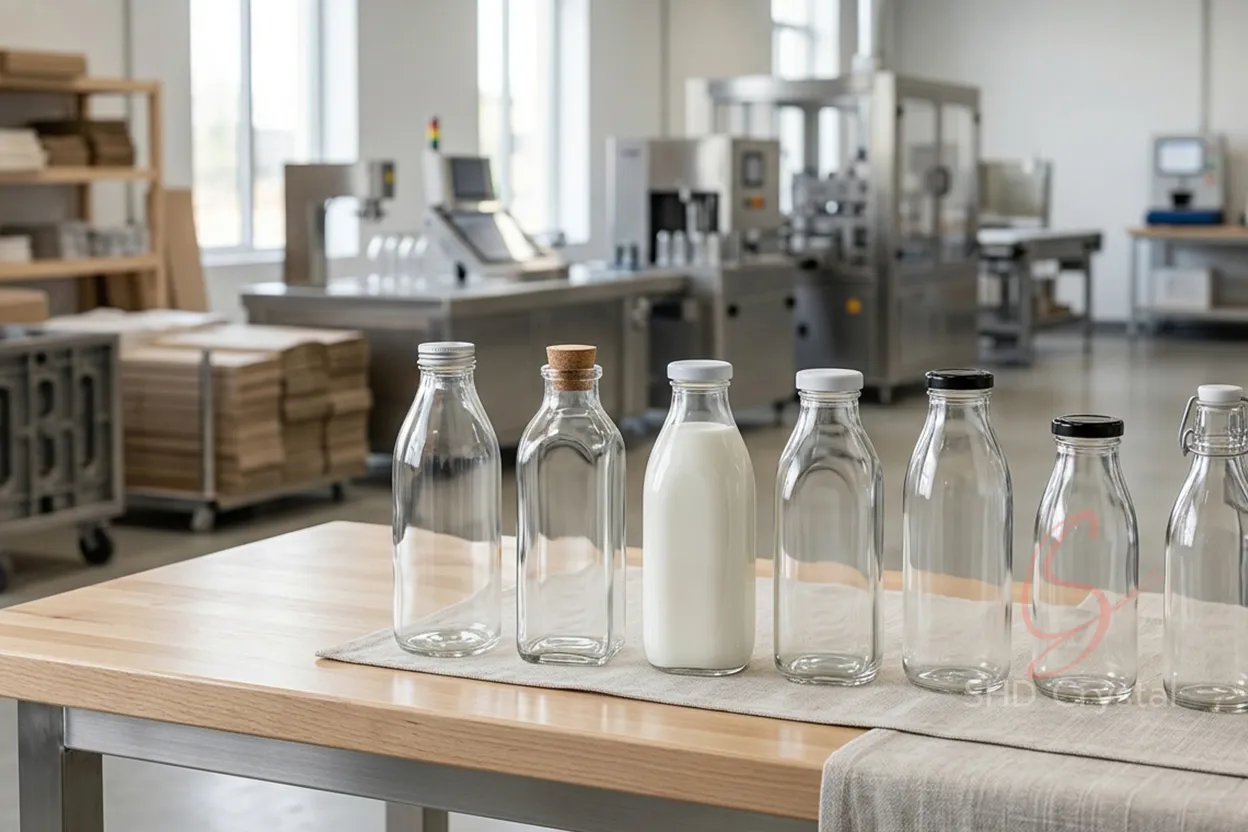
Glass Milk Bottle Manufacturer for Custom Dairy Packaging
glass milk bottle manufacturer selection affects far more than bottle appearance. For milk, yogurt drinks, flavored dairy beverages, and specialty cafe products, the container must work with filling equipment, closure systems, transport conditions, and brand presentation. Buyers should therefore evaluate the bottle as a complete packaging system, especially when developing custom glass milk bottles for repeat production.
How a Glass Milk Bottle Manufacturer Balances Design and Production
The first production question is usually capacity and shape. A compact bottle may suit single-serve yogurt or milk drinks, while a larger format may require closer attention to grip, weight, and carton efficiency. Straight-sided profiles are easier to label and pack. Decorative shoulders or embossed surfaces can create stronger recognition, but they may also increase mold complexity.
For dairy beverage packaging, neck design is equally important. The bottle finish must match the selected cap accurately, and buyers should confirm how the closure will be applied on the actual filling line. An attractive bottle can still cause problems if cap fit, sealing surfaces, or neck dimensions are inconsistent.
Forming Control Determines Dimensional Stability
During production, molten glass must distribute evenly through the mold. Forming temperature, glass volume, and mold tolerance influence the final wall structure. One common misunderstanding is that heavier glass automatically means better quality. In reality, uneven wall thickness transition can add weight while making cooling behavior harder to control.
A capable glass milk bottle manufacturer should review base thickness, sidewall distribution, shoulder geometry, and neck alignment together. These variables affect appearance, bottle stability, and compatibility with filling and packing operations.
Annealing is another important stage. Controlled cooling helps reduce internal stress after forming. This matters for custom glass milk bottles because differences in wall mass, base thickness, or decorative geometry can influence cooling behavior. Sampling should therefore evaluate structure as well as surface appearance.
Decoration Must Fit the Filling and Handling Process
Clear glass suits brands that want the product itself to remain visible. Frosting, spraying, screen printing, labeling, and embossed details can create a stronger identity, but each option adds handling requirements. For dairy beverage packaging, decoration should be considered together with filling, refrigeration, carton contact, and transport.
Buyers should avoid approving decoration before confirming the final bottle structure. If the label panel changes, the printable area may change. If the shoulder becomes more curved, artwork placement may need adjustment. Custom glass milk bottles are easier to develop when the structural design is stable before decoration approval.
Buyers Should Evaluate Repeatability, Not Only the First Sample
A successful sample proves that a design can be made once. It does not prove that larger batches will maintain the same dimensional and visual consistency. The supplier should be able to explain how neck finish, body dimensions, bottom flatness, surface defects, and batch consistency are checked.
For dairy beverage packaging, repeatability matters because closures, labels, filling lines, and cartons depend on predictable dimensions. Buyers should also confirm applicable food-contact requirements for the destination market rather than assuming one specification applies everywhere.
Conclusion
A glass milk bottle manufacturer adds the most value when bottle design, forming control, closure compatibility, annealing, decoration, and packing are treated as one production system. Better alignment at these stages reduces avoidable revisions and supports more predictable repeat orders.
Building a More Reliable Dairy Bottle Project
For brands developing custom glass milk bottles, working with a glass milk bottle manufacturer that can review drawings, capacity, closures, decoration, packing, and production tolerances early can create a more practical route from concept to stable supply.
OEM Glass Manufacturing With SHD Crystal
As a China-based OEM glass manufacturer, SHD Crystal supports custom glass milk bottles through a production system that combines automated glass forming with mold development, standardized inspection, decoration, and export packaging. Automated production is particularly useful for projects that require stable bottle dimensions, consistent neck finishes, controlled glass distribution, and repeatability across larger batches. For brands developing custom glass milk bottles or other dairy beverage packaging, SHD Crystal can coordinate bottle structure, tooling, surface finishing, closure matching, quality inspection, and packing requirements within the same OEM development process.

