


A glass plate manufacturer is best evaluated through the details that affect purchasing risk, not only through price or appearance. For hospitality buyers, distributors, importers, and sourcing teams, thickness, flatness, edge quality, stacking behavior, internal stress control, color consistency, packaging, and batch stability all influence whether a plate can move reliably from sample approval to commercial use.
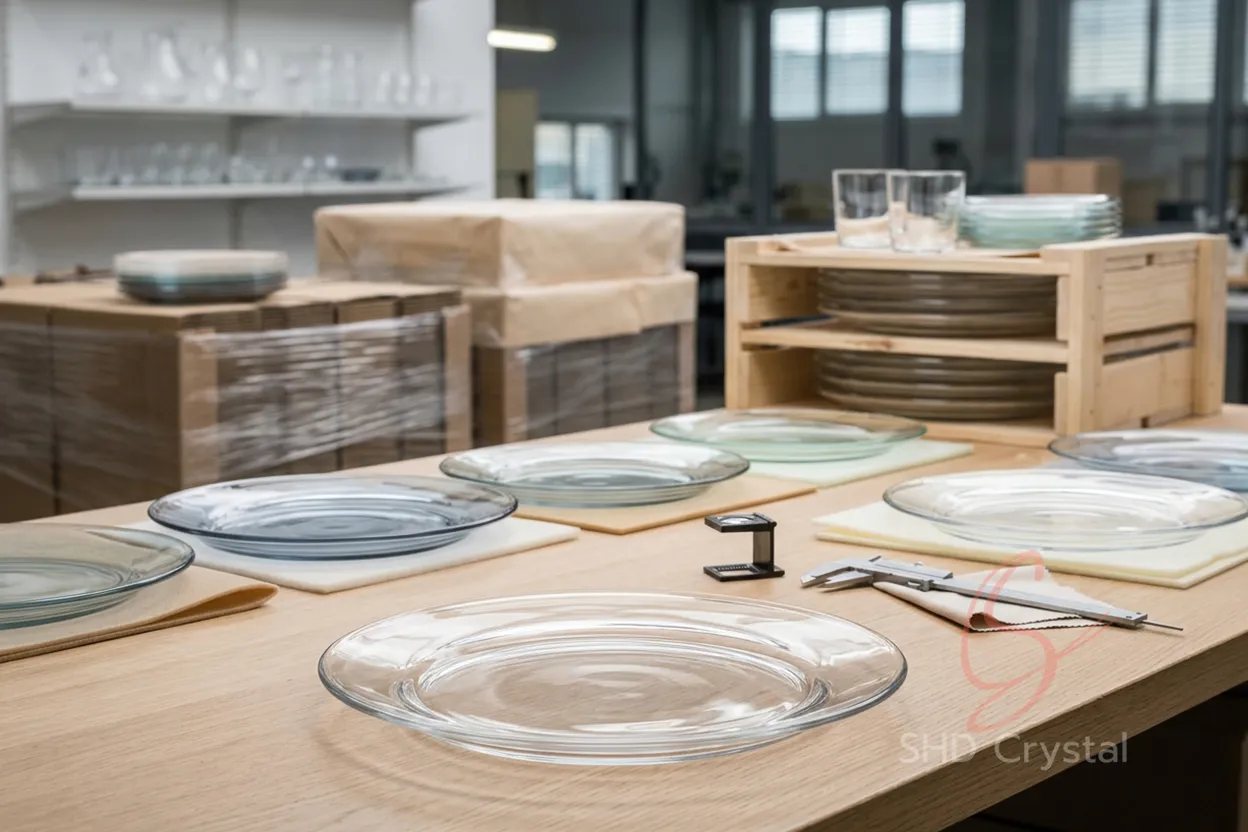
Glass Plate Manufacturer for Commercial Tableware
A glass plate manufacturer is best evaluated through the details that affect purchasing risk, not only through price or appearance. For hospitality buyers, distributors, importers, and sourcing teams, thickness, flatness, edge quality, stacking behavior, internal stress control, color consistency, packaging, and batch stability all influence whether a plate can move reliably from sample approval to commercial use.
For commercial glass plates, these details become more important when multiple pieces are used together in restaurants, hotels, catering programs, or private-label collections. A single attractive sample is useful, but repeatability across a full production batch is what ultimately determines whether the product is suitable for long-term use.
A Glass Plate Manufacturer Should Be Assessed Through Production Consistency
Thickness is one of the first specifications to review, but one measurement is not enough. Commercial glass plates may differ between the center, rim, foot, and decorative areas, and these transitions influence weight, handling, and forming stability.
For custom glass dinnerware, several samples should be compared for thickness distribution. An overly heavy rim or thin transition area may look acceptable at first, yet it can affect stacking, cooling behavior, and repeatability in mass production.
Flatness and Edge Quality Affect Daily Service
A plate should sit naturally on a flat surface without noticeable rocking. Minor instability in one sample becomes more obvious when many pieces are used in restaurants, banquets, or hotel operations.
Commercial glass plates also need smooth, consistent rims for repeated handling. Edge grinding, polishing, or other finishing steps can influence rim quality, so finishing variation should be included in sample inspection rather than judged only by overall appearance.
Stacking Contact Points Need Physical Testing
Two plates may look correct individually but create pressure when stacked. The rim of one piece may touch a raised pattern, foot ring, or decorated area on another.
For custom glass dinnerware, stacking several samples together helps reveal contact points, rocking, and unnecessary pressure. In practical sample reviews, these issues are often easier to identify with a larger stack than with only one or two plates.
A plate that appears stable individually may reveal repeated rim contact once several pieces are assembled. In some cases, a small foot-ring adjustment or a different separator can reduce rubbing during storage and transportation.
Internal Stress Cannot Be Judged by Appearance Alone
Controlled annealing helps reduce internal stress created by uneven cooling. Wide rims, thick relief patterns, and abrupt thickness transitions may cool at different rates. Visible appearance alone does not confirm whether internal stress has been adequately controlled, so stable annealing conditions remain an important part of production management.
For a glass plate manufacturer, this means production control should be reviewed together with surface quality. A visually clean plate still needs stable forming and annealing conditions behind it.
Color Consistency Should Be Judged as a Group
Colored commercial glass plates can appear different depending on thickness, texture, and finishing method. One approved piece may look correct, while several samples viewed together reveal a wider color range.
For custom glass dinnerware, procurement teams should compare multiple pieces under similar lighting and agree on an acceptable color range before production. This is particularly useful for hospitality collections where many plates appear together on the same table.
Color consistency becomes even more important when several plate sizes or related tableware pieces need to belong to one coordinated collection.
Packaging and Batch Stability Complete the Review
Transport protection should be tested with representative production samples. Rim protection, separators, carton strength, internal support, and stacking direction all influence how plates perform during export transportation.
Batch stability matters just as much. A glass plate manufacturer should be judged by whether dimensions, flatness, color, edge finish, stacking behavior, and packing remain consistent across production and future repeat orders. For commercial programs, repeatability is often more valuable than one individually perfect sample.
Conclusion
Choosing a glass plate manufacturer is ultimately a risk-control decision. Thickness, flatness, edge quality, stacking contact points, internal stress control, color consistency, transport protection, and batch stability should be reviewed together because each can affect the performance of commercial glass plates after delivery.
For custom glass dinnerware, comparing several representative samples and defining acceptable variation before mass production provides a more reliable basis for approval than relying on one visually perfect piece.
Building a More Reliable Tableware Specification
SHD Crystal supports commercial glass plate and custom tableware projects from sample review and mold evaluation to finishing, inspection, and export packing. For procurement teams evaluating a glass plate manufacturer, defining measurable requirements for commercial glass plates and custom glass dinnerware before mass production can make supplier approval and repeat ordering more predictable.

