


Glass plate manufacturing for a custom tableware project usually starts long before molten glass enters a mold. A drawing may define the diameter, height, pattern, and general shape, but these details do not fully explain how the finished dinner plate will feel in the hand, sit on a table, reflect light, stack, or survive export transportation.
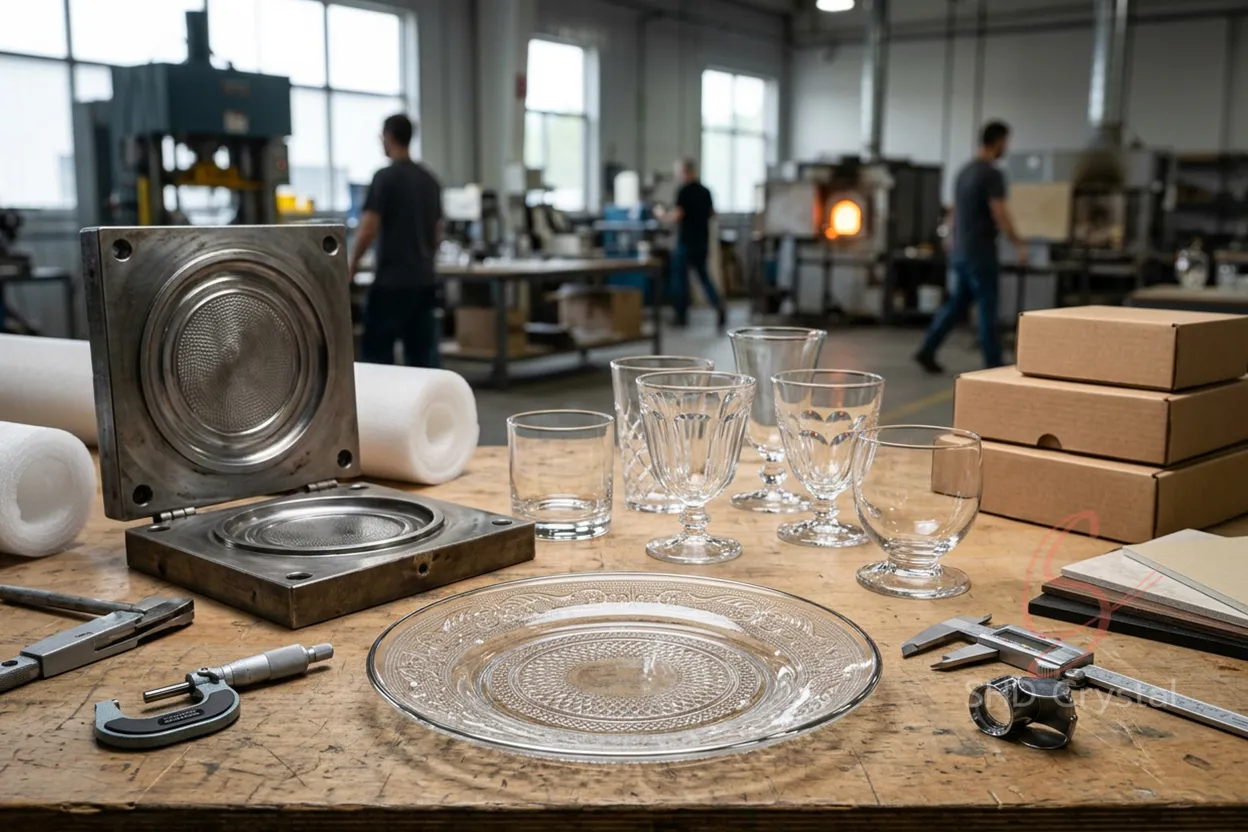
Glass Plate Manufacturing for Custom OEM Tableware Projects
Glass plate manufacturing for a custom tableware project usually starts long before molten glass enters a mold. A drawing may define the diameter, height, pattern, and general shape, but these details do not fully explain how the finished dinner plate will feel in the hand, sit on a table, reflect light, stack, or survive export transportation.
For custom glass plates, these practical details often become more important during sampling than they appeared during the initial design stage. A successful project therefore depends on balancing appearance, manufacturability, repeatability, finishing, and packaging rather than simply reproducing a reference image.
Glass Plate Manufacturing Starts With the Plate Itself
A decorative dinner plate can look relatively simple on a drawing, yet small structural choices influence the final result. Rim width, plate depth, foot-ring position, embossed patterns, and overall glass weight all affect how the product is formed.
A heavier rim can give a serving plate a more substantial appearance, but it may also make the product feel too bulky. Deep pressed patterns can create stronger light refraction, while overly sharp transitions may be more difficult to reproduce consistently. This is why the first production discussion often focuses on which visual details must remain unchanged and which areas can be adjusted slightly to make the plate more suitable for repeated production.
Thickness Is Not Only a Number
For glass dinner plates, thickness needs to be considered across the whole product rather than at one measuring point. The center, rim, decorative area, and foot may distribute glass differently during forming. This affects more than weight. Glass distribution can change the appearance of pressed patterns, the balance of the plate, and sometimes the way transparent or colored glass looks under light.
For an OEM glass tableware project, the preferred result is often a reasonable balance between visual weight, handling comfort, production consistency, and packing efficiency. The goal is not simply to make the plate as thick or as light as possible, but to make it suitable for both the intended design and repeated production.
Sampling Is Where the Design Becomes a Product
The first glass sample often answers questions that drawings cannot. In actual custom tableware development, the adjustment process is usually very practical. After the first samples are produced, the rim may feel heavier than expected, so its thickness may need to be reduced slightly. The plate may then be placed on a flat surface, and the foot structure may be adjusted if several pieces show minor rocking. Once the structure is accepted, the color sample may need to be reviewed again because the actual glass thickness can make a transparent color appear deeper than it did on screen.
Packaging may also change during this stage. If raised patterns on two stacked plates touch each other, the original separator may need to be redesigned before mass production. These details are small, but they can strongly influence the final quality and customer experience.
Finishing Can Change the Character of the Plate
After forming and controlled cooling, the plate may still require grinding, polishing, fire finishing, coloring, decals, metallic decoration, or other secondary work. These processes are not simply cosmetic additions.
A polished rim changes the hand feel. A transparent finish may look different on thick and thin areas. Metallic decoration can highlight an embossed pattern beautifully, but it may also make small visual variations easier to notice.
For custom glass plates, it is therefore useful to approve decoration on the actual glass body rather than judging it only from digital artwork or a color reference. In some custom tableware projects, texture details, color depth, or decorative positioning may be adjusted after sampling because the real effect on glass can differ from the original expectation.
Packaging Should Be Reviewed Before Mass Production
Packaging is an important part of glass plate manufacturing, especially for export orders. Dinner plates and serving plates often have wide surfaces, exposed rims, and decorative areas that need proper protection during transportation.
If plates are stacked too tightly, raised patterns or decorated surfaces may touch each other. If the separator is too thin, the plates may move during transit. Larger or heavier plates may also require stronger inner supports than standard tableware.
For an OEM glass tableware project, packaging should be reviewed together with the product instead of being treated as a final step after production is complete.
Conclusion
Good glass plate manufacturing is not defined by one individual process. It comes from many small decisions involving shape, glass distribution, forming, annealing, finishing, sampling, decoration, consistency, and packaging. For a custom dinner plate or serving plate project, the most useful development process is one that identifies these details early and allows them to be adjusted before mass production.
Developing Custom Glass Plates With SHD Crystal
SHD Crystal supports custom glass plates and OEM glass tableware development from design evaluation and mold development through sampling, decoration, inspection, and export packaging.
For a new custom glass plate or OEM glass tableware project, providing the dimensions, reference design, target quantity, desired finish, and packaging requirements at the beginning can help turn the original concept into a more practical production plan.

