


Making a glass plate for commercial use is not as simple as pressing molten glass into a round shape. In real tableware projects, the glass plate manufacturing process has to balance efficiency, consistency, appearance, and practical use. For brands, hospitality suppliers, distributors, and OEM buyers, the goal is not only to produce plates quickly, but to create pieces that remain stable in shape, weight, finish, and quality across an entire order.
Glass Plate Manufacturing Process for Custom Tableware
Making a glass plate for commercial use is not as simple as pressing molten glass into a round shape. In real tableware projects, the glass plate manufacturing process has to balance efficiency, consistency, appearance, and practical use. For brands, hospitality suppliers, distributors, and OEM buyers, the goal is not only to produce plates quickly, but to create pieces that remain stable in shape, weight, finish, and quality across an entire order.
For custom glass plates, this becomes even more important. A plate may need a specific rim profile, embossed pattern, foot structure, or decorative finish, and each of these choices affects how the product behaves during production.
Why the Glass Plate Manufacturing Process Needs More Than Forming Speed
When people look at plate production, they often focus on output. In reality, speed is only one part of the result. The glass plate manufacturing process starts much earlier, with mold design, glass weight control, plate geometry, and the way molten glass is expected to move during shaping.
A flat dinner plate, a textured serving plate, and a charger with a decorative rim do not behave in the same way. Even a small change in depth or rim width can affect mold filling, thickness distribution, and the final feel of the product in use. This is why production planning should begin with the intended function of the plate, not only the drawing.
Automatic Glass Forming Supports Repeatability
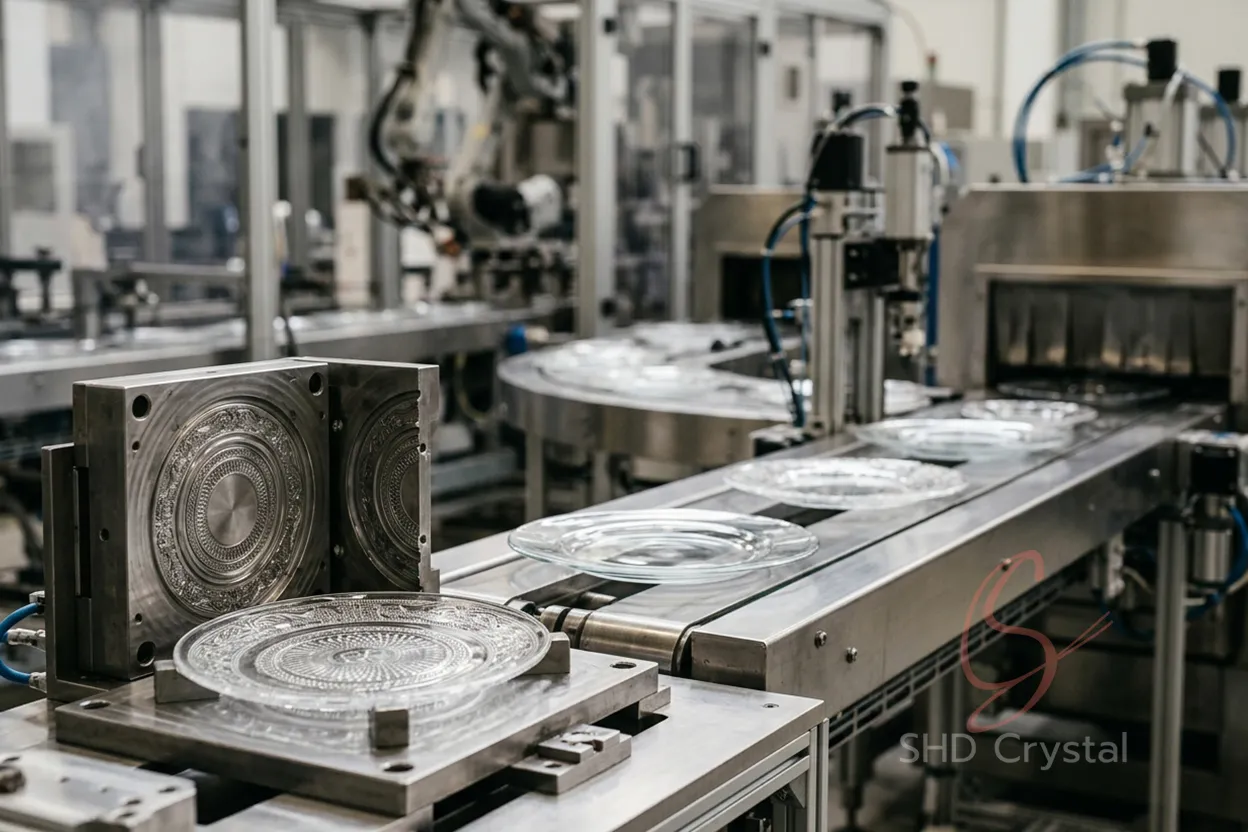
In many commercial projects, automatic glass forming is the most practical route for achieving repeatable output. A controlled gob of molten glass enters the mold, then pressure, temperature, and timing shape the plate into a defined form.
The advantage of automatic glass forming is not just labor efficiency. It also helps reduce variation from piece to piece when machine settings, mold condition, and forming rhythm are kept stable. However, automation does not solve everything by itself. If the glass temperature is inconsistent or the mold condition changes, rim definition, decorative clarity, and weight distribution can still shift.
For that reason, the glass plate manufacturing process should always treat automation as one part of a broader control system rather than as a guarantee of quality.
Thickness Distribution Affects Handling and Appearance
A plate rarely has the same thickness everywhere. Glass has to be distributed between the center area, wall transition, rim, foot ring, and any raised decorative features.
For custom glass plates, this distribution affects much more than weight. A heavier rim may make the product feel less balanced. A thick decorative zone may create attractive light refraction, but it can also influence cooling speed. If one section accumulates too much material, internal stress becomes harder to manage and consistency across a batch becomes more difficult.
This is where mold design and automatic glass forming need to work together. A good plate is not simply thick or thin. It is proportioned in a way that supports both the intended look and the production route.
Cooling and Annealing Are Part of Plate Stability
After forming, the plate is not finished. Controlled cooling and annealing are necessary to reduce thermal stress created by uneven temperature loss between thick and thin sections.
In the glass plate manufacturing process, this step is especially important for wide plates, decorative rims, and embossed surfaces. A visually acceptable plate can still carry internal stress if cooling is not managed properly. That stress may not always be obvious at first glance, which is why process control matters as much as appearance.
Secondary finishing may follow, including polishing, fire finishing, frosting, color application, decals, or metallic decoration. Each added step creates another opportunity for variation, so finishing standards should be reviewed carefully during development.
Sample Review Makes the Design More Practical
The first sample is often where theory meets reality. Drawings can show shape and proportion, but they do not always reveal how a rim feels in the hand, whether the foot ring causes slight rocking, or how a surface pattern reads under real lighting.
For custom glass plates, sample review should include multiple pieces rather than one isolated unit. Buyers can compare rim consistency, plate flatness, pattern definition, weight balance, and surface finish. In many projects, small refinements happen at this stage: reducing a heavy rim, adjusting a base profile, or modifying decoration so the product is easier to manufacture and inspect.
This is not a separate step from production. It is part of making the glass plate manufacturing process commercially reliable.
Quality Control Connects Production With Real Use
Even with automatic glass forming, inspection remains essential. Diameter, flatness, edge condition, clarity, surface finish, and packing compatibility should all be reviewed according to the product's real application.
A restaurant dinner plate, a decorative serving plate, and a private-label retail item may all use different quality priorities. The best quality-control system is one that connects measurable standards with actual tableware use rather than checking appearance alone.
Conclusion
A reliable glass plate manufacturing process depends on more than fast forming. Mold design, automatic glass forming, thickness distribution, annealing, finishing, sampling, and inspection all need to work together if custom glass plates are expected to perform consistently in commercial production.
When these stages are planned as one connected system, the result is not just a plate that looks good in a sample room, but tableware that can be produced, packed, and repeated with greater confidence.
Building a More Practical Custom Tableware Program
At SHD Crystal, we support the glass plate manufacturing process through design evaluation, mold development, sampling, finishing coordination, inspection, and export packaging. For buyers developing custom glass plates, early discussion around dimensions, decoration, quantity, and intended use can help create a production path that is clearer, more stable, and better suited to real commercial tableware needs.
FAQs
1. Is automatic glass forming suitable for every plate design?
Not always. Automatic glass forming works well for many repeatable commercial designs, but highly unusual shapes, very deep patterns, or special decorative requirements may still need additional evaluation or secondary manual work.
2. What should buyers check in a sample besides appearance?
Beyond appearance, buyers should review flatness, rim comfort, base stability, thickness balance, pattern definition, stacking behavior, and how the plate performs under realistic lighting and handling conditions.
3. When should decoration be confirmed in the glass plate manufacturing process?
Decoration is best confirmed after a physical sample exists. Color, texture, metallic effects, and embossed details often look different on a real plate than they do in drawings or digital previews.

