


In many packaging projects, people focus first on bottle shape or shelf appearance, but the long-term value of a container often depends on how well it performs in production. That is especially true for glass screw cap bottles, which are widely used for beverages, sauces, condiments, oils, syrups, and other liquid products that need a practical closure and repeatable filling performance.
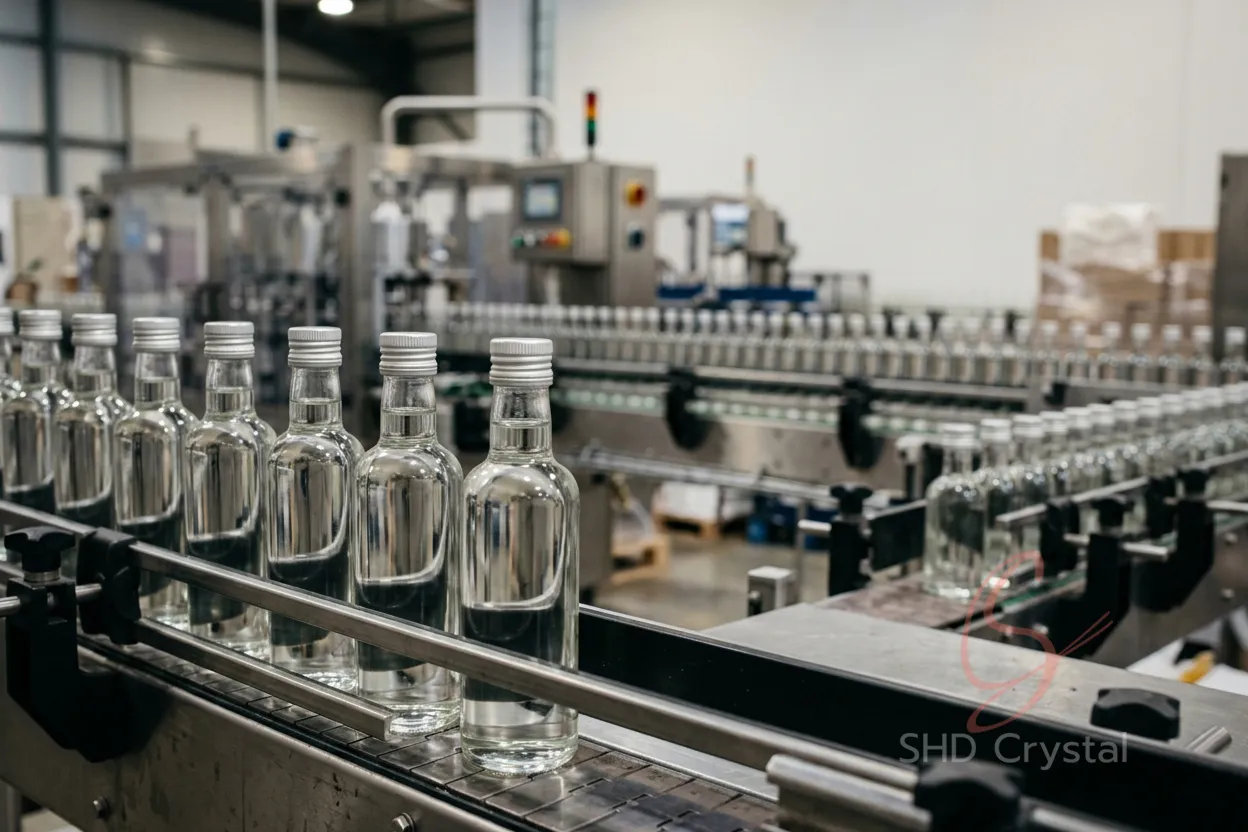
Glass Screw Cap Bottles for Automated Production
In many packaging projects, people focus first on bottle shape or shelf appearance, but the long-term value of a container often depends on how well it performs in production. That is especially true for glass screw cap bottles, which are widely used for beverages, sauces, condiments, oils, syrups, and other liquid products that need a practical closure and repeatable filling performance.
When the target is automated mass production rather than one-off customization, the priorities change. The bottle has to move smoothly through forming, capping, packing, and transport, while keeping dimensions and closure fit stable across large production runs.
Glass Screw Cap Bottles Depend on Structure and Closure Compatibility
A screw-cap bottle may look simple, but its performance depends on several connected details. The body shape affects handling and filling efficiency. The shoulder and neck influence glass distribution during forming. Most importantly, the threaded finish must match the cap system consistently.
In screw cap bottle design, the thread area cannot be treated as a minor detail. If neck dimensions vary too much, capping performance can become unstable. If the shoulder transition is too abrupt, it may affect forming behavior and cooling consistency. A bottle developed for automated lines must therefore be designed as a production object, not only as a visual package. This is why the bottle and cap should always be considered together. A strong design is one that looks right, seals well, and remains practical at production speed.
Automatic Production Changes the Design Priorities
Once a bottle enters repeated output, production efficiency becomes part of the design logic. A shape that seems attractive in a sample may become less suitable if it slows forming, increases variation, or creates instability during capping.
For glass screw cap bottles, automated production usually favors balanced geometry, controlled wall thickness transition, and a neck finish that supports efficient cap application. These features help reduce unnecessary adjustments on the line and improve consistency between batches. This does not mean every bottle should look plain. It means the visual character has to work within the conditions of automatic glass bottle production. A refined silhouette is still possible, but it should not compromise forming stability or closure performance.
Neck Finish Accuracy Matters More Than Many Buyers Expect
The threaded neck area is one of the most important parts of a screw-cap bottle. Even when the body looks acceptable, poor finish accuracy can create problems during capping, sealing, or later product use.
In real production, this area needs careful control because repeated filling and capping rely on dimensional stability. The bottle opening, thread profile, sealing surface, and cap engagement all need to remain within a workable range.
For high-volume projects, screw cap bottle design should therefore include attention to thread standard, closure compatibility, and the relationship between neck structure and filling line performance. A bottle that fits the cap reliably is more valuable than one that only photographs well.
Glass Distribution Still Shapes Performance
Automated production does not remove the normal realities of glass manufacturing. Forming temperature, mold condition, timing, and cooling behavior still influence the finished bottle.
In automatic glass bottle production, uneven glass distribution can affect weight balance, shoulder definition, and overall strength. Thick areas may cool differently from thinner zones, increasing the need for stable annealing control. Over a large run, these small variations can become more visible in handling, capping, or packing performance.
For that reason, glass screw cap bottles should be reviewed not only for appearance but also for repeatability. Several samples viewed together usually reveal more than one isolated piece.
Packaging and Logistics Complete the Production Picture
A good bottle should also work after it leaves the line. Carton structure, dividers, pallet arrangement, and movement control all affect how efficiently bottles can be packed and delivered.
This matters especially for high-volume projects, because the cost of small packaging problems becomes much larger when repeated across many cartons and shipments. Bottles with stable geometry and consistent dimensions are easier to arrange, protect, and transport.
From a practical standpoint, automatic glass bottle production is not finished when the bottle is formed. It also includes how the bottle enters packing, how it travels, and how reliably it reaches the customer in usable condition.
Conclusion
Glass screw cap bottles work best when bottle shape, threaded finish, closure fit, forming control, and packaging efficiency are planned as one connected system. For automated production, success is not defined by appearance alone, but by how consistently the bottle can move through forming, capping, packing, and repeat supply.
A well-developed screw cap bottle design should support both product presentation and production stability. When combined with disciplined automatic glass bottle production, it becomes much easier to achieve the repeatable quality needed for commercial packaging programs.
Supporting Scalable Bottle Development With SHD Crystal
At SHD Crystal, we support glass bottle projects from early structural review to sampling, production coordination, and export packing. For brands and product teams developing glass screw cap bottles, early discussion around capacity, thread finish, cap type, filling conditions, and production scale helps create a more practical and stable packaging direction.
Our experience shows that a successful mass-production bottle is usually not the most complicated one. It is the one that balances appearance, closure reliability, forming efficiency, and shipment readiness from the start.

