


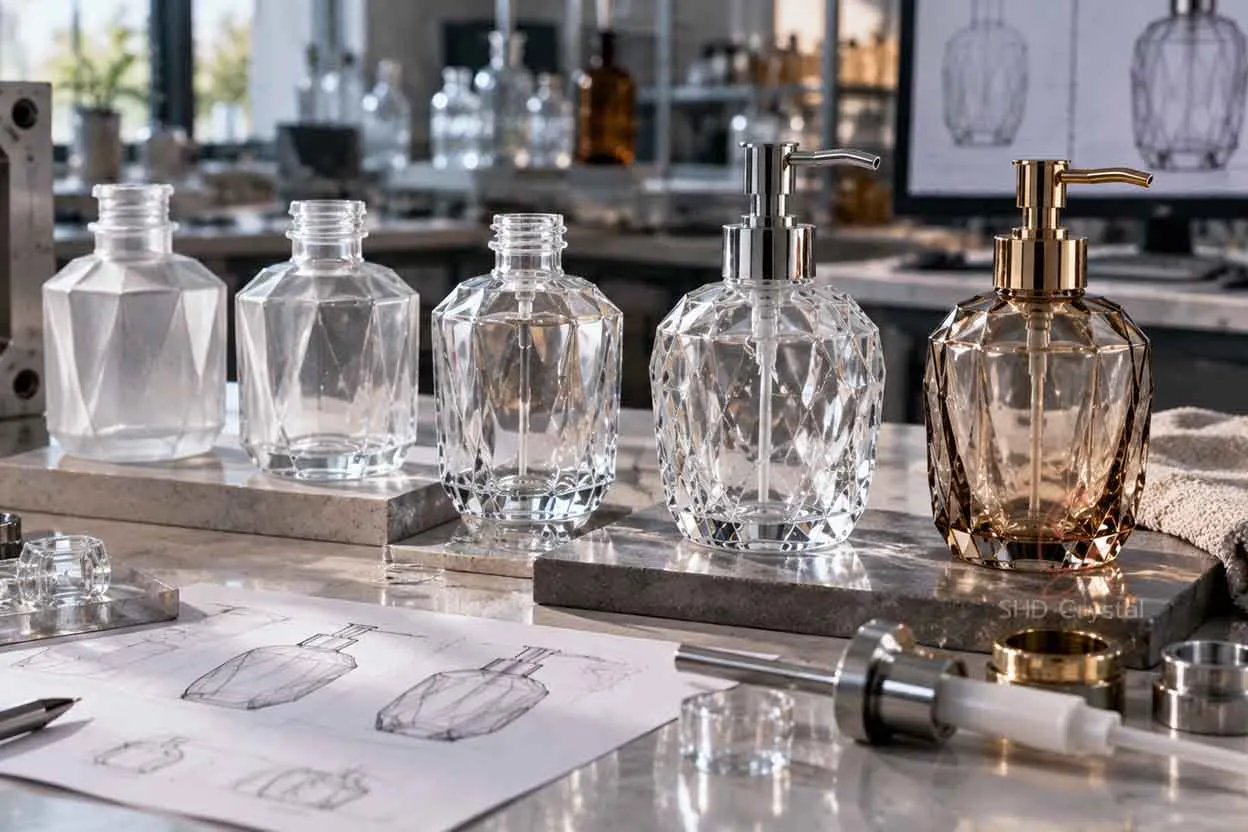
Glass soap dispenser production involves more than transforming a drawing into a finished bottle. A successful dispenser must combine visual design, pump compatibility, glass forming feasibility, surface finishing, and long-term usability.
For bathroom brands, hospitality suppliers, and interior product developers, early validation is especially important because glass products are influenced by factors that are difficult to judge from digital models alone. Shape proportions, wall thickness, weight distribution, pump fitting, and decorative surfaces all need practical evaluation before moving into larger production stages.
This is where rapid prototyping of glass becomes valuable. It helps development teams understand how a design behaves before committing to full manufacturing.
Glass Soap Dispenser Production Starts With Design Feasibility
A glass soap dispenser may begin as a concept focused on appearance: a specific silhouette, decorative pattern, color direction, or premium material feeling. However, production requires more than visual appeal. During glass soap dispenser production, designers and manufacturers need to evaluate whether the proposed shape can be formed consistently. Factors such as bottle height, shoulder transition, base thickness, neck structure, and surface details can influence glass distribution during forming.
A design with sharp geometric features may look attractive in a rendering, but the actual glass structure may require adjustments to achieve stable production. This is why early technical review is an important part of developing reliable glass products.
Rapid Prototyping Of Glass Helps Reduce Development Uncertainty
Traditional glass development often requires significant preparation before a final product can be produced. When a design contains unusual proportions or decorative features, early mistakes can increase development time and cost. Rapid prototyping of glass provides a way to evaluate important design elements before full production.
Prototype stages can help review:
l overall bottle proportions;
l pump and neck compatibility;
l hand feel and weight;
l surface appearance;
l decorative details;
l packaging requirements.
Although prototypes do not replace final production samples, they provide valuable information about whether a concept needs adjustment before investment in tooling and mass production.
Balancing Design Details With Manufacturing Requirements
A successful glass soap dispenser design needs to balance creativity and production reality. For example, a thicker base may create a premium appearance and improve stability, but excessive weight can affect handling and shipping efficiency. A complex surface pattern may create stronger visual identity, but deep textures require careful control of glass thickness and finishing processes.
During glass soap dispenser production, details such as mold design, forming conditions, cooling behavior, and finishing methods all influence the final result. The best designs are not simply the most complicated. They are designs where appearance and manufacturing capability support each other.
Prototype Evaluation Should Include Real Usage Conditions
A glass prototype should not only be reviewed as a decorative object. For a soap dispenser, practical testing should consider how the product works in daily environments. Development teams should evaluate:
l whether the pump operates smoothly;
l whether the bottle remains stable on different surfaces;
l whether the opening allows convenient filling;
l whether the weight feels appropriate;
l whether the shape is easy to clean.
This type of review improves the connection between design intention and actual user experience.
Moving From Prototype To Stable Production
After prototype approval, the project enters a more detailed production stage. Manufacturers need to establish references for:
-dimensions;
-glass appearance;
-surface finishing;
-pump matching;
-acceptable production variation;
-packaging protection.
For glass soap dispenser production, repeatability is especially important because hospitality and retail projects often require multiple batches over time.
Clear standards help ensure that later production maintains the original product identity.
Conclusion
Glass soap dispenser production requires coordination between creative design, prototype evaluation, manufacturing feasibility, and quality control. Through rapid prototyping of glass, development teams can identify potential issues earlier, refine product concepts, and create a clearer path from initial idea to reliable production.
Developing Glass Soap Dispenser Projects With SHD Crystal
SHD Crystal supports glass soap dispenser production through design evaluation, prototype development, mold coordination, glass forming, surface finishing, quality inspection, and export packaging.
For projects involving rapid prototyping of glass, early collaboration between designers and manufacturers helps transform visual concepts into practical glass products with stronger production stability.

