


Honey storage jars may look simple, but several details determine whether they work well in everyday filling, storage, and packaging. The jar needs a practical opening, stable body, suitable base, consistent rim, and reliable lid fit. Because honey is thick and sticky, the relationship between the opening and the overall jar shape also affects how easily the product can be filled and removed.
At SHD Crystal, when we review glass honey jars, we pay more attention to these practical details than to decorative complexity. A stable jar structure is the foundation for efficient production and consistent use.
Honey Storage Jars Need a Practical Opening and Stable Body
The opening is one of the first areas we review. Honey is much more viscous than water, so a narrow opening can make filling and serving inconvenient. Wider openings are common because they allow easier access with spoons or other utensils and also simplify filling operations.
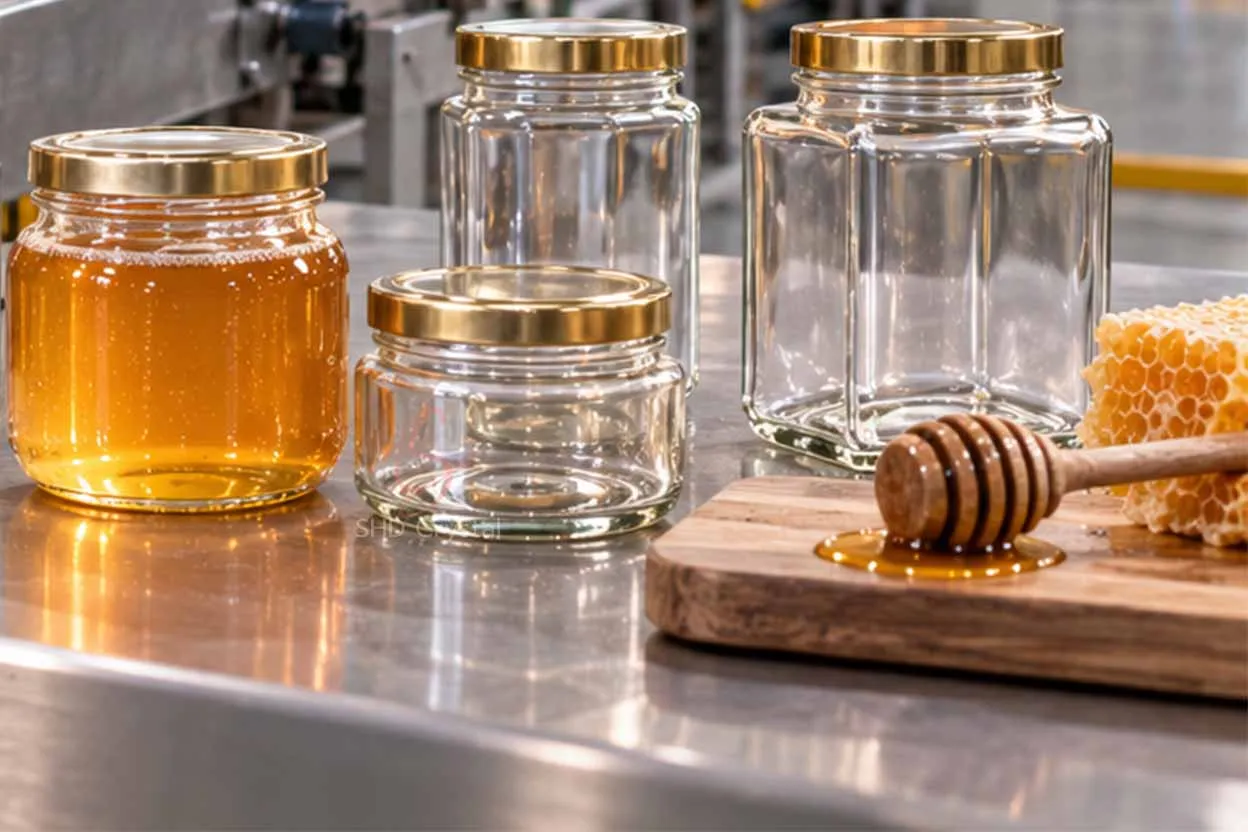
However, the opening should still remain proportional to the jar body. If the mouth becomes too large relative to the body, the jar may lose visual balance or require a heavier closure. For honey storage jars, the rim also needs consistent dimensions so that the lid can sit and close properly across a production batch.
Glass Shape Influences Daily Use
Round jars are common because they are simple, stable, and easy to handle. Square or faceted forms can create a stronger visual identity, but the corners and shoulders require more attention during forming.
For glass honey jars, we also look at how easy the container is to hold when filled. A very wide body may look substantial but can become less comfortable to handle. A tall narrow jar may save shelf width but can feel less stable.
The best shape usually balances capacity, hand feel, filling efficiency, and packing space.
Honey Jar Production Depends on Consistent Forming
During honey jar production, molten glass must be distributed consistently through the mold. The base, sidewalls, shoulders, and rim do not cool at exactly the same rate. If too much glass accumulates in one area, the jar may become unnecessarily heavy or harder to cool evenly.
We therefore pay attention to wall thickness transitions and base distribution during production. Stable forming helps maintain similar jar dimensions from one piece to another and makes later lid matching easier. For automated production, consistency matters more than producing one especially attractive sample.
Annealing Supports Stable Glass Structure
After forming, the jars move through controlled annealing. This stage allows the hot glass to cool gradually and helps reduce internal stress created during forming. It is especially important when a jar has a relatively thick base or noticeable differences between the lower body and upper wall.
In honey jar production, forming speed and annealing need to work together. Increasing output is only useful when the jars can maintain stable dimensions and structural quality through the full production process.
Lid Fit Should Be Checked Across Multiple Jars
A lid and jar should always be evaluated as a matching system. Small differences around the rim or neck finish may affect how consistently the closure fits. This becomes more obvious when hundreds or thousands of jars are being filled on the same line.
For glass honey jars, we prefer to review several jar-and-lid combinations rather than only one matched pair. This gives a better picture of actual production consistency.
Packing Efficiency Matters at Scale
Jar shape also affects how efficiently finished products can be packed. Round jars leave different spaces inside cartons than square jars, while wider bodies or heavier bases may require stronger dividers. Glass-to-glass contact should also be limited during transport.
For large honey storage jars production runs, even a small improvement in carton arrangement can make packing more organized and reduce unnecessary movement during shipping.
Conclusion
Honey storage jars need more than an attractive glass shape. Opening size, body stability, rim consistency, wall thickness, annealing, lid fit, and packing all influence how well the container performs.
At SHD Crystal, we treat glass honey jars as practical glass containers first. By keeping these production details stable throughout honey jar production, we can achieve more consistent output for repeated filling and packaging programs.

