


Popular crystal glassware has a funny habit of pretending to be serious. Put a heavy tumbler on a dark bar and suddenly everyone speaks more quietly. Place a cut crystal bowl beside afternoon tea and it immediately behaves as though it inherited the house. Behind that personality, however, buyers still need to think about proportion, clarity, forming quality, finishing, and how the glass will actually be used.
Why Popular Crystal Glassware Keeps Returning to Familiar Shapes
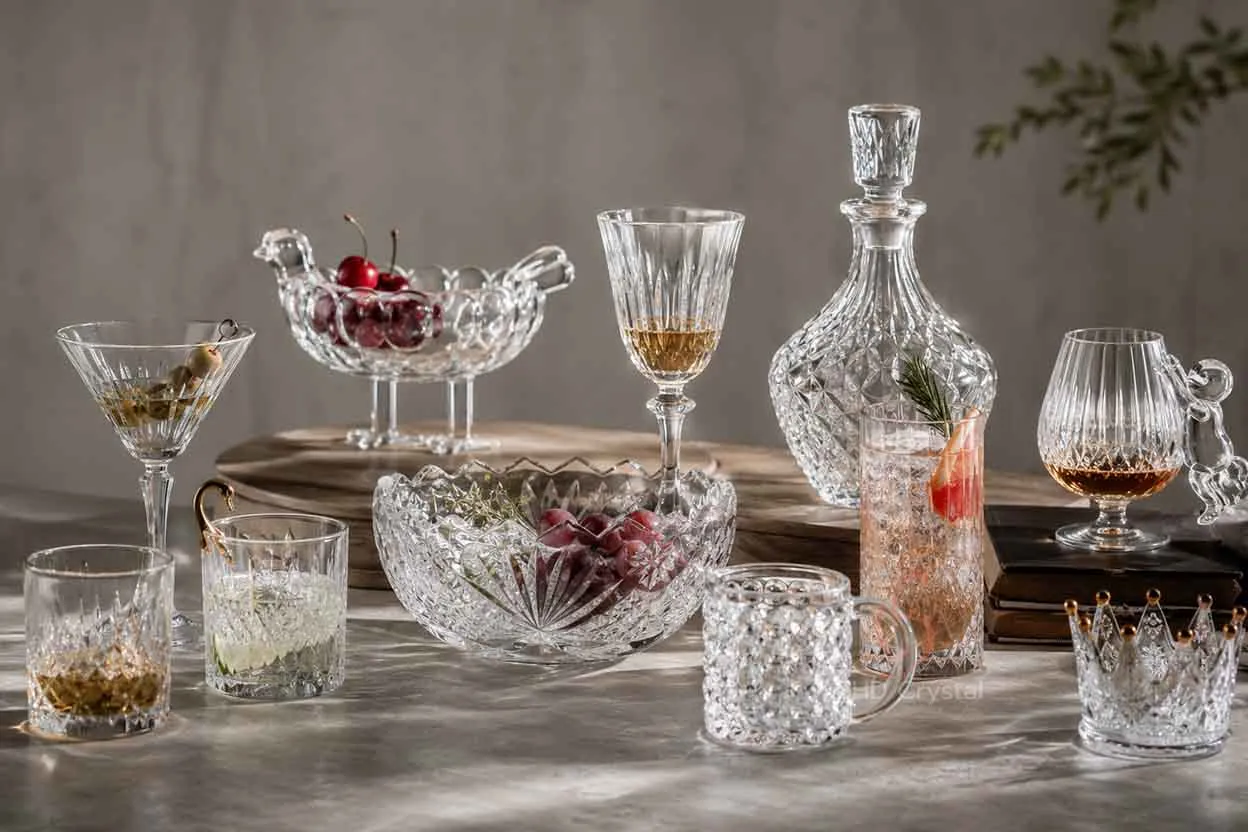
Some shapes survive because they simply work. Tumblers remain a favorite among crystal drinking glasses because the thick base feels substantial, the wide opening suits spirits and cocktails, and geometric cutting catches light without making the glass difficult to handle. Wine and cordial glasses take the opposite approach: thinner stems, smaller contact areas, and more delicate proportions create a formal impression.
Then there are bowls, trays, vases, and other decorative crystal glassware pieces. These products have fewer opinions about what should be poured into them, which gives designers more freedom with scalloped rims, deep facets, pedestal bases, and pressed patterns.
In other words, glassware popularity is rarely accidental. Familiar forms survive because customers understand them immediately.
Heavy Bases Are Doing More Work Than They Get Credit For
A thick glass base is one of the easiest ways to create perceived quality. It adds weight, improves standing stability, and gives crystal drinking glasses stronger optical depth.
But there is a manufacturing catch. A heavy base meeting a thinner wall creates a wall thickness transition that must be controlled during forming and annealing. Otherwise, the handsome heavyweight at the bottom of the glass may become a cooling problem nobody invited to dinner.
Mold tolerance also matters when facets or repeated patterns are involved. Small differences become surprisingly obvious when several pieces are lined up together.
Decoration Can Be Elegant or Extremely Enthusiastic
Cut patterns, engraving, frosting, color accents, metallic rims, and relief details all appear across decorative crystal glassware collections.
The trick is knowing when to stop. A clear bowl with carefully controlled geometric facets can already create plenty of reflection. Adding deep cutting, gold decoration, color spraying, engraving, and another decorative border may technically be possible, but the result risks looking as though five designers refused to leave the meeting.
Popular crystal glassware usually benefits from one dominant visual idea supported by quieter details.
The Most Popular Piece Is Often the One People Can Actually Use
There is a practical reason classic glassware keeps returning. A tumbler should fit comfortably in the hand. A stemmed glass needs a stable foot. A serving bowl should not become awkward once it contains food. Decorative crystal glassware may be beautiful, but hospitality and retail buyers still need to consider cleaning, packing, shelf space, and repeated handling.
The same applies to crystal drinking glasses used across restaurants, bars, hotels, and gift sets. A beautiful sample is only the beginning. Batch consistency, rim quality, base flatness, polishing, and packing protection determine whether the collection still looks convincing when dozens of pieces appear together.
That is where popular crystal glassware stops being a popularity contest and becomes a manufacturing project.
Conclusion
Popular crystal glassware remains popular because familiar forms can carry very different personalities through weight, proportion, transparency, cutting, and finishing. The strongest collections do not chase decoration for its own sake. They combine recognizable function with enough character to make the glass worth noticing.
Creating Crystal Glassware That Earns Its Place on the Table
SHD Crystal supports popular crystal glassware development through mold planning, forming, annealing, polishing, engraving, surface finishing, inspection, and export packing. For brands developing crystal drinking glasses or decorative crystal glassware, defining the intended use, visual direction, and acceptable production variation early helps create products that look distinctive without becoming unnecessarily complicated.

