


Reed diffuser bottles are used not only to hold fragrance liquid, but also to become part of the product's visual identity in the home. For fragrance collections, the bottle often remains visible on shelves, tables, bathroom counters, and hospitality interiors for a long time, so appearance and function need to work together.
That is why diffuser bottle development should not begin with shape alone. Opening size, bottle stability, glass thickness, surface finish, decoration, and packing all influence whether the final product performs well in daily use and remains consistent in production.
Reed Diffuser Bottles Should Be Planned Around Real Fragrance Use
The opening of a diffuser bottle affects both appearance and performance. It needs to allow reeds to sit naturally while maintaining balanced visual proportion. If the neck is too narrow, the reeds may feel crowded. If it is too wide, the bottle may lose visual refinement and require extra review for evaporation behavior and overall presentation.
For custom reed diffuser bottles, the bottle shape should also match how the product will be displayed. A low square bottle may feel stable and architectural, while a taller cylindrical form may look lighter and more elegant. Neither is automatically better. The right choice depends on the fragrance concept, the intended environment, and how the bottle fits into the rest of the collection.
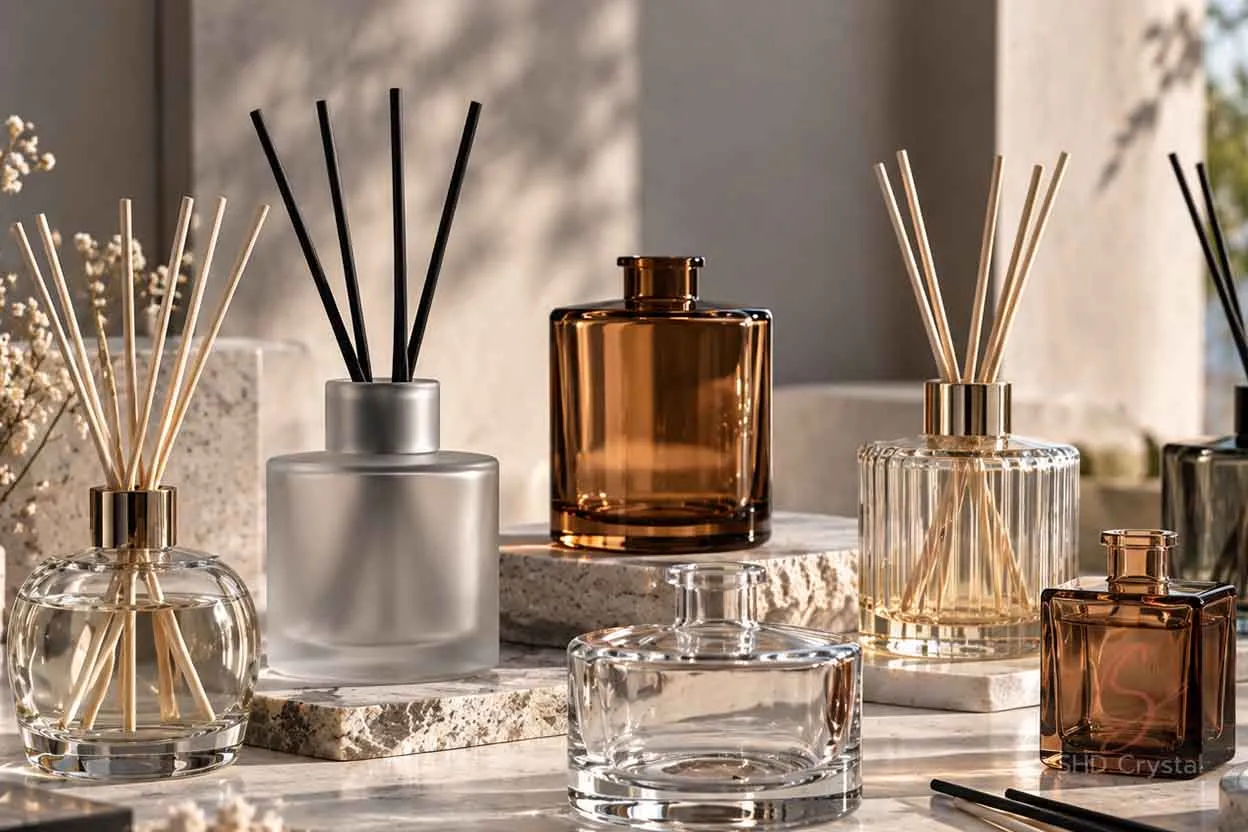
A common mistake is selecting a bottle mainly for its appearance without checking reed length, liquid level, and center-of-gravity balance. In actual use, those details matter.
Bottle Proportion Changes the Product Character
The body shape of reed diffuser bottles plays a strong role in how the product is perceived. Thick-bottom bottles can create a heavier premium feeling. Soft rounded shoulders may look calmer and more decorative. Straight walls often provide cleaner label space and a more modern appearance.
For home fragrance packaging, these design choices should also be practical. A bottle that looks attractive in a product photo may still require adjustment if it feels unstable, difficult to fill, or inefficient to pack. Proportion should support both styling and usability.
Surface Finish Should Match the Fragrance Style
Surface treatment can change the mood of a diffuser bottle significantly. Clear glass highlights the liquid and creates a clean, direct presentation. Frosted surfaces soften the look and often suit wellness or minimalist fragrance collections. Colored glass can give the product a warmer or more distinctive identity.
For custom reed diffuser bottles, decoration methods such as coating, spraying, printing, embossing, or polishing should be reviewed on the actual bottle shape rather than judged only on drawings. Curved shoulders, thicker bases, and different glass colors may all affect how a finish appears after production. This is especially important in home fragrance packaging, where the bottle is often part of the room decor rather than only a transport container.
Production Consistency Matters More Than One Good Sample
A diffuser bottle may look excellent as an individual sample, but the commercial value depends on how consistently it can be reproduced. Mold tolerance, wall thickness transition, forming temperature, and annealing control all influence opening accuracy, shape stability, and overall appearance.
For reed diffuser bottles, several pieces should be reviewed together instead of relying on one approved sample. This makes it easier to check whether the neck size, glass tone, base proportion, and decorative finish remain visually coordinated across a batch.
In practical development, consistency is often more important than decorative complexity.
Packaging and Transport Need Early Attention
Diffuser bottles may include coated surfaces, decorative collars, caps, or thick glass bases, which means they need suitable protection during shipment. Inner dividers, sleeves, carton strength, and pallet loading should be planned with the finished product in mind.
For home fragrance packaging, a bottle that arrives with scratches, friction marks, or surface damage has already lost part of its value. Packaging is therefore not a final detail added after production. It is part of the full development process.
Conclusion
Reed diffuser bottles work best when shape, opening design, surface finish, stability, and production control are considered together. A successful diffuser bottle should look appropriate in the home, support practical fragrance use, and remain consistent from sample review to repeat production.
Developing Reed Diffuser Bottle Projects With SHD Crystal
SHD Crystal supports reed diffuser bottles projects through shape evaluation, sampling, mold development, surface finishing, inspection, and packaging coordination. For custom reed diffuser bottles and broader home fragrance packaging programs, discussing bottle proportion, reed use, decoration direction, and shipping requirements early can help create a more practical and visually consistent final product.

