


A roller ball bottle is a small container fitted with a rolling applicator at the opening. When the bottle is tilted or moved across the skin, the ball rotates and transfers a controlled amount of liquid onto the application area. This simple structure is why roller bottles remain common in perfume oils, essential oil blends, aromatherapy products, beauty oils, and other portable personal-care formats.
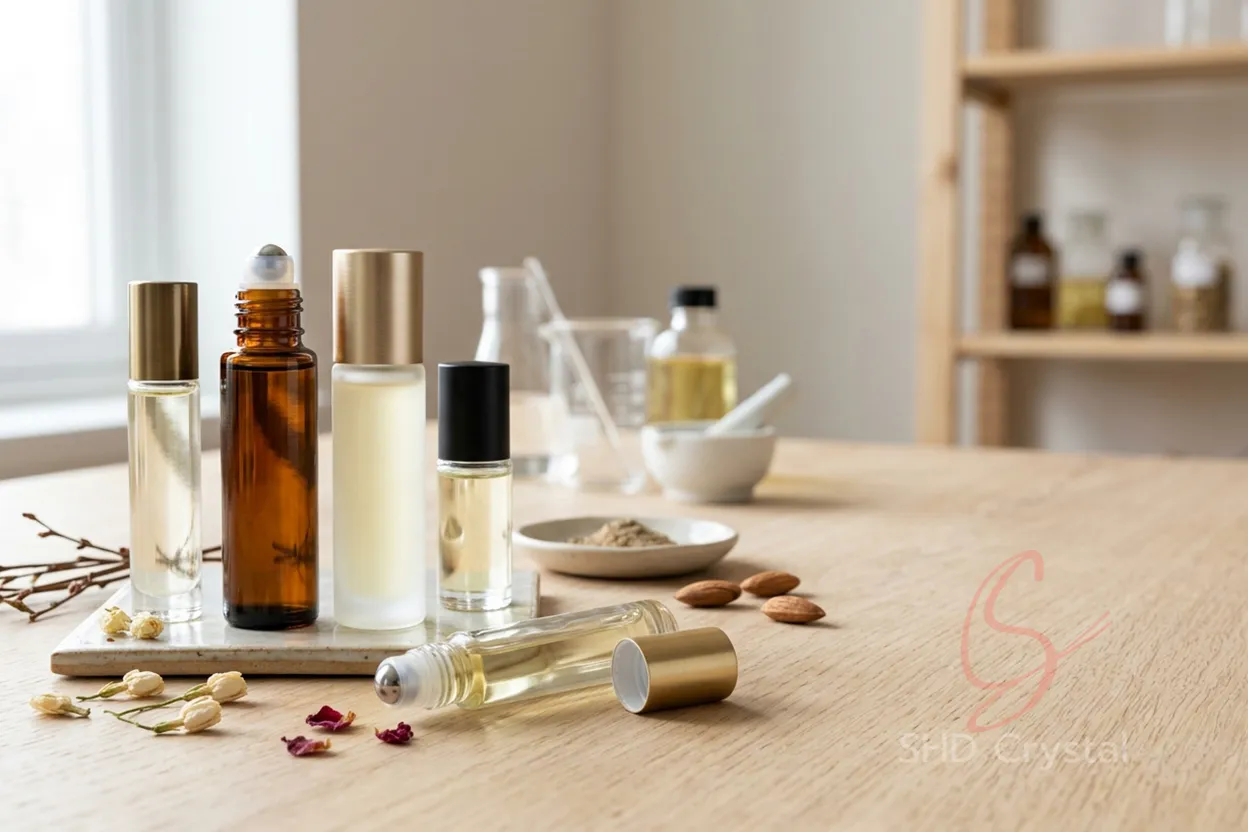
Roller Ball Bottles for Perfume Oil and Beauty Packaging
A roller ball bottle is a small container fitted with a rolling applicator at the opening. When the bottle is tilted or moved across the skin, the ball rotates and transfers a controlled amount of liquid onto the application area. This simple structure is why roller bottles remain common in perfume oils, essential oil blends, aromatherapy products, beauty oils, and other portable personal-care formats.
The bottle itself may look straightforward, but the dispensing system is not. The glass neck, roller housing, ball, liquid formula, and outer cap all have to work together. At SHD Crystal, this is where we usually begin when developing roller ball bottles: not with the bottle silhouette alone, but with how the finished package is expected to dispense, seal, travel, and feel in the hand.
Roller Ball Bottles Depend on the Complete Applicator System
For us, the most sensitive area is usually the bottle neck and roller insert. The roller assembly needs to fit the glass opening with enough stability to remain secure during normal use and transportation. At the same time, the ball needs enough freedom to rotate smoothly and transfer the intended amount of product.
Small dimensional differences can change that balance. If the insert fits too loosely, sealing or leakage problems may appear. If assembly pressure is too high, production becomes more difficult and the component may not seat consistently. The outer cap also needs to fit without interfering with the roller assembly. For custom roller ball bottles, we therefore confirm the glass neck and applicator components together rather than finishing the bottle first and trying to match the roller afterward.
What Actually Controls the Liquid Flow?
The ball does not dispense every formula in the same way. A relatively fluid perfume oil may move around the roller more easily than a thicker botanical blend. Product viscosity, surface tension, roller diameter, ball material, and the internal structure of the insert can all influence the application feel. This is one reason we prefer actual-product testing whenever possible.
During sampling, we may check whether:
-the ball starts rolling without excessive resistance;
-the liquid wets the ball evenly;
-application feels controlled rather than flooding the surface;
-the roller continues working after repeated use;
-the package remains clean around the neck after storage.
For perfume oil packaging, these functional checks are more useful than evaluating an empty bottle alone.
The Glass Bottle Still Has Its Own Manufacturing Requirements
The applicator gets much of the attention, but the glass body still needs stable manufacturing control. Because many roller bottles are relatively small, dimensional variation around the neck can become particularly important. Mold condition, forming stability, wall distribution, and annealing all influence whether the bottle remains consistent enough for component assembly.
We also look at bottle balance. A very slim bottle may create an elegant perfume-oil format but needs enough base stability for filling and everyday handling. A thicker base can add visual substance, but too much glass may make a compact product unnecessarily heavy.
Our goal is not to make a small bottle unnecessarily heavy just to create a premium impression. It is to keep the glass structure appropriate for the intended use.
Custom Roller Ball Bottles Can Take Very Different Visual Directions
The same dispensing structure can support very different brand identities. Clear glass allows the liquid color to remain visible. Amber or other colored glass may be selected for a more traditional essential-oil or wellness presentation. Frosted surfaces create a softer appearance, while coating and printing can move the bottle toward cosmetics or fragrance.
Caps also change the character considerably. Metallic finishes may feel more premium, while simpler caps can create a cleaner everyday look.
When we develop custom roller ball bottles, we review these choices as one visual system. A cap that looks attractive on its own may feel oversized once fitted to a narrow bottle. A frosted finish may change the way a printed graphic reads. A deeper glass color may affect the apparent contrast of decoration.
Physical samples make these relationships easier to judge.
Capacity and Proportion Affect More Than Portability
Roller bottles are often associated with portable products, but capacity still influences usability and presentation.
Smaller formats can work well for concentrated fragrance or travel products. Taller bottles may create a more elegant silhouette and provide additional decoration space. Broader bodies can improve stability but may reduce the slim, portable character that customers expect from roll-on products. For a series of perfume oil packaging solutions, brands may also want several scents or formulas to use one bottle family. In that case, bottle proportions, cap finish, print position, and roller components should remain coordinated across the collection. This is especially important when several SKUs are displayed side by side.
Surface Decoration Needs to Stay Away From Functional Problems
Printing, coating, frosting, and other finishing processes can strengthen product identity, but they should not interfere with assembly or dispensing. We normally pay particular attention to decoration around the shoulder and neck. Coating buildup or uncontrolled finishing close to a fitting area can make component assembly less predictable. Likewise, printed graphics should be positioned according to the actual bottle geometry rather than only the flat artwork file. For custom roller ball bottles, decorative quality matters, but the dispensing and closure areas remain functional zones first.
Production Review Should Include the Complete Bottle
A finished roller bottle is not just glass. It is: glass bottle + roller insert + ball + cap + formula. In repeated production, these elements need to remain compatible from one batch to the next. We may review bottle dimensions, roller fitting, cap engagement, glass appearance, printed position, and general assembly performance together. This complete-package approach is especially important for perfume oil packaging solutions, where a small problem at the applicator can affect the entire user experience even if the glass bottle itself looks perfect.
Conclusion
Roller ball bottles may be compact, but their performance depends on several closely matched components rather than the glass container alone. The relationship between the glass neck, roller insert, ball, cap, liquid formula, and bottle structure determines how smoothly the package works in actual use.
For custom roller ball bottles, the most reliable development process combines glass manufacturing with component testing and physical sample review. That is what allows the package to remain attractive while still delivering controlled application, secure assembly, and consistent performance.
Project Experience From Roller Bottle Development
In practical roller bottle projects, we often find that the first useful adjustment comes from testing the complete filled sample rather than the empty glass bottle.
Early discussions often focus on bottle color, shape, and cap finish, but once the actual oil is introduced, attention may shift to roller movement, liquid flow, insert pressure, or product residue around the neck after use.
In other cases, the glass bottle itself may need only a minor change. A small neck adjustment can improve component assembly, or a slightly different bottle proportion can provide better stability without changing the overall visual identity.
These are usually not major redesigns. They are the type of small manufacturing and component decisions that help turn an attractive concept into a more dependable roll-on product.
Developing Roller Ball Packaging With SHD Crystal
At SHD Crystal, we support custom roller ball bottles through glass bottle development, mold coordination, sampling, roller and cap matching, surface finishing, inspection, and production planning.
For perfume oil packaging solutions, we prefer to discuss the formula, target capacity, applicator structure, bottle shape, glass color, and decoration early. This gives us a clearer basis for developing the glass bottle around the actual dispensing system instead of treating the bottle, roller, and cap as separate components.

