


Small glass bottles for custom packaging are widely used because they make compact products easier to fill, display, carry, and combine into coordinated sets. In practical applications, these bottles are often used for fragrance samples, essential oils, tinctures, wellness liquids, mini beverage formats, gift sets, and other small-volume products where appearance and function need to work together.
For SHD Crystal, projects involving small bottles are rarely just about choosing a cute miniature container. Small formats are more sensitive to dimensional accuracy, closure fit, decoration space, and packing structure than many people expect. When the bottle is small, even a minor difference in neck finish, shoulder shape, or opening size can influence the whole packaging result.
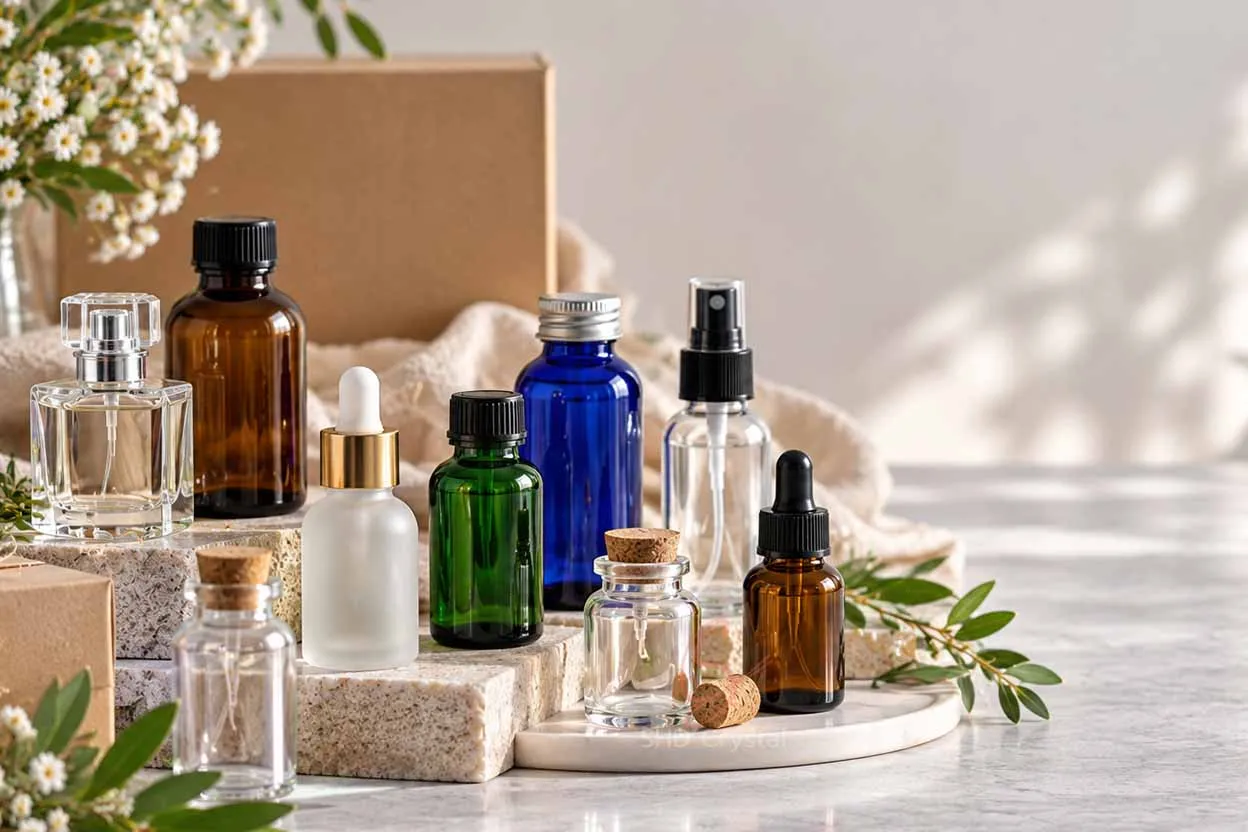
Why Small Glass Bottles for Custom Packaging Need Early Specification Review
With small glass bottles for custom packaging, the technical margin is smaller. The bottle body is compact, the available label area is limited, and closures such as droppers, caps, sprayers, corks, or roller-ball inserts need a more precise match.
A common mistake is approving the bottle mainly by volume. A bottle may hold the right amount, but that does not mean it works well for the actual product. The filling method, closure structure, decoration position, and inner tray design all need to be reviewed together.
For example, a sample-size fragrance bottle and a wellness dropper bottle may look similarly small, but their requirements are very different. One may focus on sprayer fit and cap height, while the other depends more on reducer compatibility, glass color, and drop control.
Small Formats Need the Right Match Between Bottle and Product
Small glass bottle packaging should begin with the actual use scenario. If the bottle is intended for fragrance samples, the key points may be atomizer compatibility, visual presentation, and collection uniformity. If it is used for essential oils or tinctures, closure sealing, dosing control, and light protection become more important.
This is where custom small glass bottles are useful. Standard market bottles may be enough for some products, but many brands still want better control over silhouette, glass color, decorative finish, or component matching.
At SHD Crystal, we often see customers start from a rough bottle idea and then refine the details after sampling. A compact bottle may need a wider label panel, a shorter shoulder, or a different neck finish once the real cap or sprayer is tested.
Production Control Matters More Than the Size Suggests
Small bottles may look simple, but they are not automatically easy to produce well. Mold tolerance, wall thickness transition, forming temperature, and annealing behavior all affect dimensional stability and batch consistency.
This matters because miniature packaging is often used in collections. When several small bottles appear together in one product line, even slight differences in height, decoration alignment, or glass tone become easier to notice.
For small glass bottles for custom packaging, production stability is especially important when the project includes multiple scents, formulas, or gift-set variations. The bottle should not only look good as one piece. It should also remain consistent as part of a full group.
Decoration and Packing Should Be Planned Together
Because small bottles offer less visible surface area, decoration choices need to be more disciplined. Frosting, coating, printing, hot stamping, embossing, or colored glass can all help create a stronger product identity, but crowded decoration can make a small package feel visually heavy.
Packing is equally important. Compact bottles can shift more easily inside cartons if the internal structure is not designed properly. Inner trays, dividers, sleeves, and carton strength should be planned based on the actual bottle size, closure type, and transport route.
A recent type of project we often support is a sample or discovery set. In those cases, the bottle itself is only part of the solution. The tray layout, spacing between units, closure protection, and batch appearance all influence whether the final set feels premium and practical.
Conclusion
Small glass bottles for custom packaging work best when bottle size, closure compatibility, decoration, quality standards, and packing protection are reviewed as one connected system. The smaller the bottle, the more important the details become.
Developing Compact Glass Packaging With SHD Crystal
SHD Crystal supports small glass bottles for custom packaging through design discussion, sampling, component matching, surface finishing, quality inspection, and export preparation. For brands developing custom small glass bottles and small glass bottle packaging, an early review of product use, closure type, decoration direction, and packing structure can help create a more reliable final result.

