


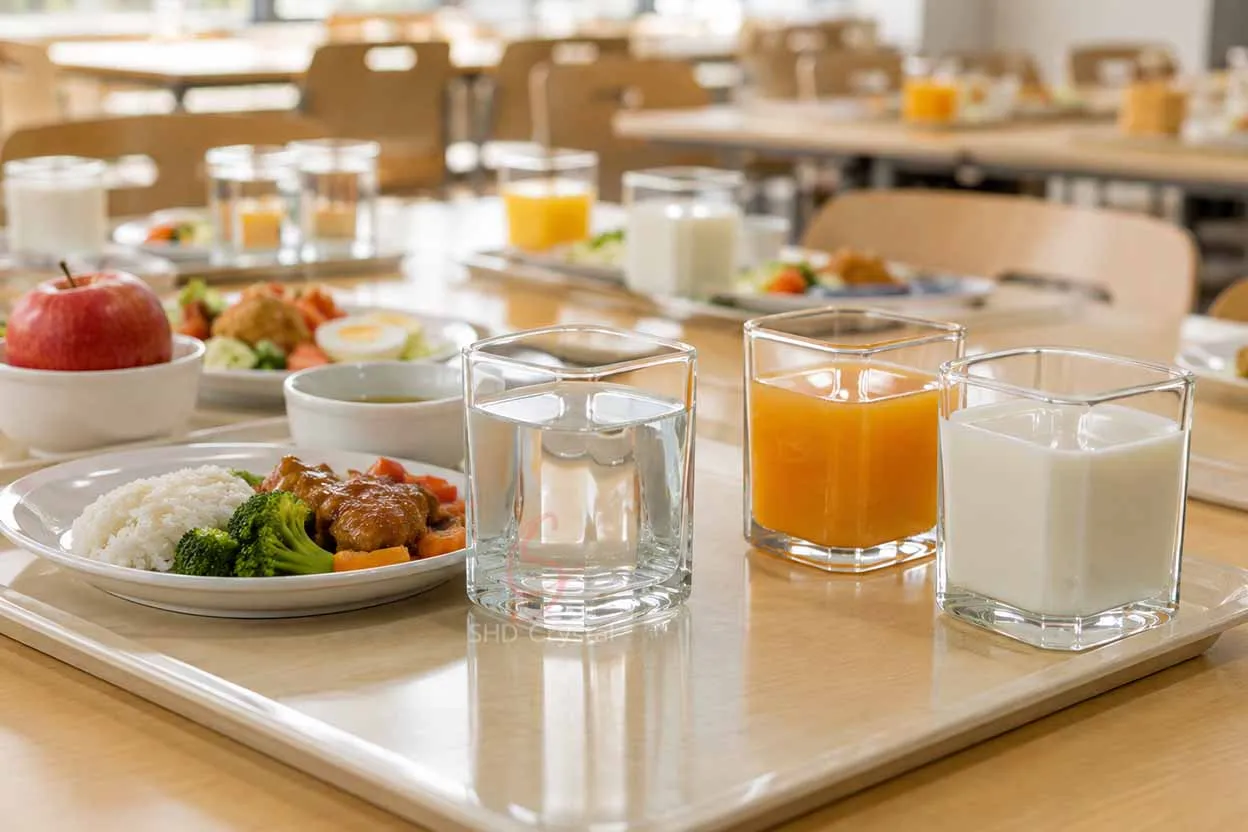
School dining spaces need drinkware that looks neat, works reliably, and can support repeated daily use. From overseas boarding schools and university dining halls to schools with cafeterias, cups are selected not only for appearance, but also for handling comfort, table stability, cleaning routines, replacement needs, and batch consistency. For institutional tableware projects, a square straight drinking cup can offer a clean shape and practical structure for water, juice, milk, and daily meal service.
Why a Square Straight Drinking Cup Fits School Dining Programs
A square straight drinking cup has a more structured outline than a traditional round tumbler. Its straight sides create a modern, organized appearance that suits school cafeterias, student dining halls, boarding school meal rooms, university canteens, and campus cafés. The square profile can also make the cup look more distinctive while still remaining simple enough for large-volume tableware use.
For overseas boarding schools, this cup style can be used in breakfast service, lunch and dinner settings, dormitory dining areas, supervised student meals, and school event catering. For universities, it can support dining halls, faculty cafeterias, reception spaces, and campus hospitality programs. Compared with highly decorative drinkware, a simple square cup is easier to match with trays, plates, bowls, and standardized cafeteria table settings.
In production review, the manufacturer should check rim smoothness, corner radius, base stability, wall thickness, usable capacity, and glass clarity. A school dining cup should not feel sharp at the corners or too heavy for regular handling. The base should sit steadily on trays and tables, especially in high-frequency cafeteria environments.
Children's Glass Cup Requirements in Institutional Settings
A children's glass cup for school dining should be reviewed differently from ordinary retail drinkware. The design needs to consider daily supervised use, easy gripping, practical capacity, smooth edge finishing, and stable placement. For boarding schools or schools serving younger students, the cup should feel controlled and comfortable rather than oversized or overly delicate.
The term children's glass cup does not mean the product can be described as unbreakable or completely risk-free. Glassware still requires proper use, age-appropriate service decisions, and school dining management. From a manufacturer’s perspective, the more responsible focus is practical suitability: rounded corners, polished rims, stable bases, controlled wall thickness, and packaging that supports bulk delivery.
If the cup includes color decoration, printed graphics, or school branding, the decoration area should also be reviewed carefully. For a school dining project, visual identity matters, but the drinking rim and hand-contact areas should remain comfortable and appropriate for the intended use.
Child-Friendly Drinking Glass for Campus Cafeterias
A child-friendly drinking glass should balance simple appearance with practical use. In a cafeteria environment, drinkware may be handled many times each day by students, staff, cleaning teams, and food service providers. This means the product should not only look clean on the table, but also support storage, washing, tray placement, and replacement planning.
A square straight drinking cup can work well in this setting if the proportions are adjusted properly. A low-to-medium height may improve handling. A stable base can reduce tipping risk during meal service. A clear body allows staff to see drink levels easily. A smooth rim improves drinking comfort for water, juice, milk, and breakfast beverages.
For university dining halls and schools with cafeterias, batch consistency is also important. A single approved sample is not enough for institutional purchasing. Buyers may need repeat orders, coordinated tableware systems, and stable supply over time. This is why cup height, capacity, rim finish, and base shape should remain consistent across production batches.
Project Notes for School Cupware Development
For SHD Crystal, school cupware development usually starts with the dining scenario. An overseas boarding school may need a practical daily water cup for student meal rooms. A university may need glass cups for dining halls, faculty restaurants, and campus reception spaces. A school dining supplier may need a standardized child-friendly drinking glass that can be packed, shipped, and replenished efficiently.
In related drinkware projects, buyers often request straight-sided tumblers, compact water cups, textured drinking glasses, colored glass cups, and simple tableware sets for hospitality or institutional use. These projects show that practical details often matter more than decorative complexity. Rim polishing, wall thickness, base stability, grip comfort, carton protection, and batch consistency all affect whether the product is suitable for real dining service.
For a children's glass cup or campus dining cup project, SHD Crystal can review mold feasibility, cup height, corner radius, rim finishing, capacity, decoration placement, packaging structure, and target-market testing requirements before production. This helps buyers develop drinkware that is suitable for organized school dining instead of relying only on a product photo.
Custom Options for School Dining Suppliers
A square straight drinking cup can be developed in clear glass, lightly textured glass, colored glass, or with simple logo decoration. For schools, design should usually stay clean and practical. Strong decorative patterns may not be necessary unless the project is for a special school event, branded dining program, or campus gift set.
For school dining suppliers, packaging can be just as important as the cup itself. Bulk orders may require inner dividers, reinforced cartons, protective wrapping, and clear packing arrangements. If the cups are intended for multiple campus locations, the packaging plan should support storage, distribution, and replacement.
A well-planned child-friendly drinking glass should serve the table first and the decoration second. The best design is usually not the most complicated one, but the one that performs reliably across daily meals, repeated handling, and large-volume dining use.
FAQs About Straight Drinking Cups OEM Supported
Q1: Can school logos or campus marks be added to glass cups?
Yes. School logos, dining service marks, or simple decorative elements can be added through suitable decoration methods. The placement should avoid the drinking rim and should be reviewed for visual clarity, durability expectations, and production consistency.
Q2: What packaging is suitable for school cafeteria cup orders?
Institutional orders usually need protective bulk packaging, inner dividers, carton reinforcement, and clear packing quantities. For school cafeterias or university dining halls, packaging should support safe transport, storage, and easy distribution to different dining locations.
Q3: What should buyers confirm before ordering cups for schools?
Buyers should confirm the target user group, cup capacity, dining scenario, cleaning expectations, order quantity, logo needs, replacement plan, and destination market requirements. These details help the manufacturer evaluate whether the cup design is suitable for the intended school dining program.
Conclusion
A square straight drinking cup can support organized drink service in overseas boarding schools, universities, and schools with cafeterias. Its clean outline, stable base, smooth rim, and practical capacity make it suitable for water, juice, milk, breakfast drinks, and daily campus dining use.
For brands, distributors, school dining suppliers, and institutional tableware buyers developing a square straight drinking cup, children's glass cup program, or child-friendly drinking glass collection, SHD Crystal can support design review, sample development, production coordination, inspection, and protective packaging preparation for practical school dining projects.

