


A bottle with a swing top is judged by more than its appearance on the shelf. It also has to show good glass clarity, seal securely, open smoothly, withstand filling and transport, and remain practical for repeated handling. For brands developing craft drinks, infused beverages, specialty products, or premium table-service items, swing top bottles for beverage packaging need to combine glass bottle quality with dependable closure performance.
Swing Top Bottles for Beverage Packaging Projects
A bottle with a swing top is judged by more than its appearance on the shelf. It also has to show good glass clarity, seal securely, open smoothly, withstand filling and transport, and remain practical for repeated handling. For brands developing craft drinks, infused beverages, specialty products, or premium table-service items, swing top bottles for beverage packaging need to combine glass bottle quality with dependable closure performance.
Unlike standard bottle formats, swing top designs combine a glass body with a mechanical closure system. That means the bottle, stopper, gasket, and wire mechanism all need to work together as one package rather than as separate parts selected at different stages of development.
Swing Top Bottles for Beverage Packaging Require Integrated Glass and Closure Development
The performance of a swing top bottle depends on the relationship between the glass body and the closure system. A bottle may look attractive as a sample, but it can still create problems if the stopper, gasket, or wire mechanism does not match the neck structure correctly.
During development, manufacturers should evaluate neck dimensions, sealing pressure, glass thickness, tolerance control, and the position of the closure components. Even small differences in the opening area can influence how smoothly the swing top operates and whether the final product gives a consistent user experience. For swing top bottles for beverage packaging, the glass bottle and closure should be reviewed as one complete system from the beginning. This helps reduce later adjustments and improves sealing reliability before production moves forward.
Custom Glass Swing Top Bottles Need Design and Production to Work Together
Custom glass swing top bottles allow brands to build packaging that reflects product identity while still meeting practical performance requirements. Customization may include bottle shape, glass color, decoration, capacity, or closure combinations.
For example, a beverage brand may want a distinctive bottle silhouette for a fermented drink or premium table-service product. In that case, the design should still allow enough structural stability around the neck and closure area. During the sampling stage, manufacturers may need to adjust mold details, test sealing performance, and confirm that the final bottle also fits the expected packaging method.
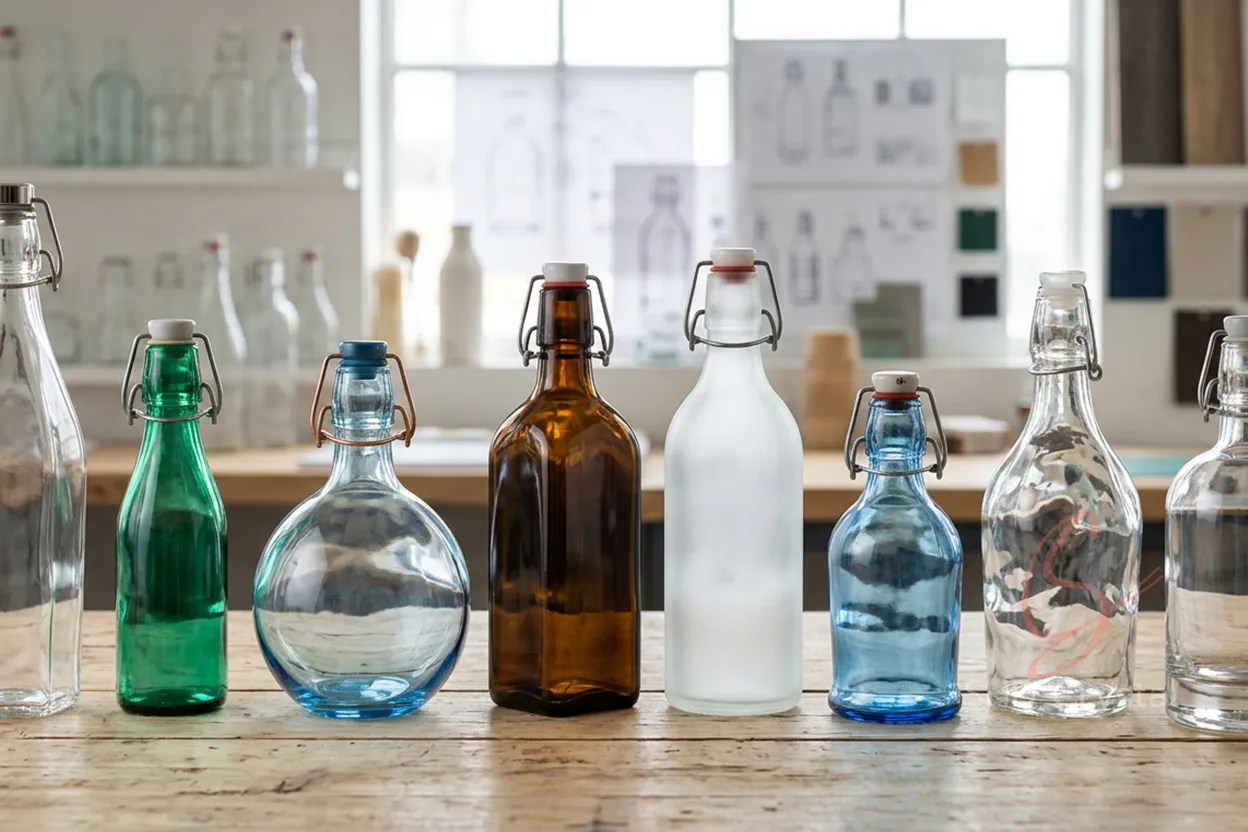
Glass selection also affects the final packaging impression. Clear glass can highlight the color and texture of craft beverages, while amber or green glass may create a more traditional beverage identity. For custom glass swing top bottles, glass clarity, color consistency, shoulder shape, and base stability should be reviewed together with the closure system because the bottle body and swing top mechanism both influence the final product experience.
Production control matters here as well. Wall thickness transition, forming temperature, and annealing behavior can all influence bottle strength and appearance. A bottle that is visually appealing but structurally inconsistent may create problems during filling, handling, or export transport.
Project Experience Often Reveals Closure Issues After Sampling
In practical projects, the most important adjustments often appear after the first sample is tested. A bottle may look correct visually, but the stopper may feel too tight, the wire mechanism may sit unevenly, or the neck tolerance may affect sealing consistency from piece to piece.
For custom glass swing top bottles, sample review should therefore go beyond appearance. It is useful to check stopper engagement, opening comfort, sealing feel, packing fit, bottle balance, and visual consistency under real handling conditions. This type of review helps improve the product before larger production begins and reduces the risk of later corrections.
The glass body should also be reviewed during this stage. Surface clarity, mold marks, base thickness, shoulder symmetry, and color consistency can all become more noticeable when several bottles are placed together. A strong sample is not only one attractive bottle, but one that shows the design can be reproduced with stable glass quality and closure performance.
Reusable Glass Bottle Packaging Needs Practical Engineering
Reusable glass bottle packaging has become more relevant for brands that want packaging formats with longer use cycles. However, reusable designs require more than a visually attractive bottle.
Brands should consider cleaning conditions, filling processes, storage methods, and customer handling scenarios before finalizing the packaging structure. A bottle that will be opened and closed repeatedly should not only look good, but also remain comfortable and reliable in everyday use.
The physical quality of the glass body also matters. The bottle should feel stable enough for repeated handling, but excessive weight may reduce service efficiency. A balanced glass structure helps support durability, table presentation, and practical reuse without making the product unnecessarily heavy.
For restaurant beverage programs, bottles may need to withstand repeated service movement and frequent handling. For retail products, the design may need to balance shelf presentation, transportation safety, and consumer convenience. In both cases, reuse performance should be considered early instead of being treated as a secondary benefit after design approval.
Manufacturing Control Supports Long-Term Packaging Consistency
A reliable swing top bottle program depends on more than the closure itself. Consistency in glass forming, neck geometry, body symmetry, and base stability also affects long-term performance.
For swing top bottles for beverage packaging, manufacturers should monitor the dimensions that most directly affect closure fit, sealing function, and overall repeatability. This includes the opening area, neck finish, wall distribution, bottle height, shoulder transition, and base flatness.
During glass forming, the neck area, shoulder transition, and base thickness need consistent control. These areas influence closure fitting, bottle balance, and durability during filling, transport, and repeated handling. Controlled annealing also helps reduce internal stress, which is especially important when reusable glass bottle packaging is part of the product strategy.
This type of manufacturing control helps keep the bottle suitable for both visual presentation and practical use. Surface defects, color variation, uneven wall thickness, or unstable bases may not always affect a single sample severely, but they can become more noticeable across repeated production batches.
Choosing a Partner for Beverage Packaging Development
Successful packaging projects usually require cooperation between designers, engineers, and manufacturers. Before production begins, brands should confirm bottle specifications, closure requirements, glass color, decoration expectations, packing methods, and intended use conditions.
For beverage packaging projects, the most helpful supplier is usually one that can evaluate both creative goals and production limitations. This includes glass forming review, sample development, closure coordination, surface finishing, quality inspection, and export preparation.
A good partner should not separate the bottle body from the swing top system. The glass material, bottle structure, closure fit, and packaging method should be reviewed together so the final product can perform consistently from sampling to commercial use.
Conclusion
Swing top bottles for beverage packaging combine a functional closure system with opportunities for strong glass bottle presentation. The most reliable results come from treating the bottle body and closure as one complete package, then supporting that package with careful sampling, glass forming control, production inspection, and practical engineering.
For brands developing custom glass swing top bottles or reusable glass bottle packaging, early attention to glass clarity, neck design, closure fit, body stability, handling conditions, and manufacturing consistency can help create packaging that performs well throughout the product lifecycle.
Developing Customized Beverage Packaging Solutions
SHD Crystal supports custom glass swing top bottles through design discussion, sample development, glass forming review, closure coordination, surface finishing review, quality inspection, and export preparation. For brands planning swing top bottles for beverage packaging, early discussion of bottle structure, stopper performance, glass color, decoration, and use conditions can help build a more reliable reusable glass bottle packaging solution.

