


For modern glassware manufacturers, a bottle is not truly finished when it leaves the forming line. It still needs to match the lid, support the intended filling method, and remain stable during storage, packing, and shipment. This is why testing of glass bottles with lids has become an important part of production review for beverage, food, fragrance, cosmetic, and household packaging projects.
How Testing of Glass Bottles with Lids Supports Production Quality
Testing of glass bottles with lids is not only a final inspection step. In a modern factory environment, it is connected with mold control, bottle mouth accuracy, annealing stability, cap matching, sealing performance, and packaging validation. A bottle may look clear and well shaped, but if the neck finish is inconsistent or the lid does not sit correctly, the final package can still fail in real use.
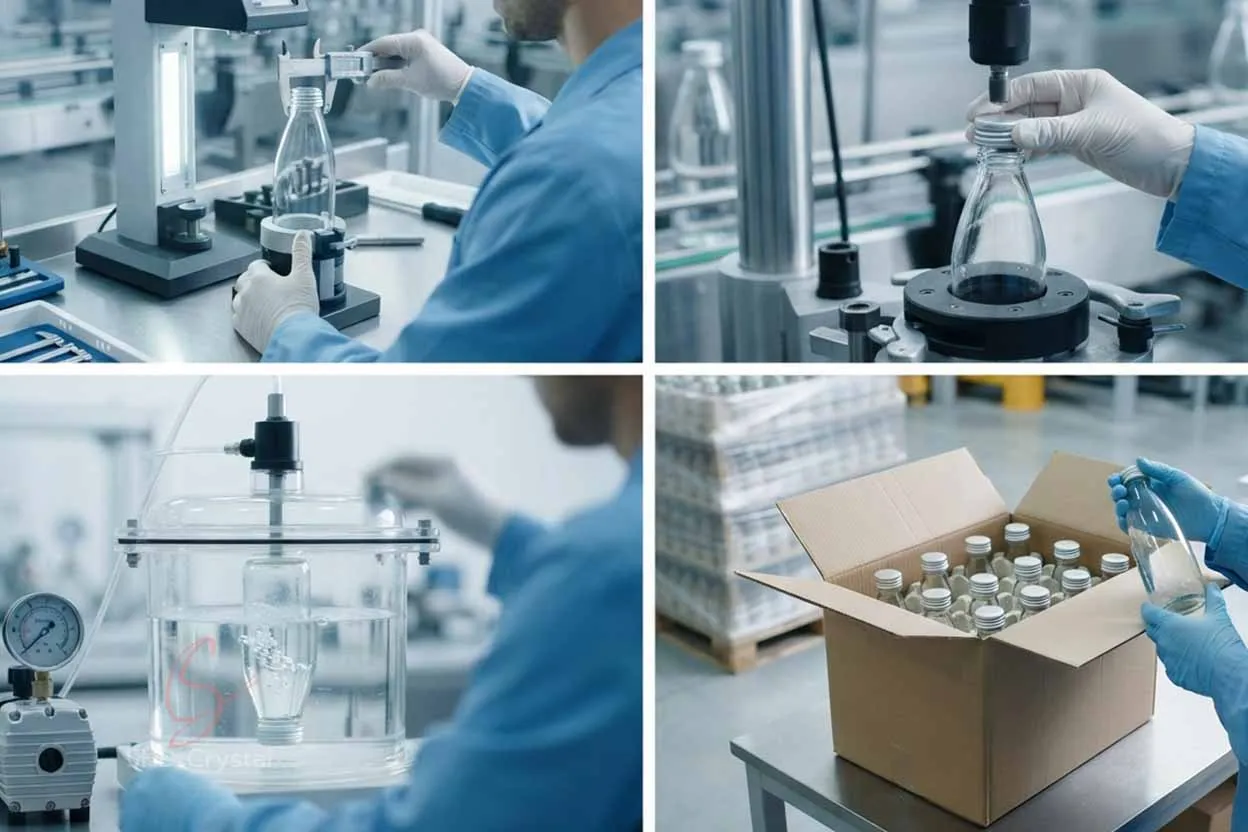
From a manufacturer's perspective, the testing process usually starts before mass production. During sample review, the factory checks whether the bottle design, neck size, thread structure, cap type, liner material, and filling plan are compatible. Once production begins, inspection teams monitor both appearance and functional performance so that the bottle-and-lid system remains consistent across the batch.
Preparing the Testing Environment
A reliable testing environment should be clean, organized, and controlled enough to support repeatable results. Bottles selected for testing are usually taken from production batches or approved samples. Lids, caps, corks, pumps, or closures should come from the actual supplier or confirmed project specification, because a test using the wrong closure may not reflect real packaging performance.
Before container seal integrity testing, inspectors should check whether the bottle mouth is free from cracks, chips, deformation, heavy mold seams, or uneven surfaces. The lid should also be reviewed for visible defects, liner position, thread accuracy, torque suitability, and fit. These pre-checks help separate bottle defects from closure defects.
For modern glassware factories, the testing environment also includes documentation. Sample numbers, batch information, test conditions, closure type, test method, and inspection results should be recorded. This makes the process traceable and helps the production team identify whether a problem comes from forming, finishing, closure matching, or packing.
Main Testing Flow for Bottles and Lids
Step 1: Dimensional Inspection
The bottle mouth, thread, inner diameter, outer diameter, height, and sealing surface are checked against the confirmed drawings or project requirements. This step is especially important for screw caps, metal lids, dispensing pumps, and closures that depend on accurate neck finish.
Step 2: Fit Testing
Inspectors apply the lid to the bottle and review whether it tightens smoothly, sits evenly, and reaches the expected closing position. A good lid should not feel loose, tilted, overly tight, or unstable. For packaging projects, this is where practical handling and assembly efficiency are first confirmed.
Step 3: Container Seal Integrity Testing
Depending on the product type, the factory may use leak checks, inverted storage, pressure evaluation, vacuum-related checks, or other project-approved methods. The goal is to confirm whether the bottle and lid can work together as a reliable closed system under expected handling conditions.
Step 4: Appearance Review After Sealing
Inspectors check whether the lid causes scratches, glass stress marks, edge damage, or visible deformation. This is important because a package must be both functional and presentable, especially for cosmetics, fragrance bottles, premium drinks, and retail glass containers.
Quality Control Standards Behind the Process
Clear quality control standards help turn inspection from personal judgment into a repeatable factory process. For glass bottles with lids, these standards may define acceptable appearance, dimensional tolerance, sealing performance, closure fit, sampling rules, packing requirements, and defect classification.
A modern manufacturer should not rely only on "looks fine" as the inspection standard. Visual inspection is useful for finding obvious defects, but it cannot fully confirm whether the bottle and lid will perform well together. This is why functional testing and record-based inspection are important in bottle projects.
In actual production, quality control standards should be aligned with the buyer's use scenario.
-Juice bottles may focus on cap fit and transport leakage.
-Fragrance bottles may focus on pump matching and premium appearance.
-Candle jars with a lid may focus on lid seating, surface protection, and retail display.
As a word, different applications require different inspection priorities.

Practical Factory Experience in Lid-Matching Projects
In many glass packaging projects, the most common issue is not that the glass bottle is completely defective. The issue is often mismatch. A bottle neck may be within general tolerance, but the lid supplier's closure may require a tighter sealing surface. A cap may close well on one sample but feel less stable when batch variation appears. A beautiful lid may also create packing pressure if it increases the overall height or needs extra protection.
SHD Crystal treats lid matching as part of the whole bottle development process. During sample review, the team checks bottle structure, closure compatibility, sealing area, surface finish, and packing method together. During production, inspection teams pay attention to repeated fit, batch consistency, and final packing safety. This approach is especially useful for buyers who source bottles and lids together. Instead of checking the bottle and closure as two separate items, the project should evaluate them as one working package.
Common Defects Found During Testing
One common defect is an uneven bottle mouth. Even a small chip, wave, or deformation around the sealing area may affect closure performance. Another common issue is thread inconsistency, which can cause the lid to sit at an angle or stop before reaching the correct position.
Loose lids, unstable torque, liner displacement, poor pump seating, and leakage during inverted checks are also important warning signs. In some cases, the bottle may pass appearance inspection but fail container seal integrity testing because the closure system is not suitable for the selected filling or handling condition.
Packaging-related problems may also appear after testing. If bottles with lids are packed too tightly, lids may rub against glass surfaces or create pressure marks. This is why final packing review should be connected with functional testing rather than treated as a separate last-minute step.
FAQs
Q01 | Why is testing needed after the lid already fits the bottle?
A lid that appears to fit is not always enough. Testing of glass bottles with lids helps confirm sealing performance, repeated closing behavior, transport safety, and batch consistency. This is important for commercial packaging projects where the bottle and closure must work together reliably.
Q02 | What is container seal integrity testing for glass bottles?
Container seal integrity testing checks whether the bottle and lid can maintain an effective seal under expected use, storage, or handling conditions. The exact method depends on the product, closure type, filling plan, and buyer requirements.
Q03 | How do quality control standards help glass bottle production?
Quality control standards define what should be inspected, how results are judged, and which defects are acceptable or unacceptable. They help manufacturers keep inspection consistent across samples, production batches, and shipment preparation.
Conclusion
Testing of glass bottles with lids is an essential part of modern glassware manufacturing because it connects bottle forming, closure matching, sealing performance, appearance control, and packaging safety. A reliable bottle project should not only look good in samples; it should also perform consistently in real filling, storage, transport, and retail conditions.
For brands developing glass bottles with caps, lids, pumps, or closure systems, SHD Crystal can support container seal integrity testing, project-based inspection planning, and quality control standards review to help improve production reliability from sample development to shipment preparation.

