


A whiskey decanter may look simple at first: a glass body, a neck, and a stopper. In development, however, these parts influence one another more than many initial drawings suggest. As a whiskey decanter manufacturer, we usually evaluate the decanter as a complete object rather than treating its body, stopper, cutting pattern, and weight as separate design decisions.
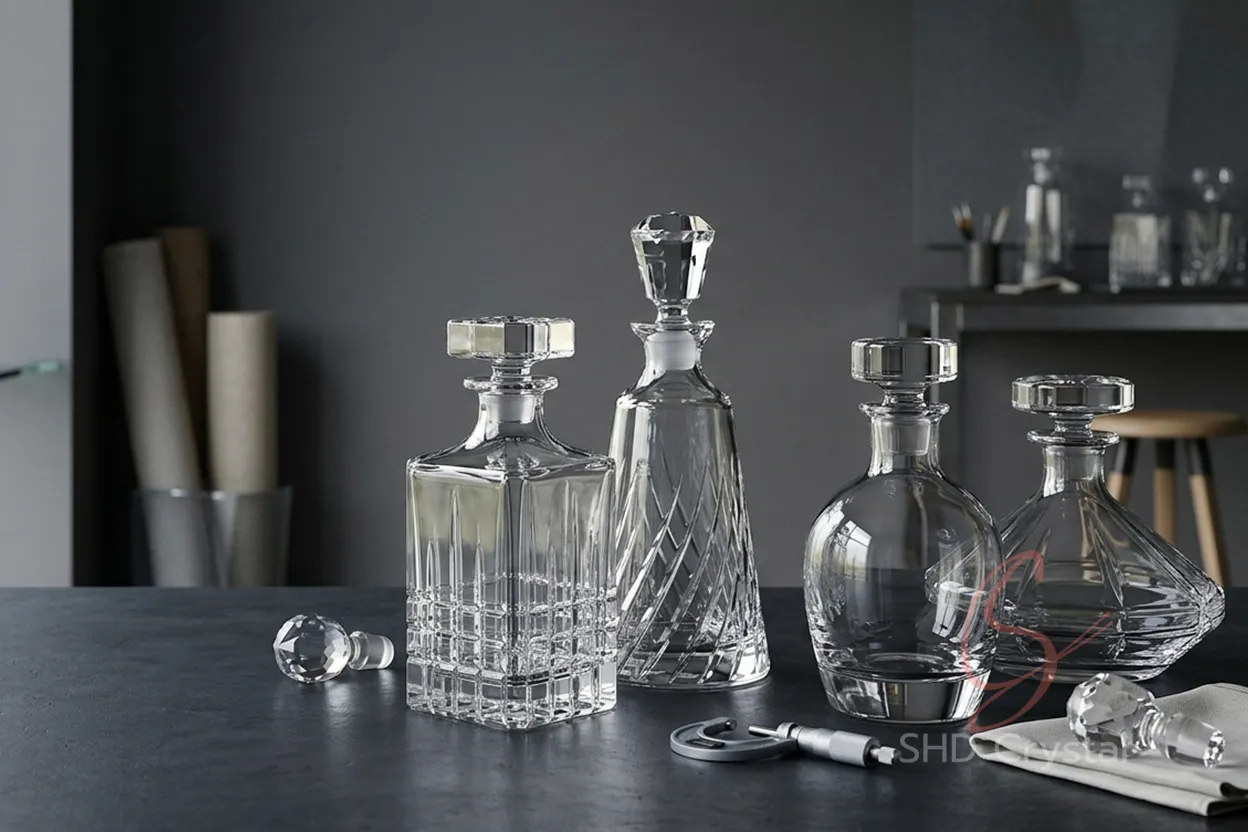
Whiskey Decanter Manufacturer for Custom Barware
A whiskey decanter may look simple at first: a glass body, a neck, and a stopper. In development, however, these parts influence one another more than many initial drawings suggest. As a whiskey decanter manufacturer, we usually evaluate the decanter as a complete object rather than treating its body, stopper, cutting pattern, and weight as separate design decisions.
For custom whiskey decanters, our main concern during early development is whether the intended visual character can still be reproduced consistently after forming, annealing, cutting, polishing, and stopper fitting. A strong design should look distinctive without creating avoidable problems in handling or repeat production.
Whiskey Decanter Manufacturer Decisions Start With Proportion
One of the first things we review is proportion. A heavy base can give a decanter visual substance, but simply adding more glass does not automatically make the product feel more premium. An excessively thick base increases weight and can change how the decanter feels once it is filled. It can also create a stronger thickness transition between the base and body that needs to be considered during forming and annealing.
We therefore look at base thickness together with body width, shoulder position, neck height, and total capacity. This is especially important with custom whiskey decanters because an empty sample does not always reveal how the product will feel in actual use. Once whiskey is added, the center of gravity changes. A decanter that initially feels substantial may become unnecessarily difficult to lift and pour if too much weight is concentrated in the wrong area.
Our goal is usually controlled weight rather than maximum weight.
We Treat the Stopper and Neck as One System
The stopper is one of the most sensitive areas of a decanter project. A sculptural or faceted stopper can become the most recognizable feature of the design, but appearance is only part of the job. The stopper must also sit correctly in the neck and provide a consistent feel from one piece to another.
During sample review, we pay attention to how deeply the stopper sits, whether it appears visually centered, how easily it can be inserted and removed, and whether finishing changes the fit.
Depending on the stopper structure, grinding or polishing may be needed to achieve the intended engagement between the two glass surfaces. This is one reason we do not evaluate a stopper separately from the finished neck.
In our experience, drawings can define dimensions, but the physical sample still needs to be handled. A stopper that looks correct on paper may feel too tight, sit too high, or show excessive movement after the real components are finished.
As a glass decanter supplier, we consider this physical fitting stage an important part of sample approval.
Cutting Should Follow the Formed Glass
Cut decoration is another area where more detail is not always better. We first look at the formed blank and ask whether the proposed facets support its proportions. A restrained geometric pattern can emphasize a heavy base or shoulder transition, while an overly dense pattern may compete with the original silhouette.
Cutting depth and facet spacing also affect finishing work. More cut surfaces mean more edges and polished areas that need to remain visually consistent across production.
For custom whiskey decanters, we therefore prefer to confirm the blank first and then evaluate how the cutting pattern interacts with actual wall thickness, curves, and reflections.
This matters particularly around corners and transitions. A pattern that works well on a broad flat body area may need adjustment when it approaches a curved shoulder or a narrower section of the decanter.
Project Experience: Samples Often Change Small Details, Not the Whole Design
In practical decanter projects, the first sample often confirms the overall concept while revealing several smaller details that need refinement.
We may find that the base feels heavier than expected, the stopper sits slightly deeper than the intended visual proportion, or the cutting pattern appears too dense after polishing. Sometimes a shoulder angle that looked balanced in a rendering creates a different reflection once it is made in clear glass.
These are not necessarily design failures. The purpose of sampling is to find these issues while they can still be corrected. A small change to base distribution, stopper dimensions, facet spacing, or polishing detail can improve the finished product without changing its original identity. This is also why we prefer customers to review a physical sample as a complete decanter rather than approving isolated components independently.
Polishing Quality Changes How the Decanter Reads
With clear glass and crystal glass, finishing quality is easy to see. Cut surfaces, bevels, edges, stopper faces, and polished areas all interact with light. Uneven polishing can make an otherwise strong design appear inconsistent, particularly when several decanters are displayed together.
We normally review whether edges remain clean, whether polished surfaces maintain the intended geometry, and whether manual finishing introduces visible differences between samples. For heavily faceted designs, this inspection becomes more important because every additional surface contributes to the overall optical effect.
A good whiskey decanter manufacturer should therefore consider cutting and polishing as part of dimensional and visual control, not simply decorative operations added after forming.
We Plan Repeat Production From the First Approved Sample
A successful first batch is not enough for a branded collection. Customers may return later for another production run, additional decoration, replacement components, or related barware using the same design language. Repeatability therefore needs to be considered while the original project is being developed.
We keep the approved product requirements focused on the details that actually define the decanter: body dimensions, stopper relationship, cutting reference, polishing expectations, decoration position, and other critical appearance points.
For a glass decanter supplier, this is more useful than relying on photographs alone when a later batch needs to match an earlier one.
We also recommend approving a representative physical sample before regular production so both sides have a clearer reference for future comparison.
Conclusion
Working with a whiskey decanter manufacturer is not simply about finding someone who can form a heavy glass vessel. The finished result depends on how proportion, glass distribution, stopper fit, cutting, polishing, and repeat production are coordinated.
For custom whiskey decanters, we find that the most useful decisions are usually made during physical sample review. That is where weight, balance, optical appearance, stopper engagement, and finishing quality can be judged together rather than as separate specifications.
Developing Custom Whiskey Decanters With SHD Crystal
At SHD Crystal, we support custom whiskey decanters from design review and mold development through sampling, forming, stopper coordination, cutting, polishing, inspection, and repeat production.
As a whiskey decanter manufacturer and glass decanter supplier, our role is to identify which design details need tighter control and which can be adjusted during development without losing the intended character of the collection. For a new decanter project, reviewing the body, stopper, finishing requirements, and physical sample together provides a more practical starting point than judging the design from drawings alone.

