


A whiskey decanter may look complete once the first sample is approved, but the real challenge begins when that design moves into a larger run. In whiskey decanter production, the focus quickly shifts from appearance alone to dimensional stability, stopper compatibility, finishing consistency, protective packing, and future replenishment. For brands planning custom whiskey decanters or sourcing commercial whiskey decanters, the key question is not whether one sample looks good, but whether the same result can be maintained across repeated production.
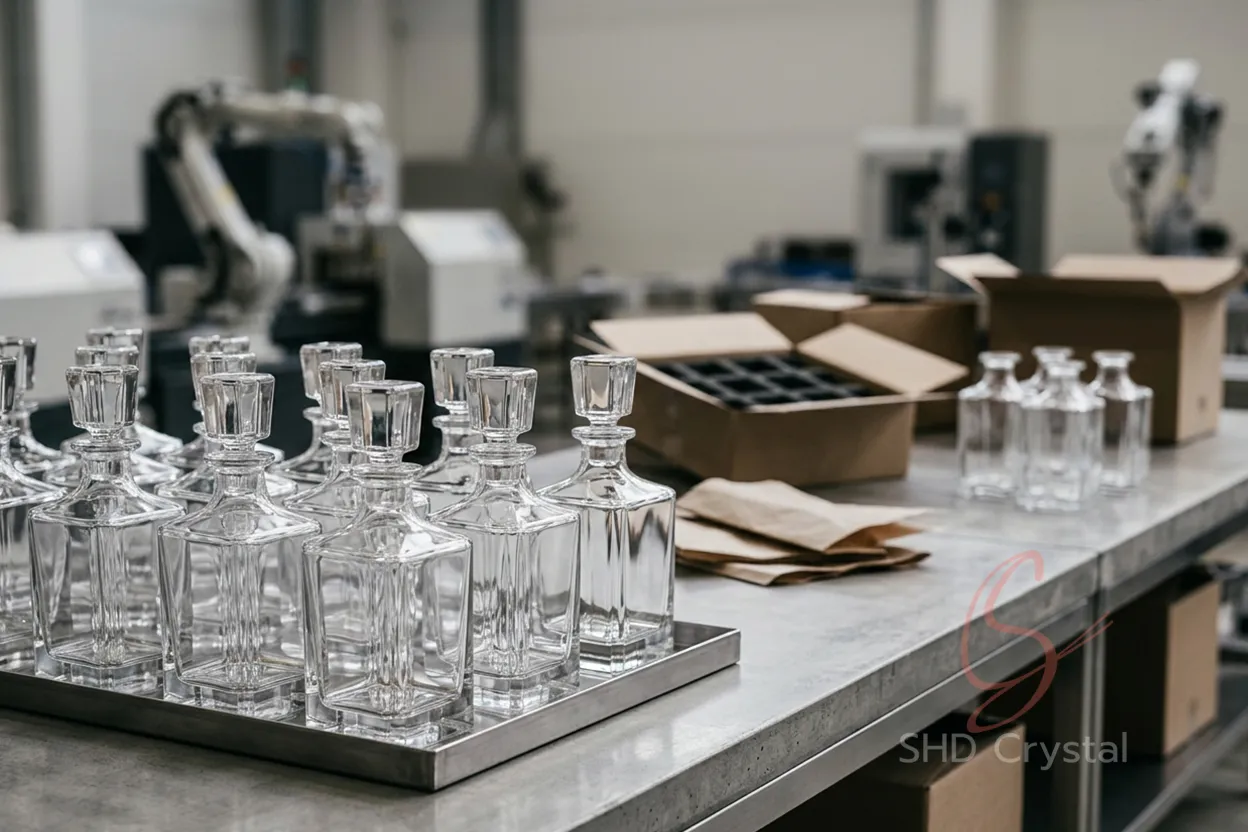
Whiskey Decanter Production for Consistent Custom Supply
A whiskey decanter may look complete once the first sample is approved, but the real challenge begins when that design moves into a larger run. In whiskey decanter production, the focus quickly shifts from appearance alone to dimensional stability, stopper compatibility, finishing consistency, protective packing, and future replenishment. For brands planning custom whiskey decanters or sourcing commercial whiskey decanters, the key question is not whether one sample looks good, but whether the same result can be maintained across repeated production.
Whiskey Decanter Production Depends on Scaling the Approved Sample
Sample approval confirms a design direction, but it does not automatically confirm large-scale repeatability. During longer production runs, forming temperature, mold condition, glass distribution, and cooling behavior can gradually influence dimensions and surface quality.
A practical production plan should define critical checkpoints before output increases. Body height, neck geometry, base stability, stopper fit, and major decorative areas all need clear acceptance criteria. For commercial whiskey decanters, this creates measurable standards instead of relying only on visual comparison with one approved sample.
Stopper Fit Becomes a Batch-Level Control Point
A whiskey decanter often uses a substantial glass stopper, and that detail introduces more variation than many buyers expect. The fit between stopper and neck may involve molded dimensions, grinding, and polishing, so both mold tolerance and manual finishing can affect the final result.
One common mistake is approving a stopper because it fits one sample well without checking several stopper-and-neck combinations together. For custom whiskey decanters, the better approach is to review multiple matched sets so the team can judge whether the specification remains workable when both parts vary within a normal production range.
In whiskey decanter production, stopper planning should also include replacement needs. If the product is intended for hospitality, gifting, or long-term retail programs, future stopper continuity matters almost as much as the first fit.
Decorative Complexity Increases Production Risk
Cutting, engraving, frosting, color accents, and polishing can all add character, but every additional process also introduces another variable.
Deep facets, for example, require sufficient wall thickness and controlled polishing pressure. If cutting depth changes too much from one piece to another, reflections may appear uneven when several decanters are displayed together. That is why commercial whiskey decanters with repeated geometric patterns need inspection standards that address not only general appearance but also key decorative details.
For custom whiskey decanters, more decoration is not always better. In many cases, a slightly simplified pattern can preserve the intended visual identity while improving repeatability and reducing finishing variation.
Packing Must Match Weight and Geometry
Heavy bases and prominent stoppers create specific transport risks. Carton strength, internal dividers, stopper protection, and pallet arrangement should be reviewed as part of the project, not after the goods are already completed.
This is especially important in whiskey decanter production because different shapes behave differently in transit. Square bodies, projecting shoulders, and unusually heavy components may require different protective structures. A decanter that leaves inspection in good condition should arrive at the destination in the same condition.
For export or multi-stage distribution, packing design is part of product reliability, not a secondary detail.
Repeat Orders Need Documented Standards
Many supply problems appear not during the first order, but during the second or third. Commercial buyers often need replenishment, and later batches are usually compared directly with earlier ones.
Tooling records, approved dimensions, reference samples, finishing specifications, and packing instructions all help future production remain aligned with the original order. For commercial whiskey decanters, even small differences in stopper fit, cutting depth, or base proportion can become obvious when older and newer batches are displayed together.
Good documentation reduces unnecessary reinterpretation and makes repeat supply easier to control.
Production Review Should Cover Use Conditions Too
A decanter may be intended for retail, hospitality, or branded gifting, and each use condition changes what should be prioritized. A retail-focused product may accept more decorative complexity, while a decanter used frequently in service may need easier handling and more predictable stopper replacement.
That is why whiskey decanter production should not be evaluated only at the forming stage. It should also consider how the finished product will be handled, packed, stored, displayed, and replenished over time.
Conclusion
Reliable whiskey decanter production turns an approved design into a controlled supply program by managing forming stability, stopper compatibility, finishing variation, packing performance, and repeat-order documentation. Successful scaling depends less on reproducing one perfect sample and more on controlling the variables that appear across hundreds or thousands of pieces.
For brands developing custom whiskey decanters or planning commercial whiskey decanters, the strongest results usually come from treating design, production, and future replenishment as one connected process.
Building a More Predictable Decanter Program
SHD Crystal supports whiskey decanter production through project review, sample coordination, forming evaluation, stopper matching, finishing control, inspection, and packing development. For custom whiskey decanters and commercial whiskey decanters, discussing the intended design features, decorative requirements, order volume, and repeat-supply expectations early can help create a more stable and predictable production path.

