


In hospitality use, a decanter is judged by more than its silhouette. It may be poured from many times in a single day, cleaned between services, stored in limited back-of-house space, and replaced when breakage happens. That is why wine decanters for hospitality should be evaluated not only for visual appeal, but also for how they perform in real operation. For buyers planning custom wine decanters, shape, capacity, handling balance, cleaning requirements, and future replenishment all deserve attention alongside appearance.
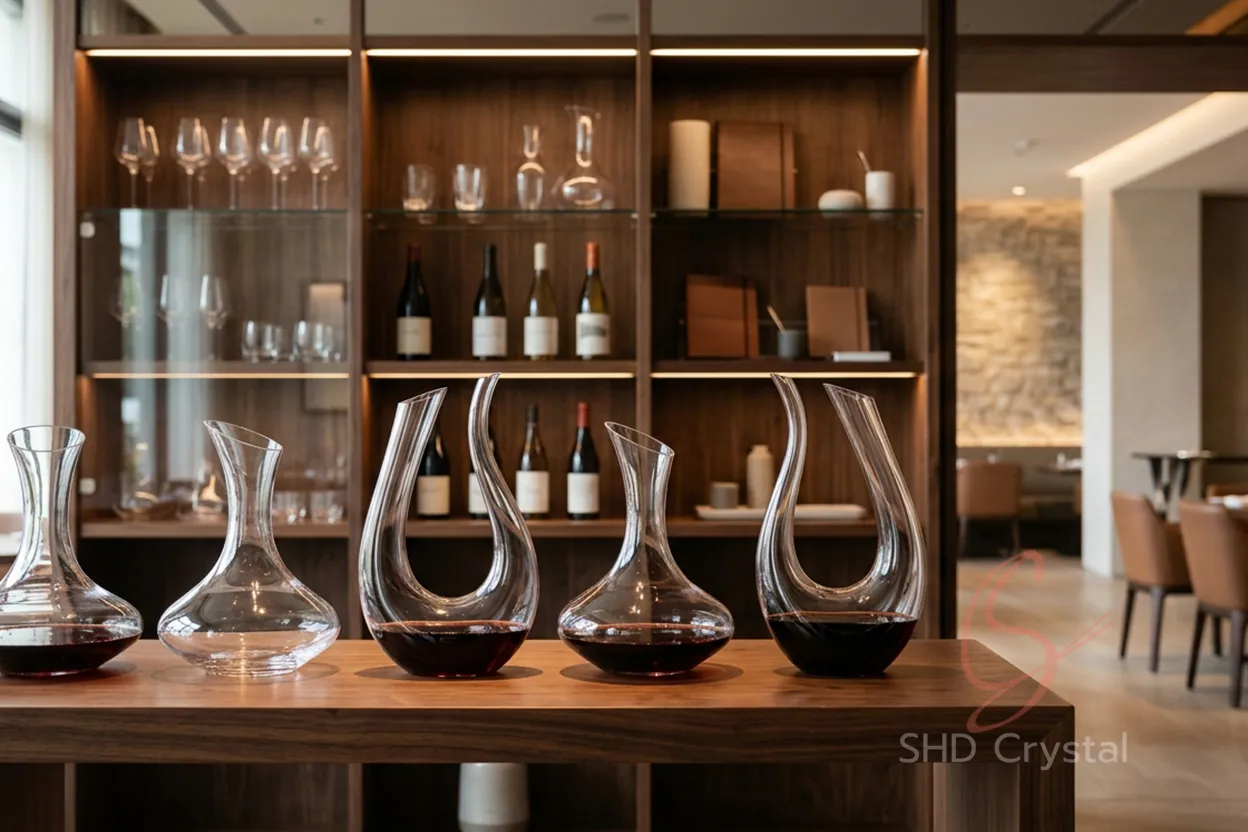
Wine Decanters for Hospitality and Retail Programs
In hospitality use, a decanter is judged by more than its silhouette. It may be poured from many times in a single day, cleaned between services, stored in limited back-of-house space, and replaced when breakage happens. That is why wine decanters for hospitality should be evaluated not only for visual appeal, but also for how they perform in real operation. For buyers planning custom wine decanters, shape, capacity, handling balance, cleaning requirements, and future replenishment all deserve attention alongside appearance.
Wine Decanters for Hospitality Must Fit Real Service Conditions
A dramatic decanter can create a strong impression on a dining table or retail shelf, but daily use quickly reveals whether the design is practical. Wide bases take up more storage space, elongated necks can make cleaning more difficult, and excessive glass weight may reduce pouring comfort during repeated service.
For this reason, glass wine decanters should be reviewed in the environment where they will actually be used. Restaurants may care more about handling efficiency and easy maintenance, while hotels, wineries, and retail programs may place greater emphasis on gifting value, presentation, or distinctive design.
Shape Influences Pouring and Storage
The relationship between bowl width, neck position, base weight, and liquid capacity determines how a filled decanter behaves in the hand. A broad bowl may enhance wine presentation, but it also changes the center of gravity and increases the storage footprint.
For custom wine decanters, wall thickness transition should be reviewed carefully during development. Excessive glass accumulation around the base or shoulder can increase weight and create uneven cooling behavior during production.
Well-designed wine decanters for hospitality perform better when visual proportion is considered together with pouring comfort and storage efficiency.
Cleaning Places Practical Limits on Design
Complex forms often introduce maintenance challenges. Narrow passages, sharply curved interiors, and difficult internal transitions may look elegant, but they can also require more attention during cleaning. This does not mean decorative forms should be avoided. Instead, glass wine decanters intended for repeated use should balance recognizable design features with internal geometry that remains practical for washing and handling.
A common misconception is that a more elaborate shape automatically creates a better commercial product. In reality, ease of maintenance can become just as important as visual impact once the decanter enters regular service.
Production Variables Affect Repeat Supply
Hospitality and retail programs often need replenishment. A successful collection may require additional units months later, so repeatability becomes an important sourcing issue.
For custom wine decanters, mold tolerance, forming temperature, annealing behavior, and finishing variation can all influence how closely a later batch matches the approved sample. Critical dimensions and visible appearance points should therefore be defined before repeat production begins. When glass wine decanters are displayed or used together, even small differences in bowl shape, neck angle, or visual weight become easier to notice.
Retail Programs Add Another Set of Priorities
Retail use changes the decision framework again. Gift-box compatibility, shelf presence, packaging dimensions, and perceived value may matter more than rapid service handling.
Some projects need one design to serve both hospitality and retail channels. In that case, wine decanters for hospitality should not be developed around only one environment. A balanced specification usually works better than a design optimized entirely for either restaurant use or retail presentation. This is where early application planning helps reduce unnecessary redesign later.
Conclusion
Wine decanters for hospitality perform best when service conditions, cleaning, storage, production consistency, and future replenishment are considered together with visual identity. The strongest programs are not built around appearance alone, but around how the decanter continues to function and remain consistent throughout its commercial life.
For buyers developing custom wine decanters, a more practical result usually comes from reviewing the product as part of a long-term use system. That same approach also helps glass wine decanters stay visually consistent across hospitality and retail programs.
Planning for Service and Future Supply
For hospitality groups, wineries, and brands developing new collections, SHD Crystal can support the development of wine decanters for hospitality through sample review, proportion evaluation, finishing discussion, and repeat-production planning. When custom wine decanters are developed with clear application requirements, inspection standards, and future replenishment in mind, it becomes easier to maintain a stable glass wine decanters program over time.

